To provide a closed terrarium with too many nutrients at the start is a common mistake. This is how it can look like.
The hermetosphere featured today has been presented before. Nearly three years after launch, I am still learning from it.
The lesson to be learned today is, that even a carefully measured amount of nutrients given in a closed ecosystem can turn out to be too much. When a plant can easily reproduce vegetatively and lighting is sufficient, the availability of nutrients in the substrate – nitrate, phosphate and others – is usually the factor that limits growth. Rhizomatous plants like Begonia lichenora are able to colonize large portions of a container as long as nutrients are available. This is what happened to one of my hermetospheres after all other plants of the initial setup had been outgrown by B. lichenora, which had turned out to be the most competitive plant under the given conditions (see the video below).
Just ten months earlier, it had looked as though the begonia would remain confined to the slope for which it was initially intended (see the video below).
Rhizomatous begonias can often be pruned without causing them any harm. That is what I was doing here. By removing the cut plant material, nutrients can be taken out of the system. Once the container is sealed again, hopefully a new balance will be established in which the begonia no longer grows so excessively. The video below shows the container after pruning.
Is it possible to estimate by how much the nutrient content in the container has been reduced by the removed plant material? Let me do the calculation for nitrogen (N) as an example: In addition to lava gravel and cocopeat, only earthworm humus was used as a substrate. We will neglect the rather scarce initial planting and assume that the cocopeat decomposes very slowly and does not release significant amounts of nutrients in the periods under consideration. In that case, all plant-available nutrients in the container come from the earthworm humus. At the launch, 40 g of this was added to substrate mixture. The manufacturer specifies an N content of 1,2%. That amounts to 0,48 g = 480 mg of nitrogen (N). The N content of dry plant material is estimated as 15 mg/g (Schulze e.a. 2019: 204). The dry weight of the removed B. lichenora material (see the picture below) weighs 1,35 g. That amounts to 20 mg of nitrogen (N).
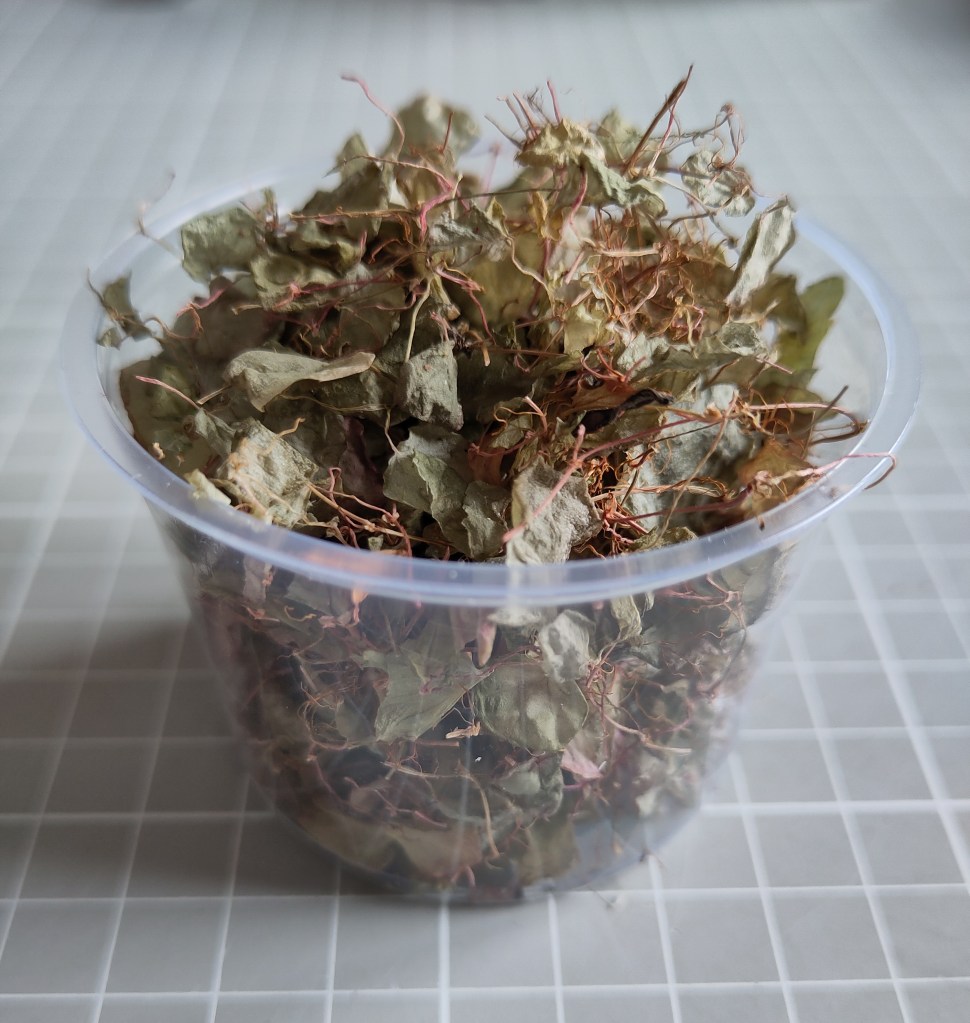
This means that even after removing all the excess plant material, the nitrogen content in the container could still only be reduced by less than 5%. In other words: I can start the next similar container with much less earthworm humus without having to worry that the plants will suffer from nutrient deficiencies. For the existing container, it means that further pruning can be expected to become necessary.

