You wouldn’t expect this from such a widely grown plant: it appears that all cultivated specimens are descended from a single wild collection. Discover the story of the Asian Violet and find out how it thrives in a closed terrarium.
This Gesneriad is often traded under one of its former names Chirita tamiana, Primulina tamiana or Deinostigma tamiana. Following new findings regarding its phylogeny, the species was recently assigned to the genus Metapetrocosmea (Li e.a. 2022). If you think this is the least appealing of the four genus names, I agree with you. In botany, the right to name a genus lies with the first author, provided they adhere to the rules of taxonomy. In this case, the author (Wang 1981) wanted to emphasize the similarity to the genus Petrocosmea and therefore added the prefix ‘meta-’ (meaning here: ‘modified’).
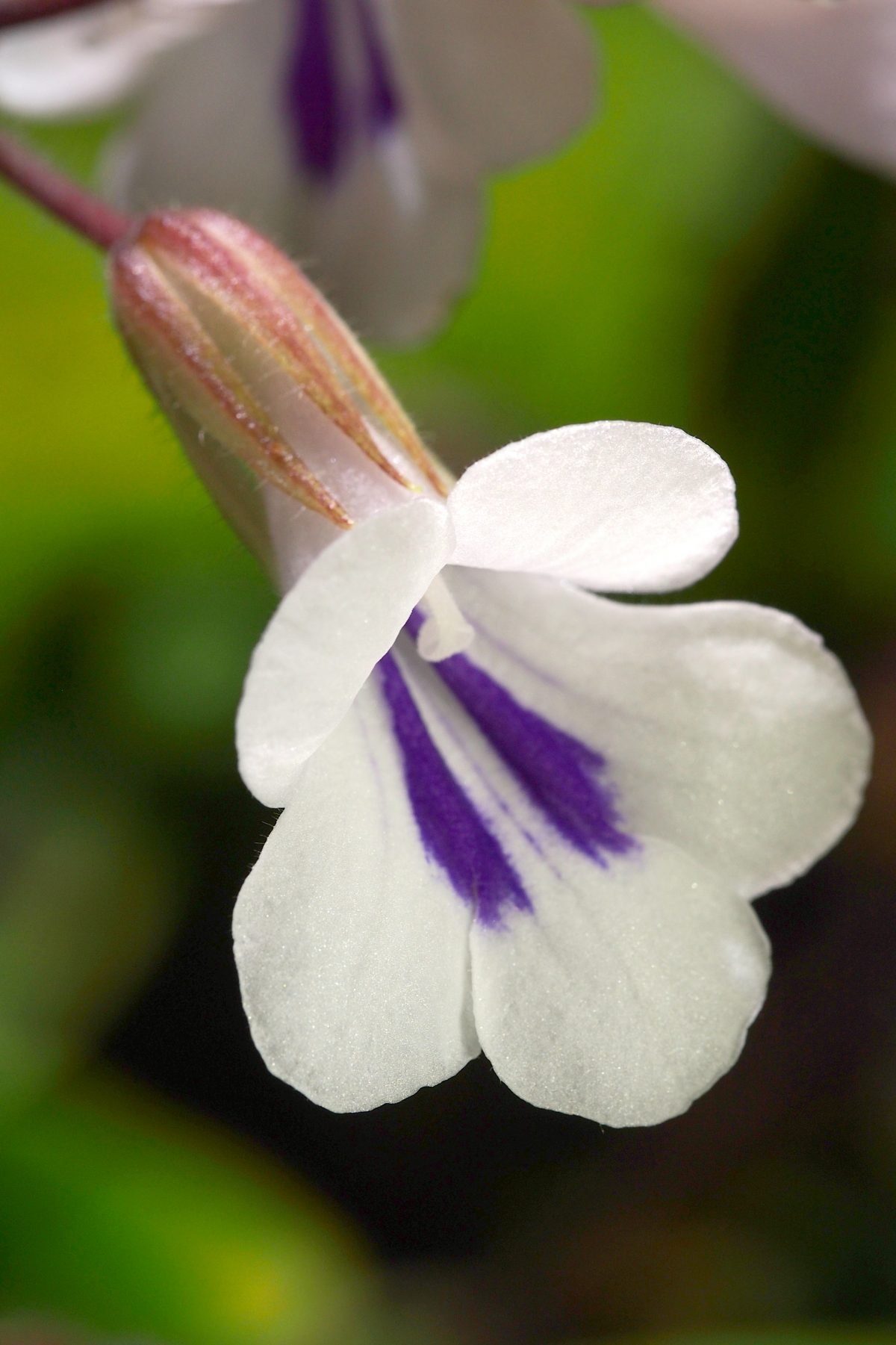
M. tamiana thrives easily and flowers regularly in a closed terrarium and is just the right size to serve as the main attraction for a container of 5 litres.
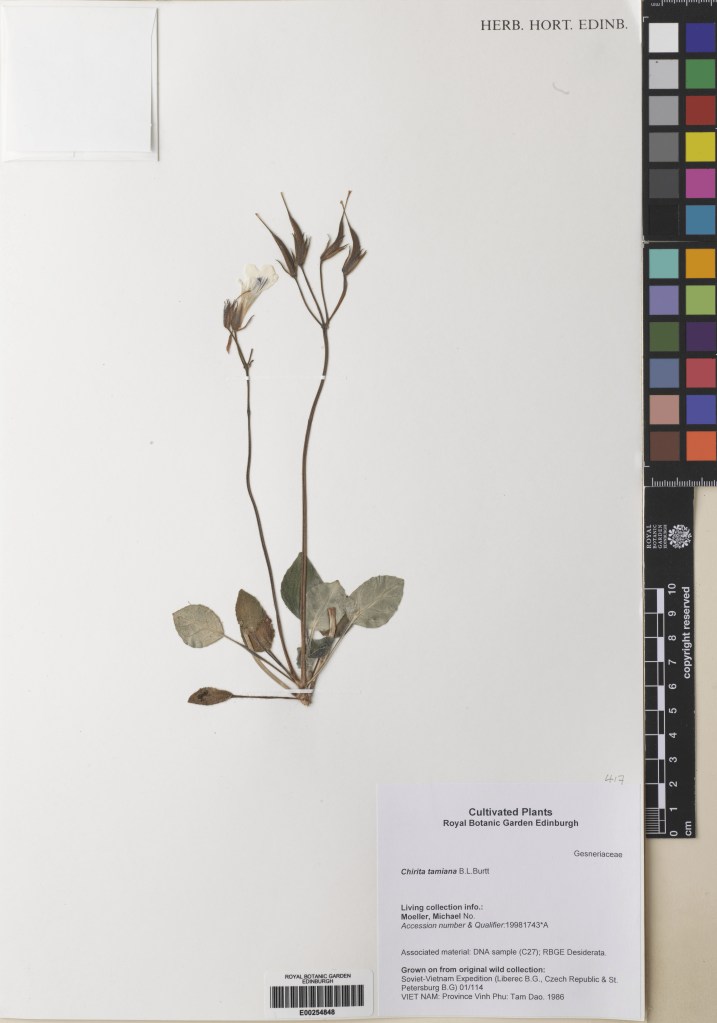
As far as I have been able to ascertain, all records of this species, including all cultivated specimens, originate from a single collection made in 1986: “It was collected on Tam Dao, a mountain NW of Hanoi, the capital of Vietnam, by the Soviet-Vietnamese Expedition of 1986. Plants flowered in the Botanic Garden at St. Petersburg in 1991 and have now found their way, via the gardens at Liberec (Czech Republic), Vienna University and R.B.G. Edinburgh into more general cultivation.” (Burtt 1999: 20) By now, the species has presumably never been observed again in the wild. Li e.a. (2022: 462) sum it up nicely: “Metapetrocosmea tamiana is easy to cultivate and propagate, and it has been widely grown by Gesneriad growers or botanical gardens. However, we know little about this charming plant in the wild.” Even the holotype (the single specimen taken as the “type” by the original author of a species) of M. tamiana is a specimen from cultivation (see image below).
The protologue gives no description of the plant’s natural habitat. Information on suitable growing conditions must therefore be derived from a general description of the area where the plant was collected and from other grower’s experiences.
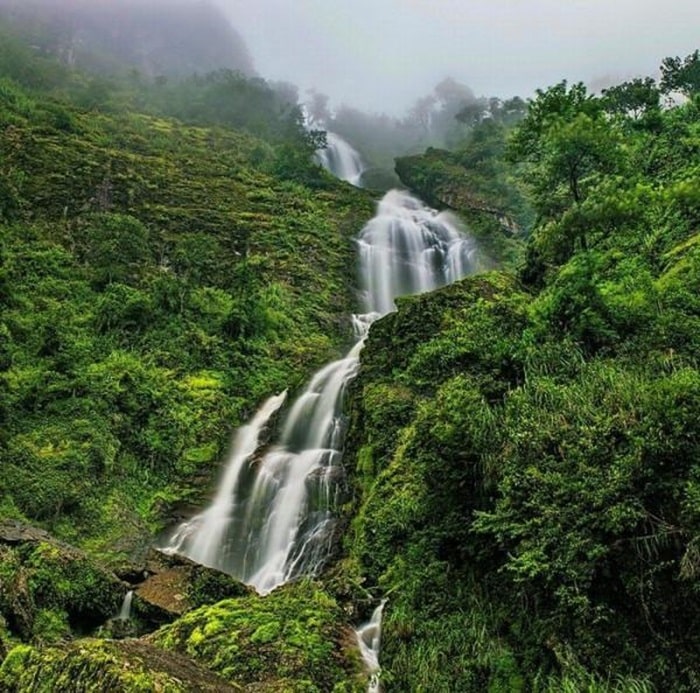
The following description of the Tam Dao Mountain region is based on Ninh (1993). The Tam Dao Mountains are in northeastern Vietnam, extending from northwest to southeast, more than 60 km in length but are less than 15 km wide. The topography is complex and the mountains are deeply dissected by narrow valleys. The three main peake’s reach between 1,300 and 1,600 m. Their slopes are rather steep (25°-30°), with many small streams, rapids, and waterfalls in the valleys. The mountains are mostly composed of an acid eruptive Triassic formation of tuff, rhyolite, and crystalline rocks. The lower belt of the mountains is almost entirely cultivated, with only the bottoms of valleys containing forests of any size. In the upper belt, though, from 800 to 900 m, lower montane evergreen rain forest is extensive. On the highest slopes the forest composition is very simple, consisting of a forest canopy of 5-8 m, classified as a mossy elfin forest. The commonest trees are Agapetes spp., Rhododendron grandiflorum, R. simsii, and Vaccinium spp. Below this summit vegetation the belt between 1,100 and 1,500 m is composed of a forest entirely different from that below, classified as an upper montane mossy forest. At lower elevations, below 600 to 700 m, in moist protected valleys near streams, there are small remnants of lowland tropical rain forest. The canopy in this area may reach 40-50 m.
The following horticultural advice has been published in the journal of The Gesneriad Society. “Chirita tamiana will grow from seed to bloom in less than 6 months. Because the plant bloomed from seed so quickly and set seed so freely, I feared that it might be an annual, but the plants rebloomed after a short semidormant period and I have heard from other growers that the plants are perennial, producing new leaves and flowers on a gradually elongating stem. When the stem gets too long, the plant can be treated like a
long-necked saintpaulia: pot it deeper, or cut the top off and re-root it. Chirita tamiana is easily propagated from leaf cuttings as well. This is not a fussy plant, growing well under a variety of growing conditions. I have grown the plants both with and without extra lime in the soil, and they have done quite well either way, provided they are given a well-drained soil. They are tolerant of moderately dry conditions and drying out slightly does not seem to affect flowering. The plants have a small root system, and a 3” pot is plenty large enough. Several plants blooming together in a larger pot would produce a much shovvier display.” (Boggan 1999: 22) For another experienced grower’s advice check Pumpkinbeth.
 Hermetospheres