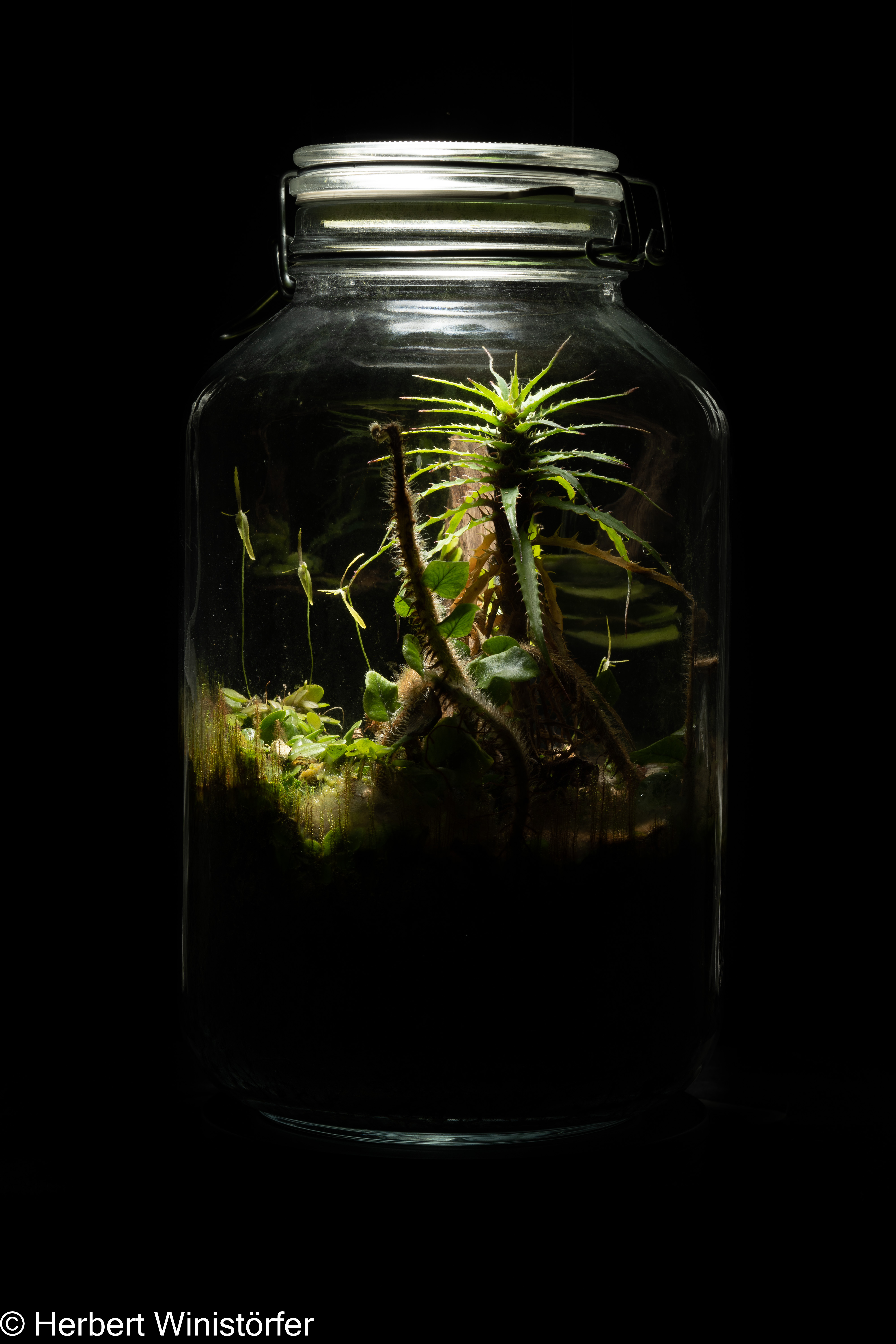
It is the first orchid I ever planted in a hermetosphere, and the fragile beauty of its flowers strikes me again every time. Initially it was planted on one side of the substrate with a small portion of its creeping rhizome. It has since worked its way across the entire diameter of the glass to the opposite side. These days, four flowers have developed simultaneously, three on the initial site and one in the newly colonized area: Barbosella cogniauxiana.
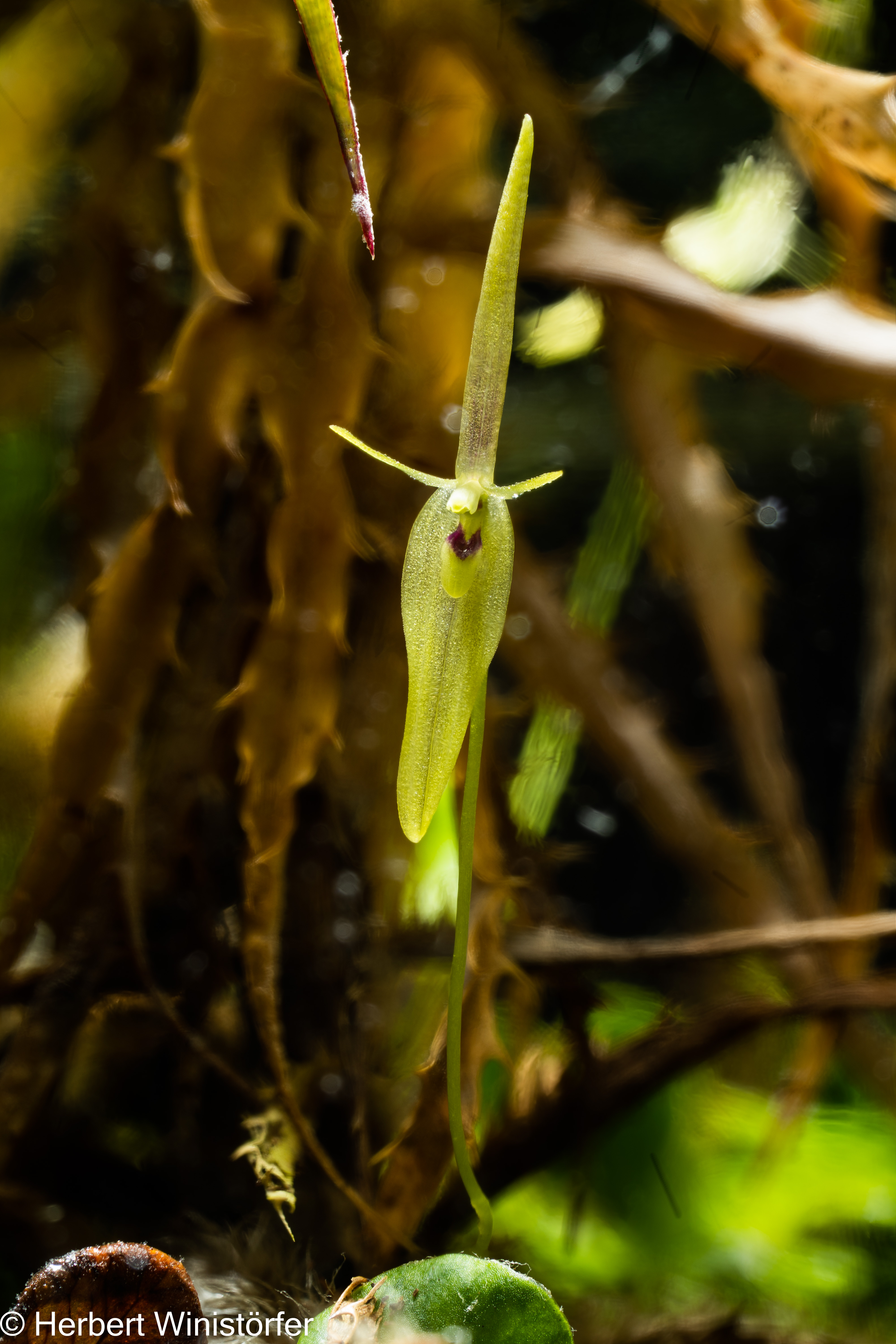
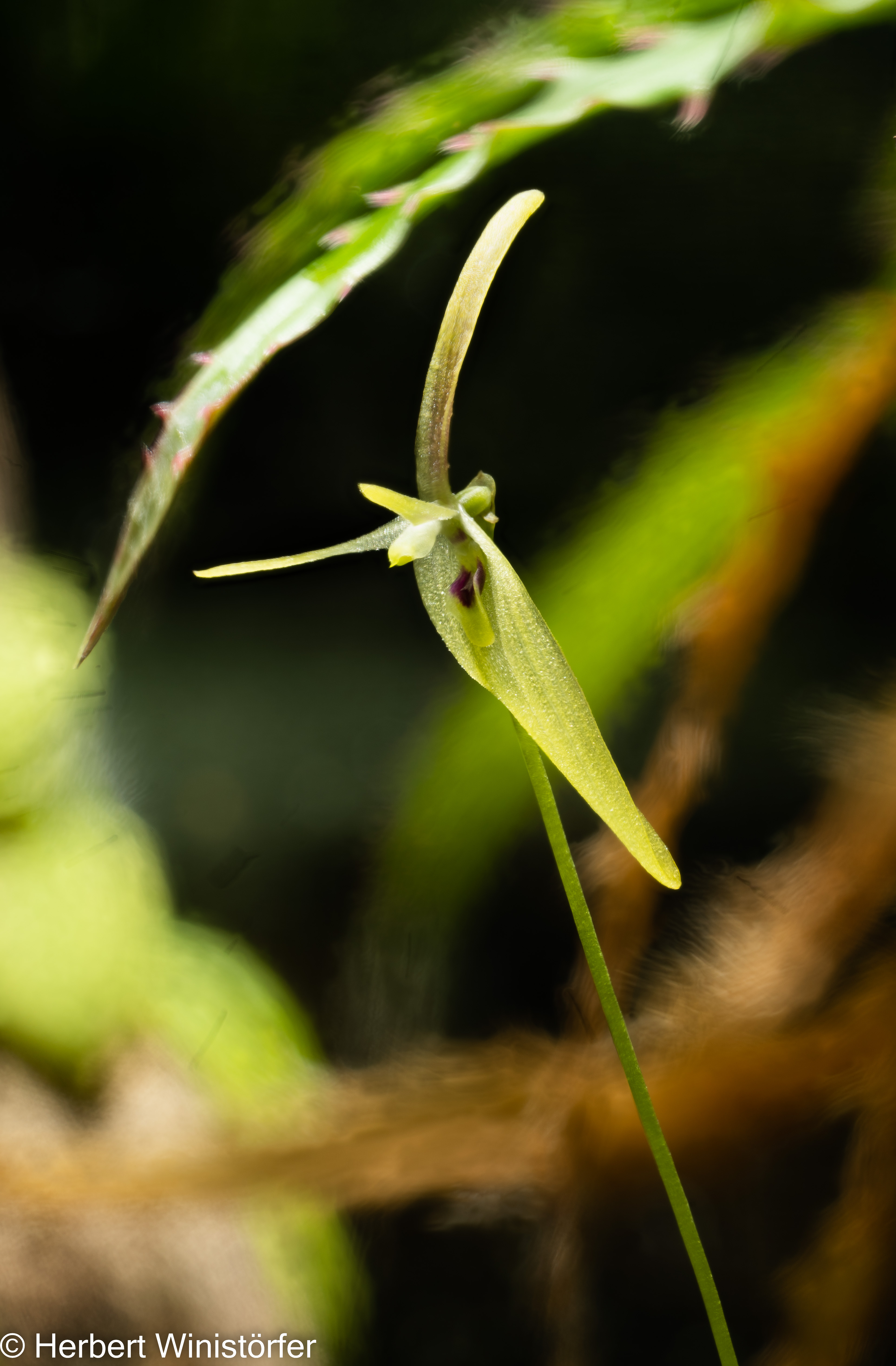
The fragility of the flowers is emphasized even more in the overall view of the jar.
The genus Barbosella with currently 19 accepted species has been introduced in 1918 by Friedrich Richard Rudolf Schlechter (1872-1925). He used it to separate a number of mainly Brazilian species from the genus Restrepia on the basis of differences in flower morphology. He chose the name Barbosella “[…] in recognition of the merits of the late Brazilian orchidologist J. Barbosa Rodrigues, whose work in the field of orchidology I have often had the opportunity to acknowledge.” (Schlechter 1918, p. 258) In doing so, he honoured a highly interesting yet also controversal personality. Could part of Schlechter‘s admiration for Barbosa Rodrigues stem from the fact that neither had traditional academic careers, but had to work hard to earn their recognition as scientists?
A recently published biographical work (Romero Sá 2022) brings to light new aspects of the eventful life of João Barbosa Rodrigues:
He was born in 1842 in the Brazilian state of Minas Gerais and grew up with his father, a merchant who had immigrated from Portugal, and his stepmother. In Minas, he first studied mathematics, natural history, language and literature, and then moved to the Institute of Commerce in Rio de Janeiro. His first passion however was poetry. Since he was 13 years old, he wrote verse. Soon after having finished his course, he began an intense literary production alongside an employment as secretary at Colégio Pedro II. The Colégio, named after the then reigning emperor Dom Pedro II (1825-1891), was an important meeting point for the Brazilian and foreign intellectuality. Barbosa Rodrigues strove for the ideal of the polymath who wants to understand and modify nature and society together and through the knowledge about climates, customs, races, flora and fauna, and the environment. The awakening to natural history came together with his artistic and literary skills. His easy style of writing and his mastery of French and Latin were fundamental to propel his career as a taxonomist in the area of botany.
With the help of a wealthy and well-connected mentor, the Baron of Capanema, Guilherme Schüch (1824-1908), Barbosa Rodrigues was able to start collecting orchids in his home province of Minas Gerais in 1868. At that time, he met Anders Frederick Regnell (1807-1884), a Swedish physician and botanist established in the south of Minas. They became friends, and through his mediation Barbosa Rodrigues was put in contact with the leading specialist in orchid taxonomy, Heinrich Gustav Reichenbach (1823-1883) in Hamburg, who offered him to publish the botanical description of new orchid species in Barbosa Rodrigues´ collection under joint authorship. Barbosa Rodrigues declined the offer and decided to publish on his own. His disadvantage however was, that all important herbaria or libraries needed for comparison and control were located in Europe at the time. Nevertheless, a three-volume monograph on orchids was published (Barbosa Rodrigues 1877-1891) but did not include the nearly 900 plates of Brazilian orchids he had prepared with the help of his wife Dona Constanza. The necessary funds for the expensive printing of the plates could not be raised.
Barbosa Rodrigues’ dream and ambition was to contribute to the monumental work Flora Brasiliensis with the section on Orchids. However, after other renowned orchidologists rejected the work, Alfred Celestin Cogniaux (1841-1916) was finally entrusted with the task. It is a testimony to Barbosa Rodrigues’ abilities as an orchidologist that 538 of the 1795 species recognized by Cogniaux (1893-1906) in Flora Brasiliensis were initially described by Barbosa Rodrigues. Of the original collection of his drawings, only 550 were copied for the Kew collection, while the originals are lost.
Barbosa Rodrigues died in 1909 as director of the Botanical Garden of Rio de Janeiro, regarded in scientific circles in the country and abroad as one of the most important names in Brazilian science.
 Hermetospheres
4 responses to “In honour of João Barbosa Rodrigues”
Das ist ein sehr interessanter Beitrag. Dieser Mann war eine Art Universal Gelehrte. Ist auch etwas bekannt von seiner Dichtung?
Dein Brasilien Glas sieht richtig bevölkert aus. Es grünt und blüht.
LikeLiked by 1 person
Thank you, Marianne, for your comment!
I was not easy to find records of Barbosa Rodrigues’ lyric work, but I finally found a review of his volume of poetry “De Orlinã” in the daily newspaper Diarió de Rio de Janeiro from 12. October 1861. The jouralist, a certain A. Zóraro, is enthusiastic about this work and quotes the following verses as evidence (translated with the help of http://www.deepl.com).
It is so beautiful in a dark night
to enjoy the sweetness
that can be found in solitude;
To give the breast more rest
among the songs of the backwater,
to give relief to the heart!
To see the waves break,
on the rocks, crashing,
roaring, moaning;
to see the boat rocked
by the waters,
sweetly suspended!
To see the moon coming up,
its rays expanding
over the waters, smiling,
the gurgling curls,
where the waves burst,
everything trembles at its roar!
Who doesn’t love those moments
of dreamy thoughts
that show us the loneliness?
When sad we hear
and in the chest we feel
the heart beating?
Who doesn’t feel sweet calm
reborn inside our soul,
inspiring us love,
our mind ravishing,
our pains freeing,
without leaving us bitter?
How beautiful it is to hear in the forest
the groan that portrays
the passion of dove;
when we are cut off,
and from the world abandoned,
beside the trunk of the mirim tree?
I don’t want to have riches
nor any vain nobility
exchanged, without value
by gold corrupted,
by gold acquired
in the market, without a flush.
I only want a dwelling,
[of rough stone],
where the sea comes to sob;
where the salty waters,
fighting angrily,
come to clash on the cliffs.
The final comment by the journalist however shows that among parts of the audience the work did not find the same recognition:
“I could still give you much more to read, but that is enough for us. Now accept from our part Mr. Barbosa Rodrigues the compliments he deserves, and continue without fear in the career he started. To those who, like dogs, bark at him from afar, seeking to stain the candid pages of his book with the bile of their putrid insides, I despise them, or say like the great Bocage: It’s nature to have thorns and flowers side by side.”
LikeLike
A delicate beautiful flower and as always a great history of science and scientists that did great that few know. Thanks Herbie for sharing, great to read and know how your plants are growing.
LikeLiked by 1 person
A post scriptum or rather a corrigendum is necessary because one piece of information in the original post is not correct. Unlike reported in Mori and Castano Ferreira F. (1987), the original drawings by J. Barbosa Rodrigues meant to be published in his “Genera et Species Orchidearum Novarum” (Barbosa Rodrigues 1877, 1882, 1891) did not disappear. In 1992 five of the six volumes of drawings were stored at the library of Jardim Botânico do Rio de Janeiro. Volume 4, bought in 1940 by orchidologist Ames Oakes (1874–1950), was kept at Harvard University Herbaria in Cambridge MA, USA. In 1996, after extensive restoration by the University of Basel, a facsimile edition of all surviving original drawings was published together with the original descriptive texts as “Iconographie des Orchidées du Brézil” (Barbosa Rodrigues 1996). The adventurous history of this publication project was described by its initiator Samuel Sprunger (Sprunger 1999). The scientific importance of the drawings lies in the fact that today 370 of his orchid drawings are considered iconotypes, since the type herbarium of J. Barbosa Rodrigues has actually been lost.
(You can find the literature cited in this comment in the blog’s literature list.)
LikeLike