Tillandsia ionantha has been popular as an ornamental plant since it arrived in the greenhouses of Belgian horticulturist Louis Van Houtte (1810-1876). This is where Jules Émile Planchon (1823-1888) found the specimen he used for his botanical description of the new species (Planchon 1855). As currently circumscribed, T ionantha is widely distributed in Mexico and Central America. Along this range of distribution, the plants show morphological variation in the rosettes and leaves, characters that have supported the recognition and description of six varieties and two forms. All the taxa are are referred to as the T. ionantha complex. A species complex is considered a group of organisms where the boundaries between species and the number of species are not clear (Ancona e.a. 2021). While other characteristics vary within the complex, floral morphology is identical (Ancona e.a. 2022). As with all bromeliads, T. ionantha flowers have 3 sepals, 3 petals and 6 stamens. However, the purple-colored petals do not open but stay connate and form a tubular corolla.
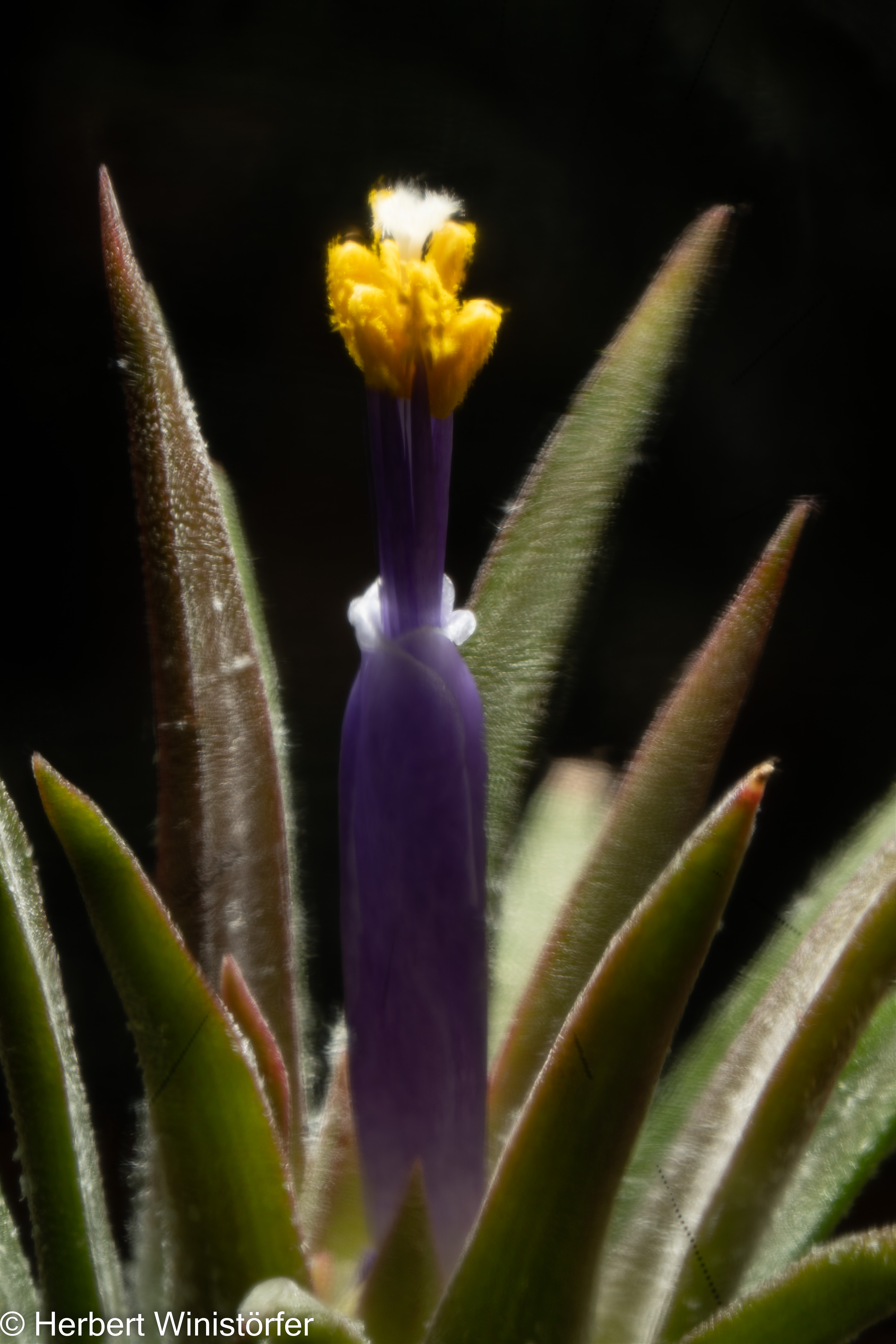
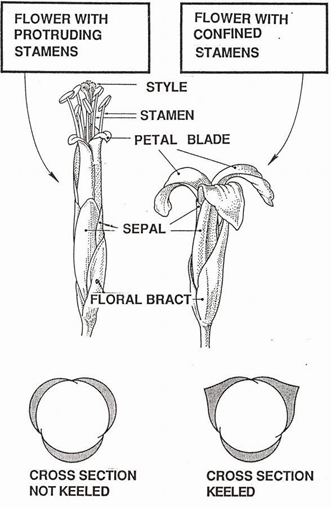
The exact pollinator species for T. ionantha are unknown. However: “Many species […] with tubular corolla and exserted stamens and stigma are pollinated by hummingbirds. Birds are attracted by the brightly colored bracts (often red and yellow) and scentless flowers. Flowers are available over a longer period of time and individual flowers are open for only one or a few days. This is ideal for ‘trap-line’ pollination by birds, where a bird flies a certain route, probably several times a day, from one plant to another.” (Gouda 2020) Although the flower has nectaries and produces nectar, it is scentless. Nevertheless, volatile organic compounds that could play a role in pollinator attraction have recently been isolated from T. ionantha flowers, (Gonzalez 2022). Or is it the luminous purple and yellow color of petals and anthers, respectively, that attracts pollinators?
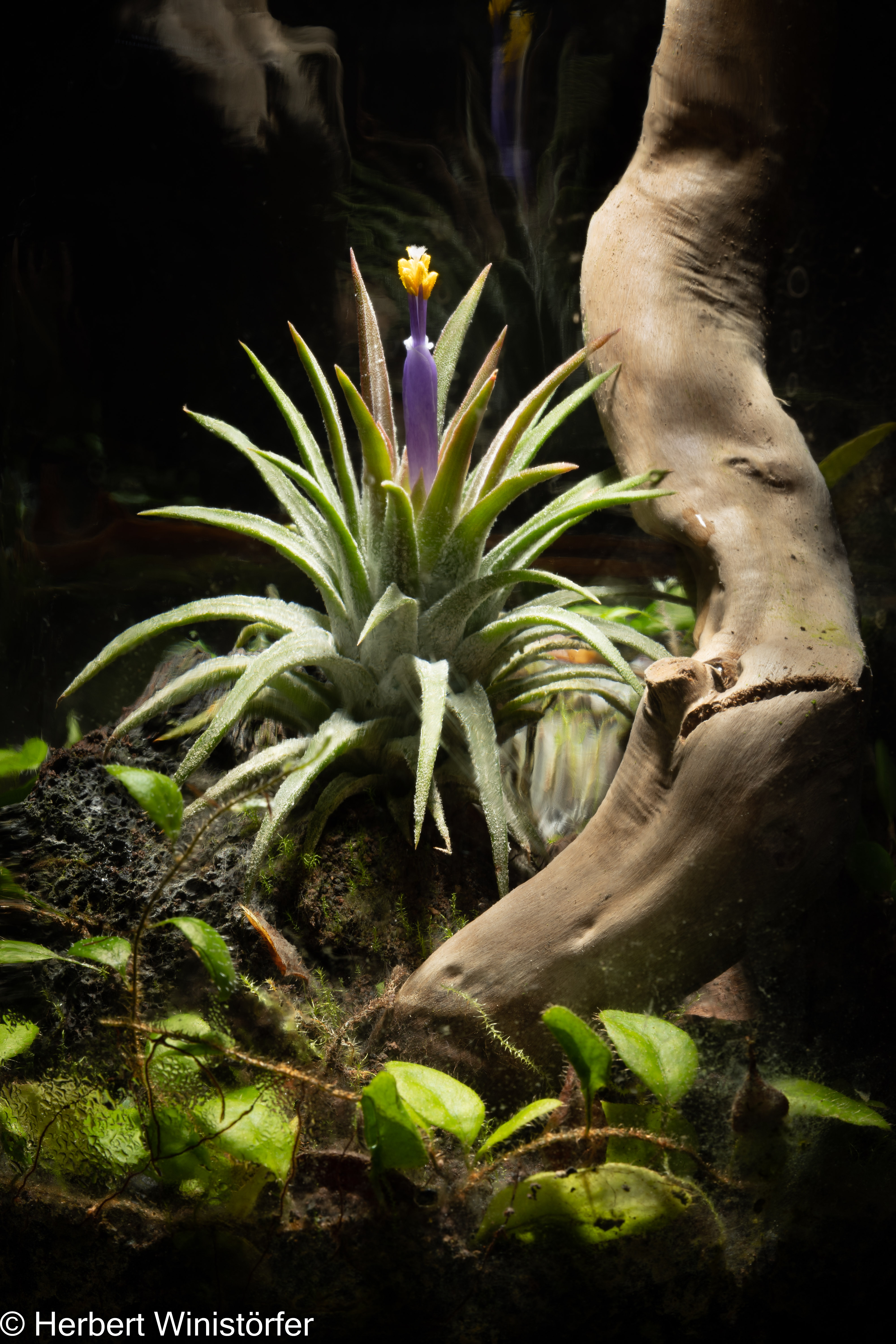
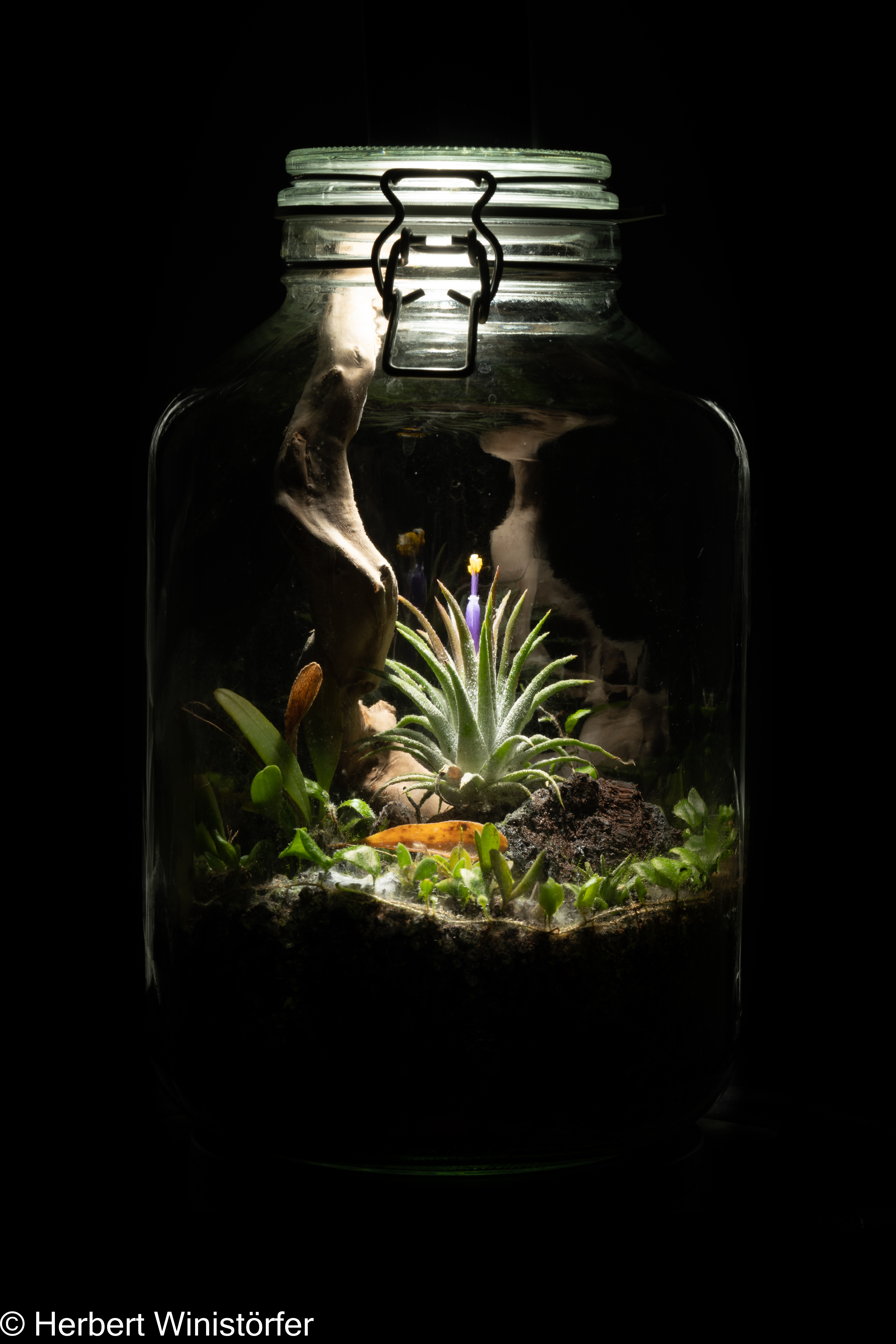
In my hermetosphere, the flower has developed with stunning speed. Only three days after I took the pictures presented here, two more identical flowers had emerged. This was all the more surprising as the plant seemed to have hardly changed since the start of the hermetosphere. Since cross-pollination seems to be mandatory for this plant (Pemberton and Liu 2007), fruit development is not expected in my jar. Instead, the leaf rosette is expected to die slowly, lateral shoots (“pups”) are formed, and the plant thus reproduces vegetatively.


One response to “What makes a flower attractive?”
It looks fantastic in this area.
LikeLike