For some tropical plants that have a reputation for being difficult to grow in culture, the hermetosphere is just what it needs. This seems to be the case for this small Begonia from São Paulo province in Brazil. According to one of the most experienced Begonia growers today, B. hoehneana is “a species that is famous for its delicate culture” because, among other things, “the watering on the leaves makes it quickly wither away” when grown in a terrarium (Barrère 2016b).
The closed glass container seems to be just right here: it offers permanently high humidity without getting the leaves wet. In its natural habitat this begonia grows mainly on limestone rocks, and in cultivation attempts are often made to imitate this by using a calcareous substrate. However, my experience shows that this is not strictly necessary.
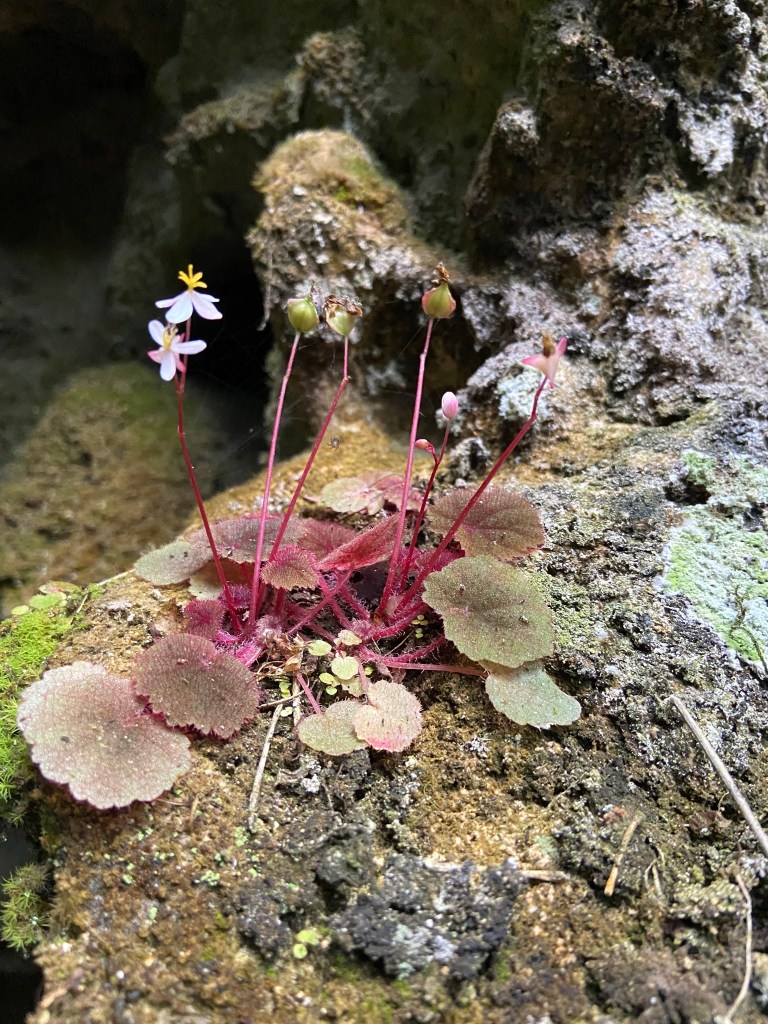
The two pictures below show Begonia hoehneana in its natural habitat.

Some tropical plants are more readily available as seeds than as young or adult plants. This is why I recently focussed on gowing from seed. The containers I use are trays made of glass and a transparent plastic lid with rubber seal. The substrate is similar to the substrate I use in my hermetospheres (see a previous post) except that I use lava sand instead of lava granulate.
Of the first four species I sowed in a first tray, Begonia hoehneana germinated and grew steadily (see picture below, red arrow).

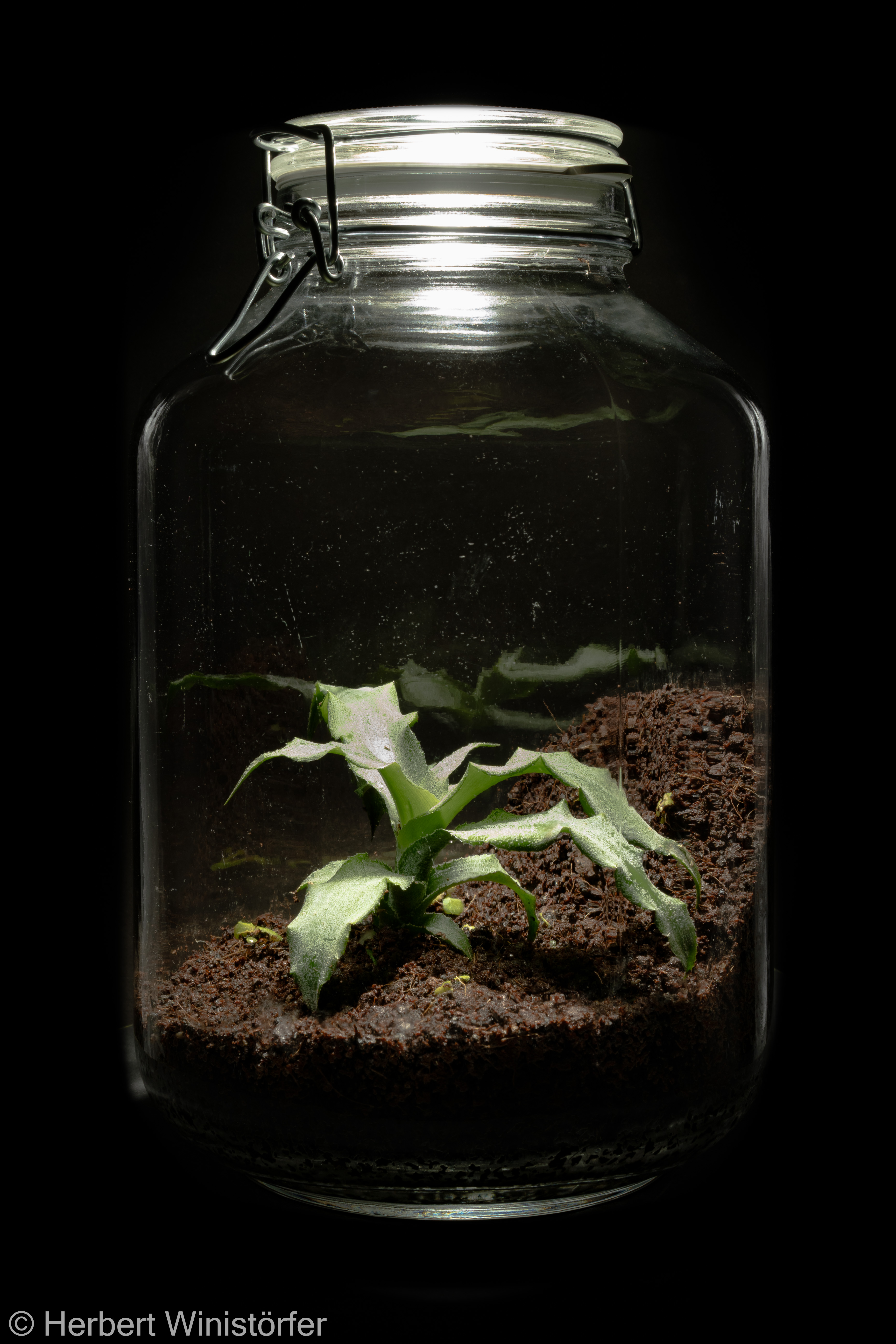
Now, how did B. hoehneana do in closed-container conditions after germination? I planted the two to three weeks old seedlings in my standard setting and documented the development. The pair of pictures below show the initial set-up and the situation six weeks later, when the seedlings had grown into respectable-sized plants.

None of these plants have yet produced flowers, but I look forward to discovering the first signs of a developing inflorescence and will report back here.

According to the notes on the preserved holotype specimen of B. hoehneana (speciesLink network 2024), the species was discovered in October 1883 by Juan Ignacio Puiggari (1823 – 1900) at the great cascade of Palmital, near Apiaí, in the São Paulo area of Brazil. The scientific description as a new species was only made sixty years later by Edgar Irmscher (1887-1968). It was named after Frédérico Carlos Hoehne (1882-1959), Director of the Botanical Gardens in São Paulo, who has significantly promoted knowledge of the flora of Brazil through numerous works (Irmscher 1953: 71).
In a major revision of the genus Begonia based on molecular phylogeny, B. hoehneana was assigned to a new section Stellandrae as its only species: “Given its phylogenetically isolated position and the large morphological differences […] we create B. sect. Stellandrae to encompass this species. Begonia sect. Stellandrae is easily distinguished from all other American sections of Begonia by its combination of a creeping habit and anthers spreading from the apex of a long column.” (Moonlight e.a. 2018: 307)
Addendum dated 15 December 2025:
Unfortunately, my enthusiasm about the success with Begonia hoeneana in the hermetosphere was somewhat premature. The plants never flowered, and about a year after the start, they gradually died off.
 Hermetospheres