When it comes to the growing medium, every plant enthusiast has his or her favourite product or recipe. So do I, and here is mine.
To find my standard recipe, I read a lot, gave it a lot of thought, made an initial choice and started a trial, assessed the result, made small changes, started a new trial, etc. Following this process, I arrived at what I describe below. Because every new container is a new experiment, the process is far from complete. And, as always, what suits me doesn’t necessarily suit others.
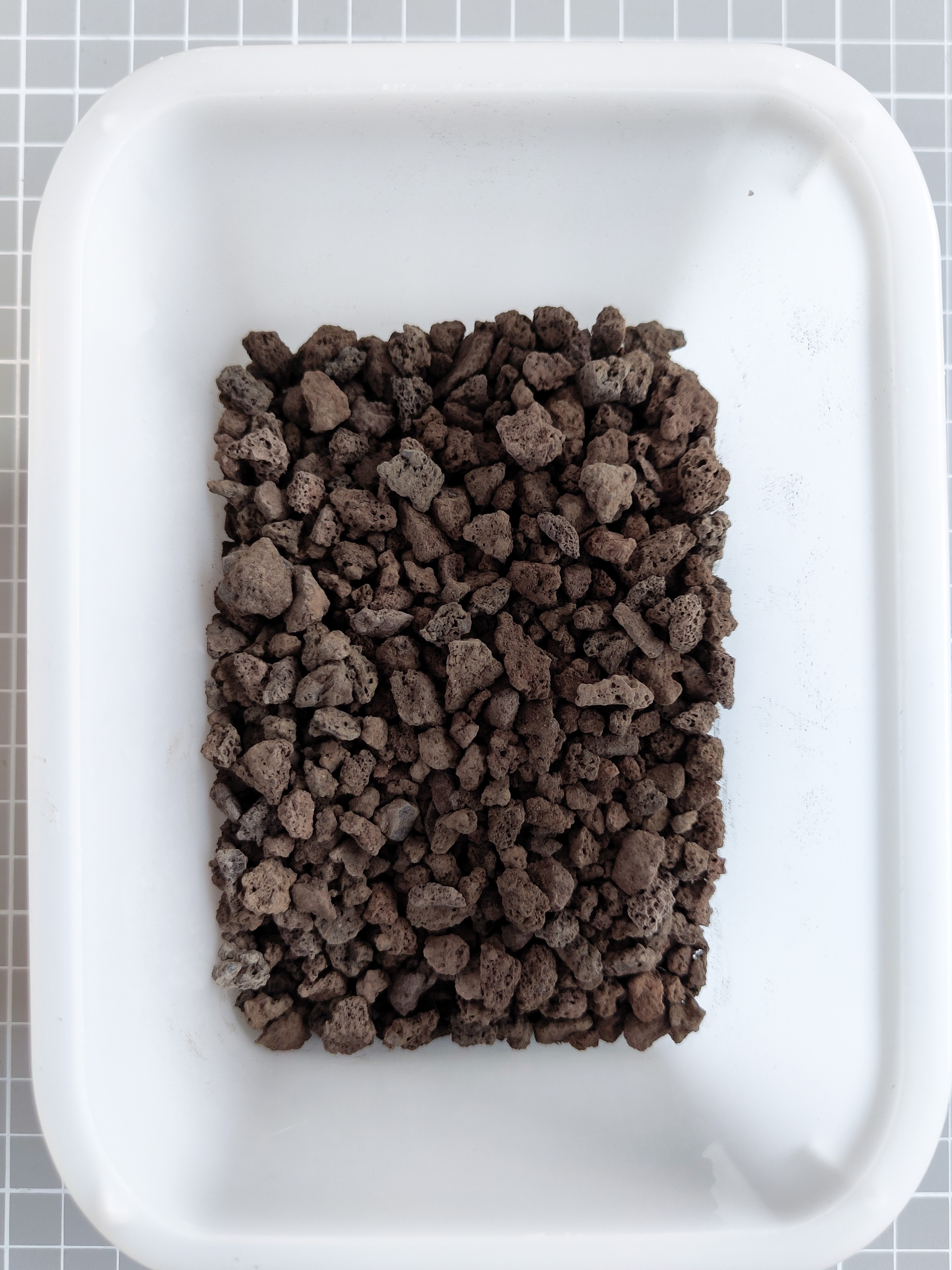

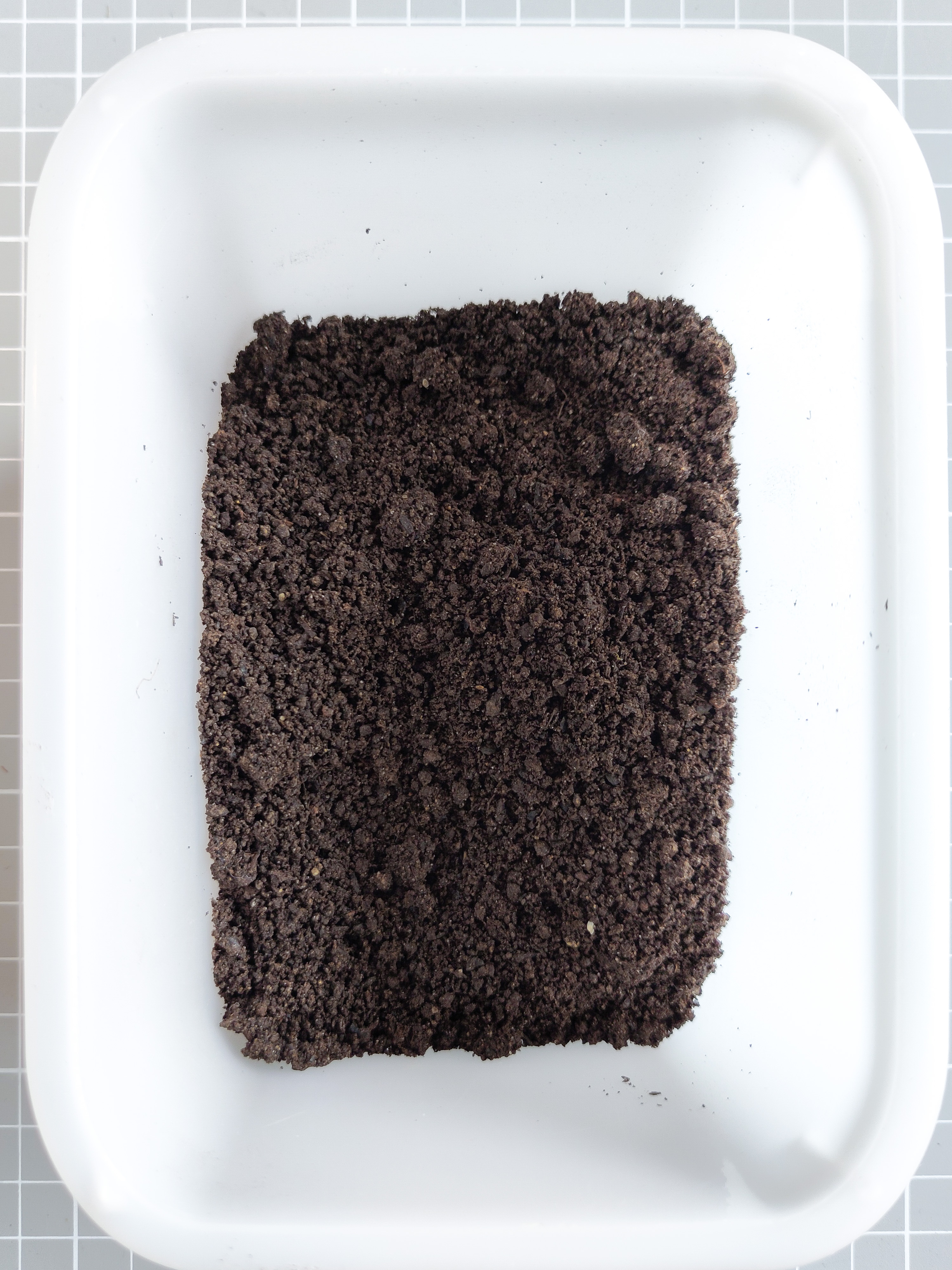
Of the three components I use (cf. pictures above), each fulfills a specific purpose:
- For structure and stability, I use lava granulate. Depending on the mining region, lava is generally not considered a scarce raw material. My product is mined in central Europe in roughly 500 km transport distance to my home. It comes in either 2-5 or 2-8 mm grit size. Together with the other two components of my substrate as a ‘cement’, it allows me to build even steep slopes in my containers without additional structure. Lava is very suitable because it is lightweight, does not decompose, is chemically inert, i.e. it hardly releases any nutrients or potentially toxic elements even over a long period of time and does not change the pH value of the soil.
- For water retention, I use coconut coir peat (coco peat). While Sphagnum peat moss is often still used for this purpose, coco peat is not only less harmful to the environment, but also has better properties in some respects: Coir is made of husk and short fibres from the coconut mesocarp, which are a waste product of the coconut industry, coming mainly from Philippines, Indonesia, Sri Lanka, Malesia, and Thailand. Coir is a renewable and largely available resource. It provides a favourable balance between air and water, similar to peat, and higher pH and lower cation exchange capacity (CEC) than peat (Mariotti e.a. 2020). A certain CEC is desired for substrates as it helps keeping certain nutrients (K, Mg, Na, among others) available for plants; this, however, should be provided in my substrate by the organic matter in the earthworm humus (see below). According to Wilkinson e.a. (2014) “Coconut coir has many desirable qualities: high water-holding capacity; excellent drainage; absence of weeds and pathogens; […] slow decomposition; easy wettability; and acceptable levels of pH, cation exchange capacity, and electrical conductivity.” My product is sold as ‘terrarium substrate’ with a PH value between 5.0 and 6.0, heat-sterilised and therefore fungus- and germ-free and without the addition of fertilisers. It comes dried and compressed and is capable of absorbing eight times its dry weight of water:
- For nutrient supply, I use earthworm humus. It contains 46% of organic matter in the form of clay-humus complexes, 1.2% total nitrogen, 1.2% K2O and 0.9% P2O5. With the help of this declaration, I can add exactly the desired amount of nutrients to my container. My product is not sterilized and contains plenty of soil microbes, even tiny nematodes and sometimes mites and springtails, that hopefully help decompose the dead plant material that will occur in time within the closed terrarium. So far, I have not observed any introduction of plant pests with the product.
From these three ingredients (lava, coco peat, earthworm humus) at a ratio of 20:5:1 (weight), the substrate is made by:
- Washing the lava with demineralized water and letting it drain.
- Adding demineralized water to the coco peat until fully swollen and letting it drain.
- Adding eathworm humus to the coco peat and mixing thoroughly.
- Adding the coco peat / earthworm humus mix to the lava and mixing thoroughly.
The result looks like the picture below, has a pH around 5.8 and is moist, too moist often for the closed terrarium. That is why I open the lid several times in the first few days after planting and allow condensed water to evaporate until the amount of newly formed condensation has noticeably decreased.

 Hermetospheres
One response to “The substrate”
[…] lid with rubber seal. The substrate is similar to the substrate I use in my hermetospheres (see a previous post) except that I use lava sand instead of lava […]
LikeLike