Since the times of the ‘plant hunters’ of the colonial era, orchids have held a special fascination for plant lovers. Only a small proportion of tropical orchids live with roots anchored in the soil (terrestrial), far more live as epiphytes on other plants. They obtain moisture and nutrients from the precipitation water that runs down the branches and stems on which they grow. In the hermetosphere, it is difficult to mimic the conditions for epiphytes. Here, most of the water condenses on the inner walls of the glass and runs past the plants into the substrate. Terrestrial species therefore appear to be favoured. Jewel orchids are among the few terrestrial, tropical orchids. It therefore makes sense to check how well they thrive in a closed terrarium.
It took several attempts before I was successful with a jewel orchid in a hermetosphere. The conditions seem to have been too damp for Anoectochilus albolineatus and Dossinia marmorata, which rotted after a short time. Goodyera schlechtendaliana survived for a longer time, but was unable to form upright shoots. Instead, the shoots grew lying on the substrate. Only the species Anoectochilus setaceus was the first to thrive without restrictions in the hermetosphere.
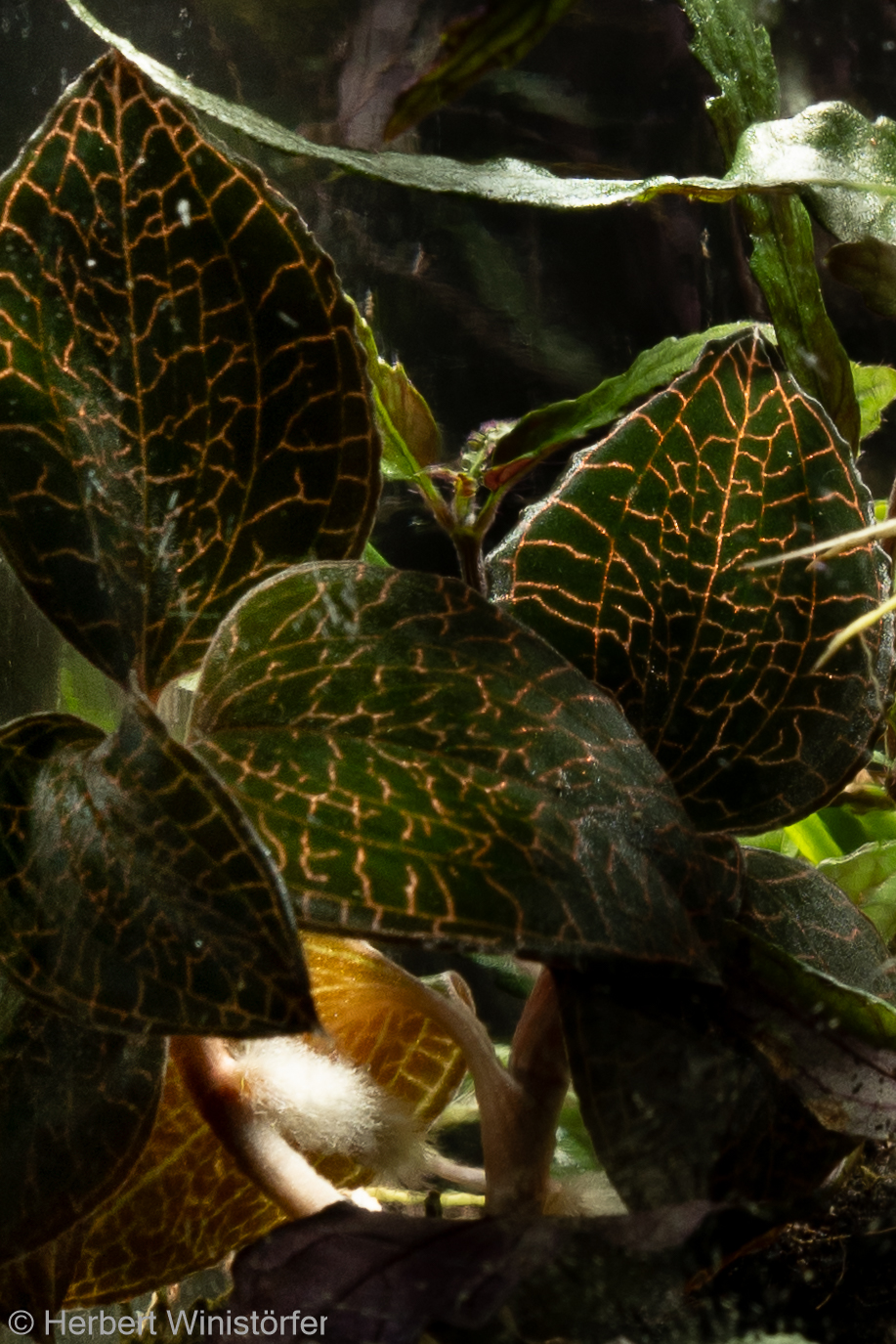
Like most jewel orchids, Anoectochilus setaceus, native to Southeast Asia, is loved mainly for its uniquely patterned leaves (see pictures above and below), rather than its less spectacular flowers. As John Lindley wrote about the plant in Edwards’s Botanical Register in 1837: “The beauty of the plant consists in this character, for its flowers are white and green, and very inconspicuous. But the leaves are singularly painted with golden veins upon a brown-ish purple ground, as if, in the words of Rumf, ‘some cunning painter had traced them over with unknown characters.’”
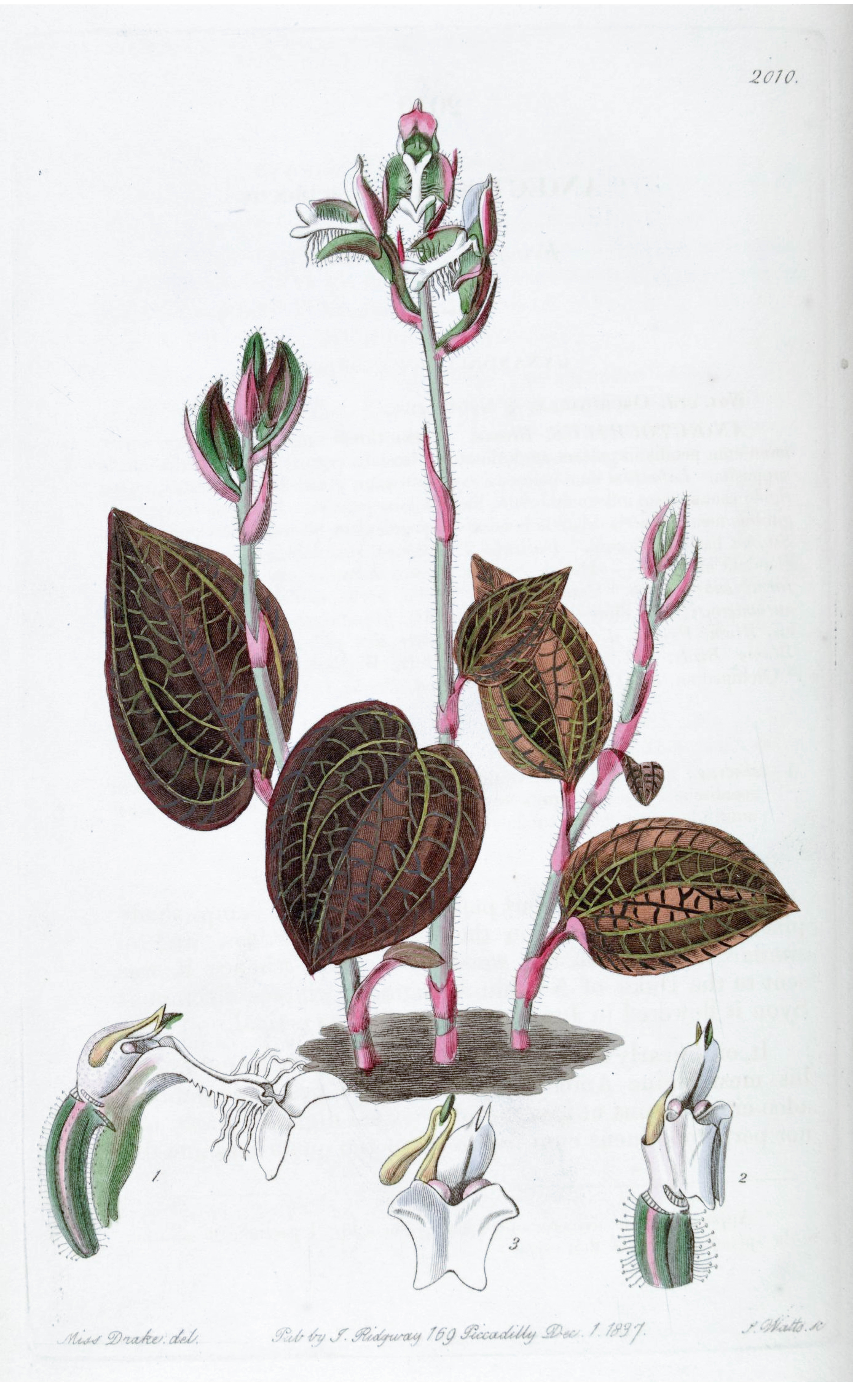
The jewel orchids (Goodyerinae), named after their often colourful leaves, occur in all tropical regions of the world. The subtribe Goodyerinae (Orchidoideae, Cranichideae, Orchidaceae) comprises 33 genera and 746 tropical and subtropical species. Their phylogenetic origin and main centre of biodiversity today lies in Asia. However, America represents a second centre of diversity, with one-third of known species of Goodyerinae. Recent studies based on molecular phylogenetics suggest two independent dispersal events to the New World from the Indomalesian region during the Miocene (c. 11 Mya and c. 8.4 Mya, respectively). (Smidt e.a. 2021)
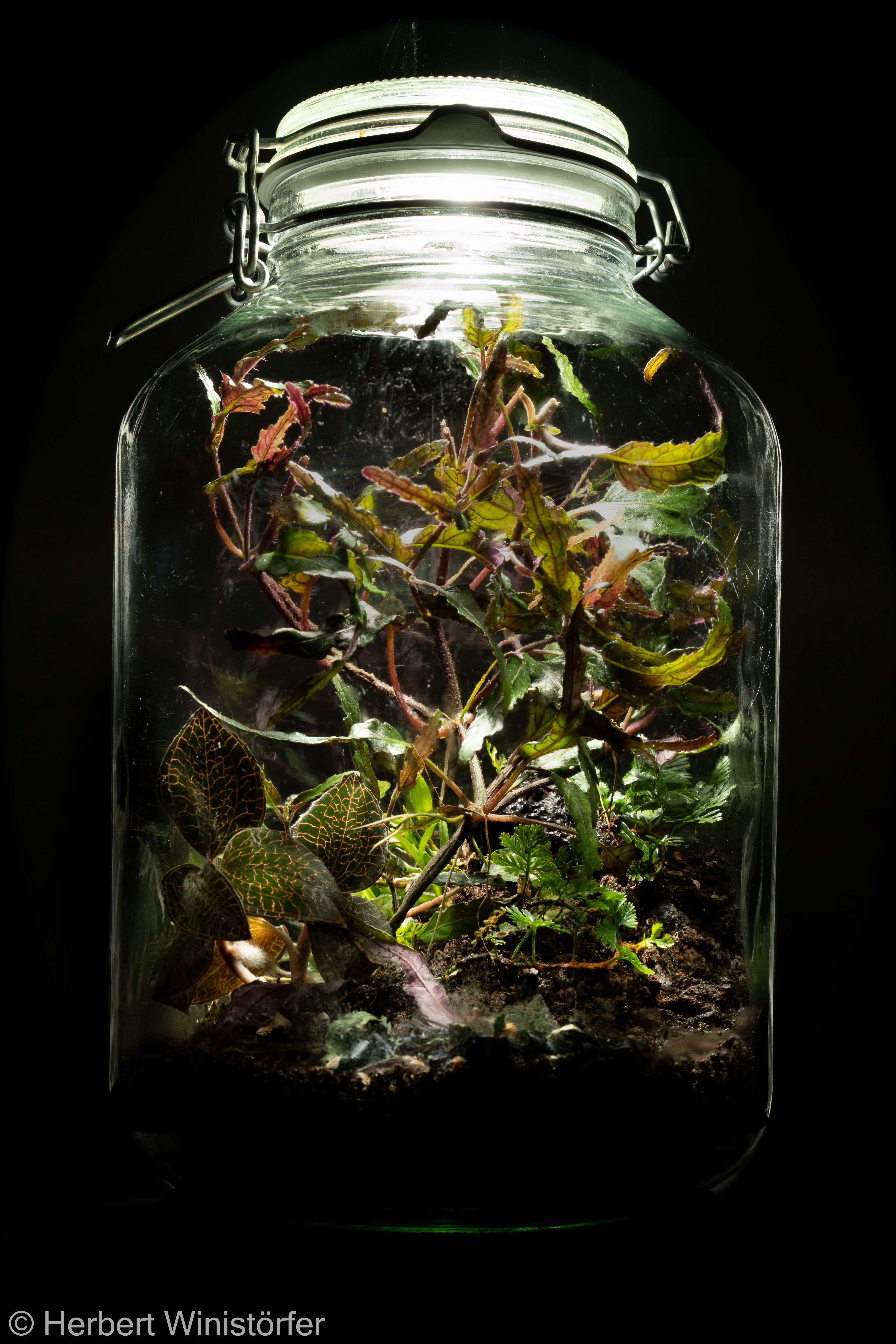
The picture above shows A. setaceus after nearly 10 months in its closed terrarium, the leaves being shaded by Strobilanthes sinuata, but a section of the roots with root hair nicely illuminated by the flash light from above.
 Hermetospheres
2 responses to “Jewels of the closed terrarium?”
Die faulen manchmal einfach, keine Ahnung, warum. Dossinia marmorata ist mir erst super gewachsen, hat sehr große Blätter gemacht, dann wurden die Blätter kleiner und schließlich ist sie (nach 1 oder 2 Jahren) gestorben. Lag schätzungsweise an der Pflege. Anoectochilus habe ich verschiedene, die vom Wuchs nicht so schön werden, trotz viel Licht eher gakelig. Gleichzeitig haben Juwelorchideen bei in vitro auch hohe Luftfeuchtigkeit und viele Sammler halten sie bei hermetosphärenähnlichen Bedingungen (geschlossene Glasterrarien oder durchsichtige, oben geschlossene Plastikbecher).
LikeLiked by 1 person
Danke für diesen Erfahrungsbericht. Die “Einsteigerversion” scheint Ludisia discolor zu sein. Zu ihr finden sich Erfolgsgeschichten auch für Hermetosphären. Die werde ich auch noch in ein Glas einbauen, wenn es sich mal ergibt
LikeLike