Why does a plant begin to produce miniature leaves after a change in environmental conditions? This is the provisional story of a Peperomia sp. in one of my hermetospheres.
The genus Peperomia is one of the largest genera of basal angiosperms, comprising about 1500–1700 species distributed across all (sub-)tropical regions of the world. The greatest diversity occurs in the Neotropics, followed by Southern Asia (about 100 species), Africa (about 20 species), Madagascar (about 40 species), and Australia and New Zealand (less than 20 species). (Wanke e.a. 2006)
Because Peperomia species are recommended as suitable by experienced hermetosphere growers (e.g. Ulf Soltau), I seized the opportunity when I was given a shoot of a not further identified Peperomia from Ecuador. Based on my pictures, a Peperomia expert suggested Peperomia cf. metallica as identification. As I always do with new plants, I first put the shoot in a separate 0.5 l glass for a while. This way I can detect any diseases or pests that have been introduced and see if the plant can get used to the high humidity. With this plant, I made an observation that was completely new to me. During the three months in quarantine, the shoot grew, branched and looked healthy. However, all the new leaves that emerged were distinctly smaller (less than 1/3 as long) compared to those on the original shoot. How could this be?
The video above shows the Peperomia together with its fellow inhabitants of a newly established hermetosphere, a few daws after the plant has been replaced from its quarantine container.
The following two pictures give an impression of the massive difference between the leaves that grew “before” arrival (under conditions I could not verify) and those that grew “after” the plant was quarantined under closed container conditions.
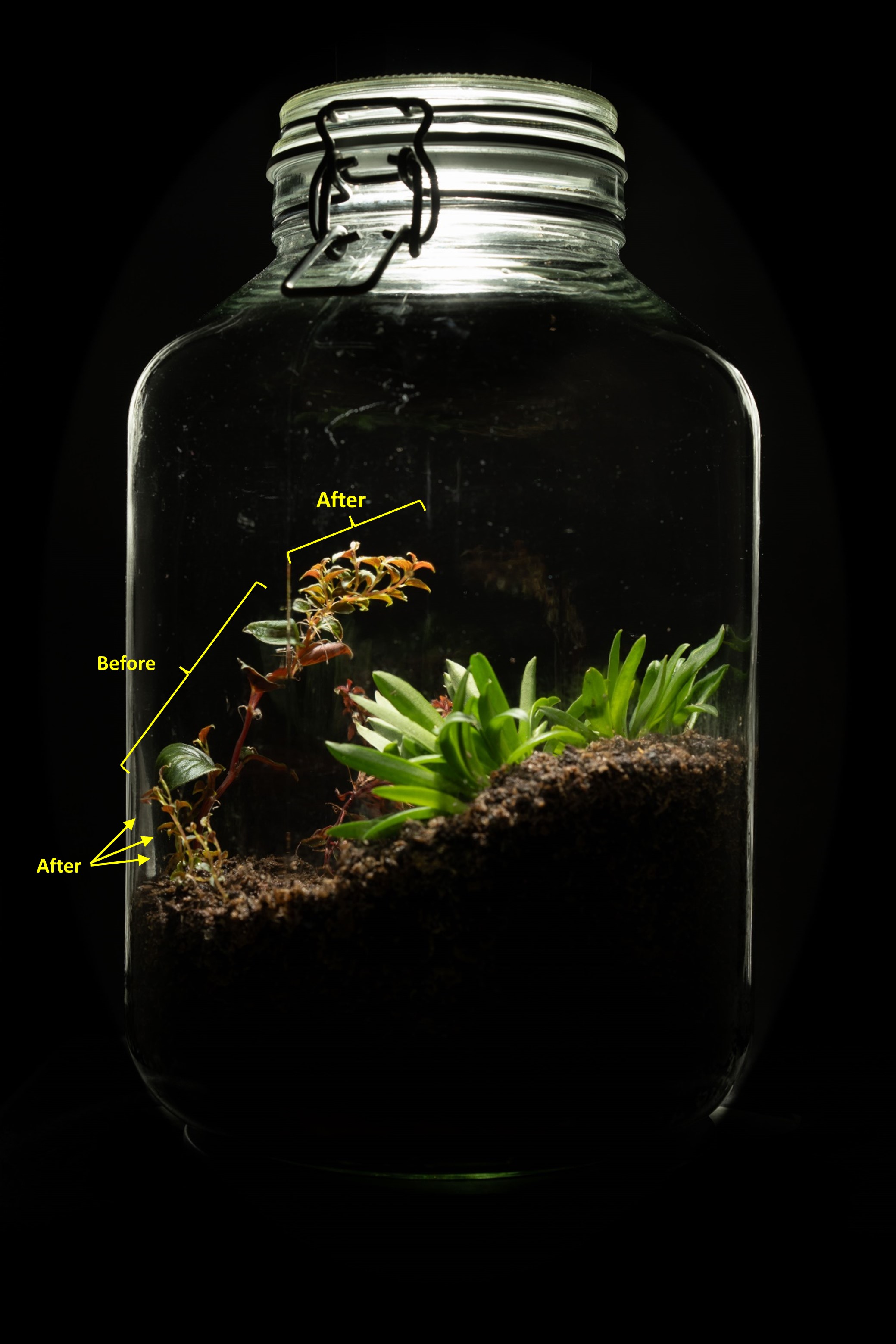

What environmental factor could be the cause of this kind of acclimation reaction? First, large differences in leaf size are a known phenomenon in Peperomia, both within a species and on a single plant. An example is P. prolifera (see e.g. herbarium records A and B), with variable leaf size cited by Yuncker (1961, p. 63) as a distinguishing characteristic.
Reduction in leaf size has been discussed as a reaction to scarce resources (Carins Murphy e.a. 2012, p. 1404): “The portion of biomass available for photosynthetic tissue is comparatively less in larger leaves as they require greater investment into support and conductive tissues […]. Hence […] smaller leaves are favoured under stressful conditions as the construction of larger leaves becomes expensive when carbon and water is scarce. Both of these explanations are broadly consistent with general trends towards narrower leaves and leaves with lower lamina areas in dry climates […].” In my hermetospheres however, carbon and water are not likely to be scarce.
Two other causes are more likely in my case: (1) nitrogen deficiency or (2) high irradiance. According to Aiswarya e.a. (2023, p. 797) reduced leaf size can be a result of nitrogen deficiency (1), instead of or besides leaf loss or chlorosis: “A lack of nitrogen often results in a reduction in leaf size. The leaves might be smaller than usual and their leaf blades could be thinner. The total photosynthetic potential of the plant may be impacted by this drop in leaf size.” Because the plant grew only in moist, long fibered Sphagnum during the three months in quarantine, with no nutrients added, this possibility is plausible. So is high irradiance (2): During quarantine, when the small leaves occurred, the plant was exposed to around 35 µmol m-2 s-1 of photosynthetically active radiation (PAR), which is close to or beyond light compensation point of herbs of the undergrowth in tropical forests (see a previous post). To avoid damage from excessive radiation, reducing leaf area by smaller leaves seems to be an appropriate response. Moreover, in experiments under controlled conditions, such an acclimatization response could be observed (see the table below).
From the moment the plant was moved from quarantine to the 5l jar, where sufficient nutrients were available and light intensity was lower, the plant began to produce larger leaves again.
If you have ever made similar observations with your plants, let me know.
| Species | Observation | Conditions | Source |
| Toona ciliata M. Roem. (Meliaceae), a woody angiosperm | Leaves and expanded under low irradiance (50 umol m-2 s-1) were 116% larger in area than leaves expanded under high irradiance (1500 umol m-2 s-1). | Plants grown for 3 months in controlled conditions (glasshouse / growth chamber) | Carins Murphy e.a. 2012 |
| Rhododendron ‘Furnivall’s Daughter’ and ‘XXL’, and R. dalavayion | When grown at high light (HL) compared to low light (LL), stomatal density and vein density increased in all plants; leaf size decreased by approx. 20% (R.‘Furnivall’s Daughter’ and ‘XXL’) and approx. 35% (R. dalavayon). | Two-year-old seedlings were grown outdoor for four months and exposed to full sunlight (high light, HL), medium light (ML, 65% of full sunlight), and low light (LL, 35% of full sunlight) with the use of shade nets. | Wang e.a. 2020 |
 Hermetospheres
One response to “Acclimation (3): Peperomia sp.”
[…] entries in this blog (#1, #2, #3) have already discussed the observation that some plants change their habitus after being planted […]
LikeLike