This post is last of a three-part series discussing water conditions, nutrient conditions, and light conditions in hermetospheres. When I started my first hermetospheres, I intuitively felt that the place chosen within my apartment did not provide enough natural light for plant growth. I therefore installed LED grow lights, first one, then a second. Now, it is time for a closer look: Does the existing lighting situation support the goals I am pursuing with my hermetospheres? What potential for improvement exists regarding the lighting situation and plant wellbeing? To answer these questions, I first look at some basics of plant photobiology (A), then I examine the light conditions under which my plants grow in nature (B), then I describe the light situation for my hermetospheres (C), and finally I draw conclusions (D).
A. To begin, it is helpful to remember some basics of plant photobiology:
- Light is of dual significance for plants: (a) as energy source through pigments such as chlorophyll absorbing light energy and making it available for plant growth, (b) as regulator through photoreceptors perceiving signals that contribute to the control of growth (Schulze e.a. 2019, p. 57ff.)
- The light characteristics with high relevance for plant growth are: (1) intensity (quantum flux, indicated in µmol photons m-2 s-1), (2) spectral composition (colour, indicated in Kelvin), (3) duration (day length). The photosynthetically active radiation (PAR) is the visible light from 400 to 700 nm wavelength. However, blue (<500 nm) and red (>600 nm) can be used much more effectively for plant photosynthesis than green light (500-600 nm). This is why the most common measure for light in plant photobiology is photosynthetic photon flux density (PPFD, indicated in µmol photons m-2 s-1).
- Regarding wavelength, two qualities of radiation other than visile light are of relevance: ultraviolet radiation (UV, <400 nm) is potentially harmful to plant cells and acts as a stressor; various protective mechanisms normally ensure that damage does not occur; however, this comes at the expense of vitality (Schulze e.a. 2019, p. 78ff., Roeber e.a. 2021). In addition, long-wave UV radiation (UV-A, 315-400 nm) also has regulatory functions in plants (Verdaguer e.a. 2017). Far-red radiation (FR, 700-800 nm) has an important regulating function for plants; the ratio between red light and far-red light (R:FR ratio) differs between dusk/dawn and noon, sun and shade, above canopy and below canopy. The R:FR ratio is detected by the plant´s phytochrome system and plays a crucial role in the control of seed germination, flower induction and other physiological processes.
- With regard to adaptation to different light intensities, plants can be divided into sun plants and shade plants. Shade plants can use low light intensities more efficiently. This means that they reach the range where they take more CO2 up than they release (light compensation) at low light intensity. But they also reach their maximum photosynthetic rate (light saturation) at relatively low light intensity. Sun plants behave in exactly the opposite way. They can use low light intensities only poorly, but high ones all the better. This specialization may be genetically determined (shade and sun species) or acquired to a certain extent (shade and sun forms of given species). (Lüttge 2008, p. 103ff., see figure below)

- Too much light: At light intensities far above the species-specific light saturation points, photosynthesis (and thus CO2 uptake) is inhibited to protect plant tissue from excess radiant energy. If these protective mechanisms are overused, the tissue is irreversibly damaged (Guidi e.a. 2017).
- Not enough light: Sun plants exposed to shade conditions rapidly respond with shoot elongation a.o. (shade avoidance response) that helps them overgrowing neighbors and reaching back into sunlight. In the plant geneticists’ model plant Arabidopsis thaliana, “shade light causes alternative growth and developmental patterns including the repression of seed germination, the promotion of hypocotyl growth, the promotion of petiole growth and more erect leaves and early flowering.” (Casal 2012, p. 2) Shade plants do not show the typical shade avoidance response. Instead, (further) reduced light intensities lead to reduced growth and/or stress symptoms like leaf wilting (see figure below).
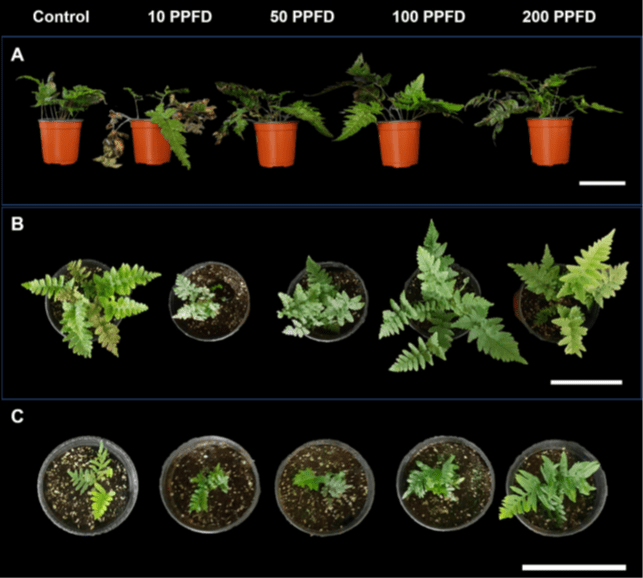
The length of the light period in the diurnal cycle of 24 h (photoperiod) is an important environmental signal. Plants have evolved sensitive mechanisms to measure the length of the photoperiod. This enables plants to synchronize developmental processes, such as the onset of flowering, with a specific time of the year. (Roeber e.a. 2022). Prolongation of the light period initiates the photoperiod stress syndrome (Roeber e.a. 2021).
B. With few exceptions, the natural habitats of plants doing well in hermetospheres are the understoreys of humid, tropical low-land forests. The light conditions in these habitats are characterized by the following traits (Chazdon and Fetcher 1984, Chazdon and Pearcy 1991):
- Intensity: Total daily photosynthetic photon flux density (PPFD) often below 1.0 mol m-2 d-1,[= 23 µmol m-2 s-1] and measurements as low as 0.15 mol m-2 d-1 [= 3.5 µmol m-2 s-1] have been recorded. In experiments with the deep shade plant Selaginella erythropus, light intensities above 75 µmol m-2 s-1 led to inhibited growth and tissue damage within a week (Ghaffar e.a. 2018).
- Occasional sun flecks or light flecks: brief increases in solar irradiance that occur in understories of an ecosystem when sunlight is able to directly reach the ground. They are caused by either wind moving branches and/or leaves in the canopy or as the sun moves during the day; although each sunfleck only last for seconds or minutes at a time, they can be responsible for more than 80% of the photons that reach plants in the understory.
- Duration: constant day lengths of around 12h year-long
- Light passing through vegetation (foliage shade) is altered in its spectral composition (see chart below), and this shift can profoundly affect plant development. Leaves absorb radiation strongly in the range of 400-700 nm and very weakly at 750-1100 nm. Thus, as radiation passes through foliage the ratio of quanta centering on 660 nm (red) is reduced in relation to quanta at 730 nm (far-red). This red to far-red ratio is approximately 1.10-1.25 under full sunlight and as little as 0.10 under forest canopies. (Lee 1988)
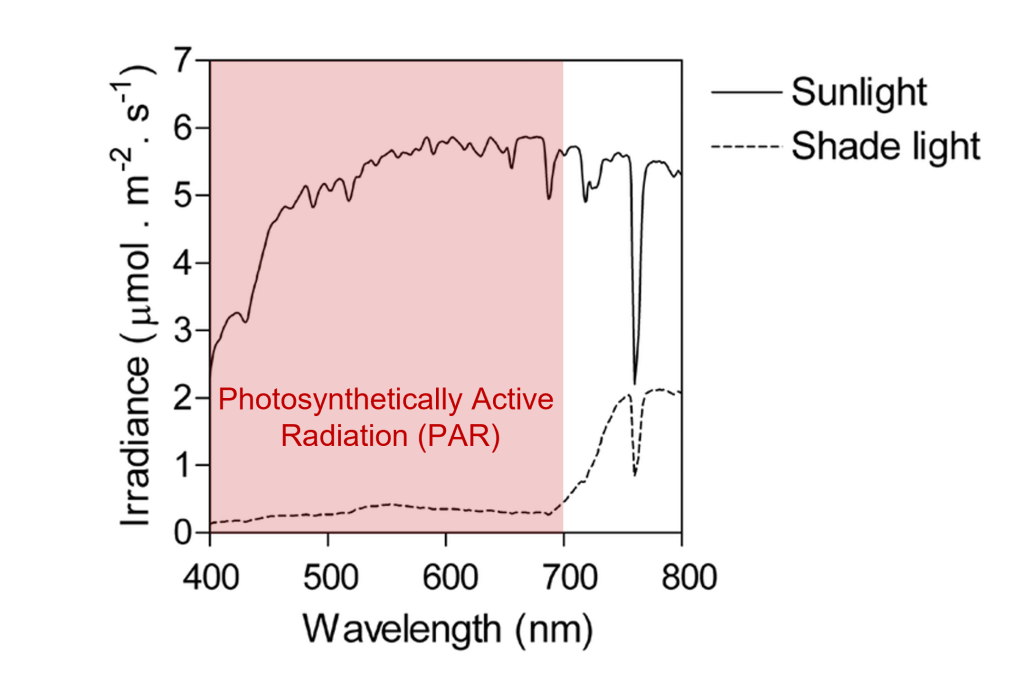
Herbs of the undergrowth in tropical forests have light compensation points between 2.6 and 6 µmol m-2 s-1 and light saturation points between 25 and 37 µmol m-2 s-1; epiphytes in tropical forests have light compensation points between 5 and 75 µmol m-2 s-1 and light saturation points between 100 and >500 µmol m-2 s-1 (Lüttge 1984, p. 560).
C. What are the light conditions in my hermetosphere setting?
The following graphic shows the lighting situation for my hermetospheres. The jars are placed on a shelf near a large window with only indirect light coming in. The additional lighting consists of two 18W LED grow lights.
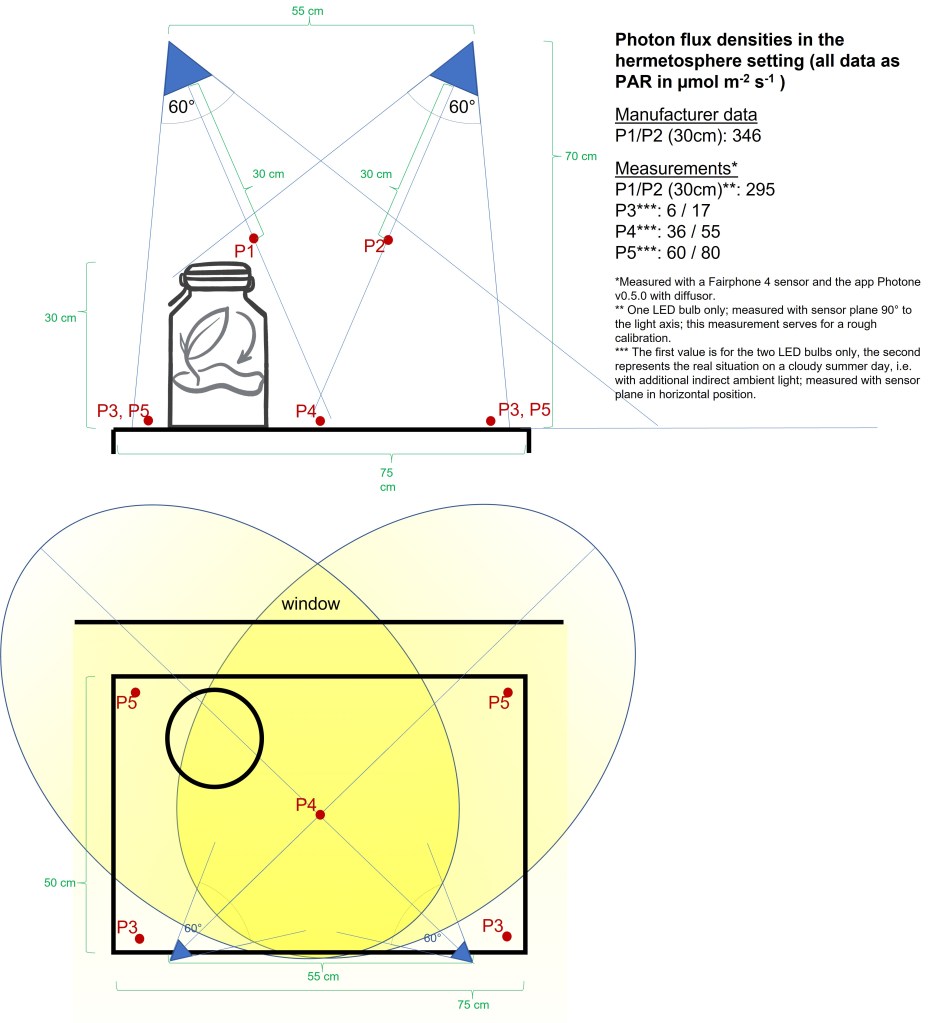
Under this setting, the following can be said about the quality of light outside of the glass containers:
1. Intensity: Roughly speaking, half of the light comes from the two LED lamps and half from indirect sunlight through the window. The light intensity varies between 10 and 100 µmol m-2 s-1 depending on the time of day and position on the shelf. Direct sunlight is avoided at all times, as it would quickly increase the temperatures inside the glass containers excessively.
2. Spectral composition: The spectral composition of the LED light is specified by the manufacturer as follows.
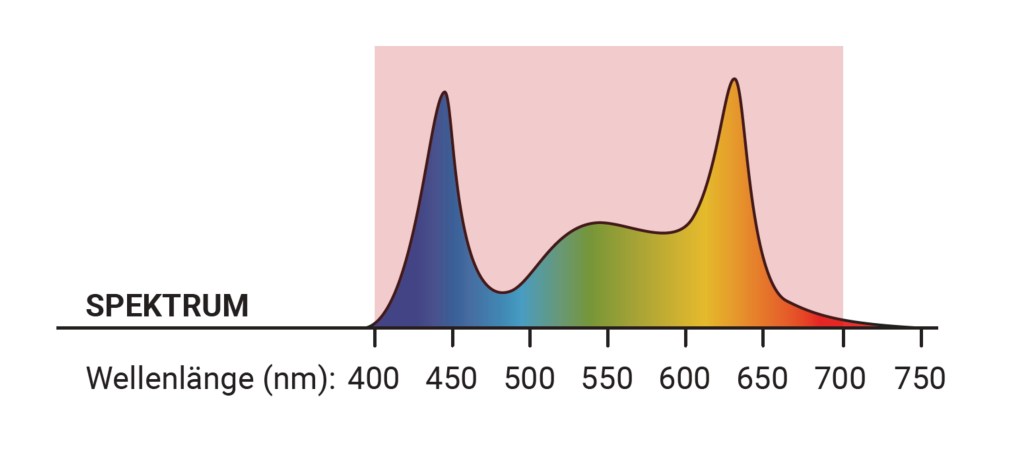
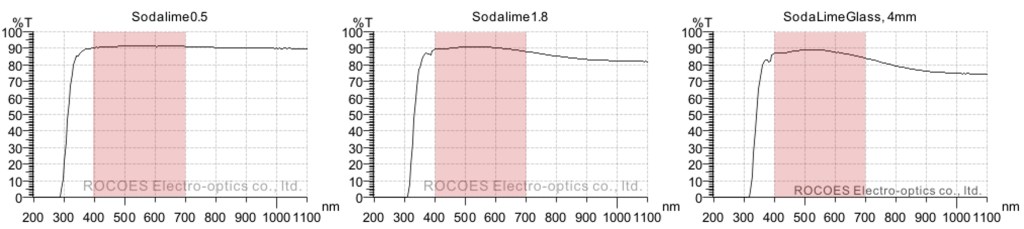
The spectral composition of the proportion of natural light is determined by the spectrum of shade light (see figure above) and the transmission spectrum of window glass. The figure below shows the transmission spectrum of soda-lime glass of different thickness. In the photosynthetically active range (PAR) the glass is very well transparent, in the UV range only partially for the long-wave UV-A radiation, and in the infrared range slightly less than in the PAR range.
3. Duration: The proportion of natural light follows the seasonal changes in day length given by the geographical location in the northern hemisphere, i.e. between 8 hours (December 21) and 15 hours (June 21); the LED light is regulated to 12 hours all year round by timer.
D. Assuming that the same light conditions prevail inside the glasses as outside, the following conclusions for my hermetosphere setting can be drawn from the above considerations:
- Given that my hermetosphere plants are understorey herbs and epiphytes of tropical forests, I assume that the optimal light intensity (in µmol m-2 s-1) ranges between the typical light compensation and light saturation points of these plants, i.e., between 5 – 25 (minimum) and 30 – 100 (maximum). Using two 18 W LEDs positioned as shown above, light intensities are within this range and close to the intensities measured in the natural habitats of these plants (about 23 for forest understory, see above). On cloudy winter days (which are quite common at my place), the natural light alone is probably insufficient because the light compensation points of some plants are not reached.
- Damage to plants due to excessive exposure to UV radiation is not to be feared.
- If some of my plants are significantly regulated (e.g. in regard to flowering) by the ratio between red and infrared light or by the length of the photoperiod, it could be that they behave differently in my setting than in their natural environment.
- Understorey herbs and epiphytes of tropical forests actually seem like a good choice with respect to the given light situation.
On 7 November 2025, a minor addition was made to the article.


5 responses to “Light conditions”
[…] With certain limitations, we consider hermetospheres as closed systems. To get closer to the goal of long-term stability of this system, it is important to understand the conditions and processes within the system. They depend on the initial situation and on external factors such as temperature or light. With this in mind, this article begins a three-part series discussing water conditions, nutrient conditions, and light conditions. […]
LikeLike
[…] direct sunlight is transmitted through gaps in the canopy, resulting in sunflecks (cf. a previous post). These short-time high light intensities can be especially damaging to plants whose photosynthesis […]
LikeLike
[…] First, the plant is a shade adapted plant and these usually do not show etiolation. Second, the light intensity for my containers varies between 10 and 100 µmol m-2 s-1 depending on the time of day, which should be sufficient […]
LikeLike
[…] S. erythropus is described and illustrated as green on the upper side (adaxial) of the shoot and reddish on the underside (abaxial) (e.g. Sheue e.a. 2007: fig. 1). However, the variation in colouration appears to be quite large in nature (cf. iNaturalist_2025c). It has been described for various Selaginella species that at higher light intensities, the green colouration ‘bleaches out’ and red pigments are formed instead (Goodwin 1980: 204). I therefore attribute the reddish colouring on both sides of the plants in my containers (see the picture above) to the light conditions. […]
LikeLike
[…] initial setup was the same that worked fine with other containers for years: substrate, moisture, light, all based on sound […]
LikeLike