The title of his article can be understood in two ways. If you have read my [About], you know that my goal in dealing with hermetospheres is to design miniature systems in which each plant reproduces over several generations. With this post, I begin a series of successful examples of second or third generation plants in hermetospheres.
Furthermore, the concept of “succeeding generations” or “future generations” (Brundtland 2009) is relevant today because our societies are currently in the process of destroying the foundations of live for future generations of humans. Among the many threats, biodiversity loss and climate change are perhaps the greatest challenges. Can engaging with hermetospheres be meaningful in terms of a sustainable future for men? If anything, it is this: Getting a sense of how biological systems can become unbalanced, so that an initial diversity of organisms becomes a monoculture with only one surviving species. Once we have this experience, we should immediately stop interfering with natural ecosystems that have taken millions of years to develop a balanced diversity.
A 5l container representing Myanmar was started with two shoots of Biophytum sensitivum, one slightly smaller than the other. The other plants consisted of Bulbophyllum oblongum, Pyrrosia nummularifolia and Ficus punctata. After several weeks, the larger shoot of B. sensitivum began a period of intense flowering and seed formation. By means of an active mechanism in the seed capsule (Boesewinkel and Bouman 1995: 17), the ripe seeds were ejected and distributed all over the container and immediately began to germinate. Over the next months several of the seedlings developed into plantlets of a second generation (see below).
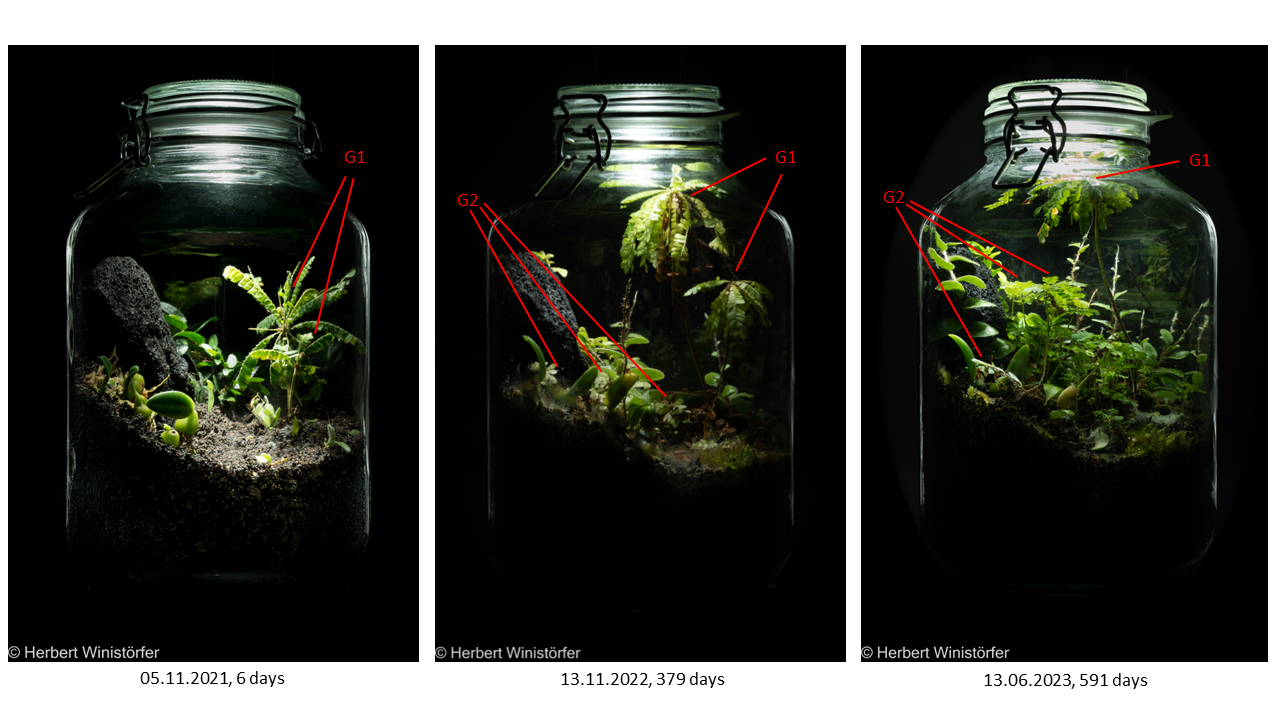
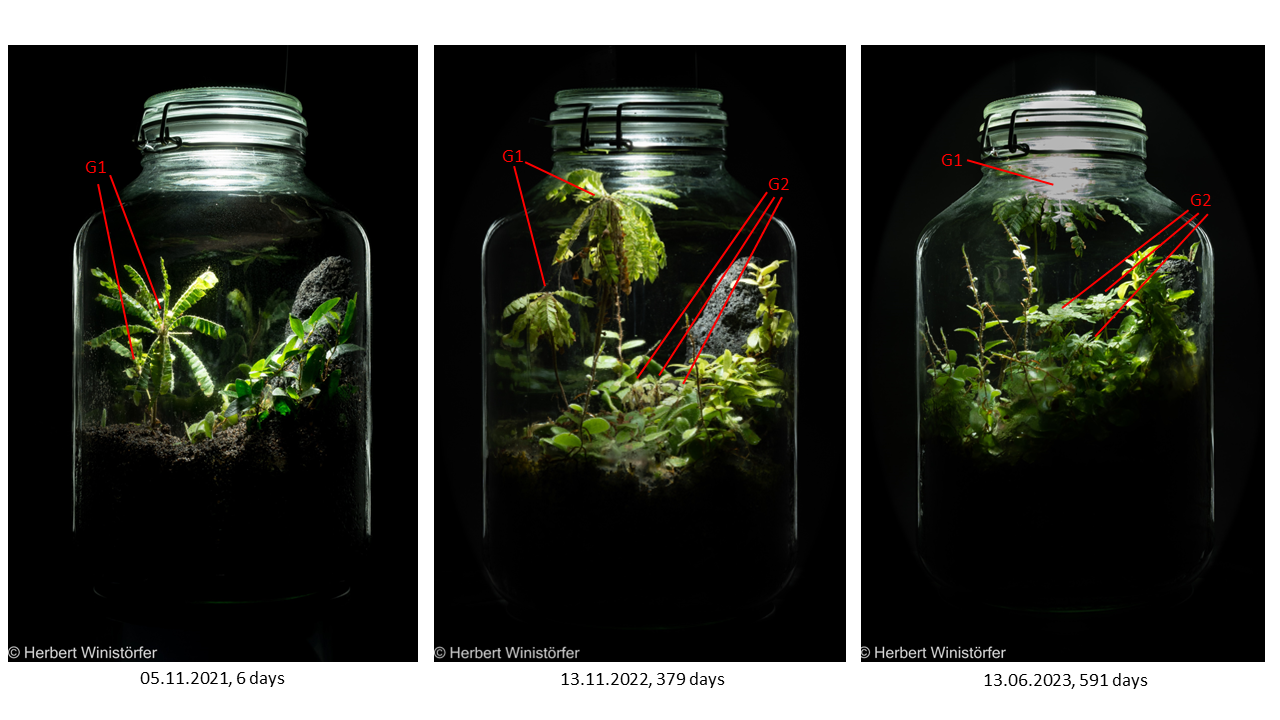
The way the container looks today, further generations of Biophytum sensitivum can be expected.


One response to “Succeeding generations (1): Biophytum sensitivum”
[…] been able to observe and describe two different kinds of second generation plants: Production of seed through self-pollination and spontaneous formation of ‘leaf cuttings’. The terrestrial […]
LikeLike