When creating and observing hermetospheres, I focus on plant life. However, one must be prepared to encounter unexpected guests. This is what happened to me once before, when a whole container was overgrown with a fungus within a few hours. With the latest guest, I got to know an entire new and extraordinary life form.
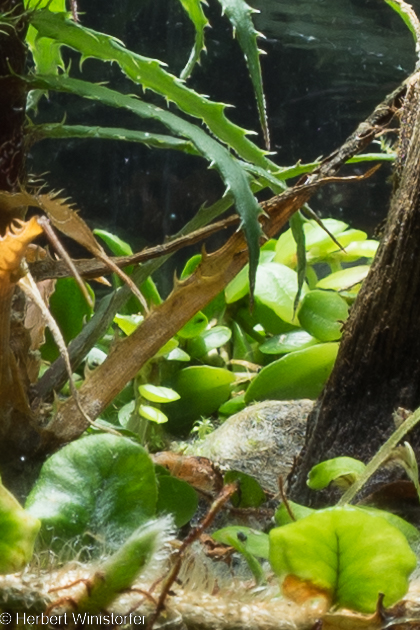
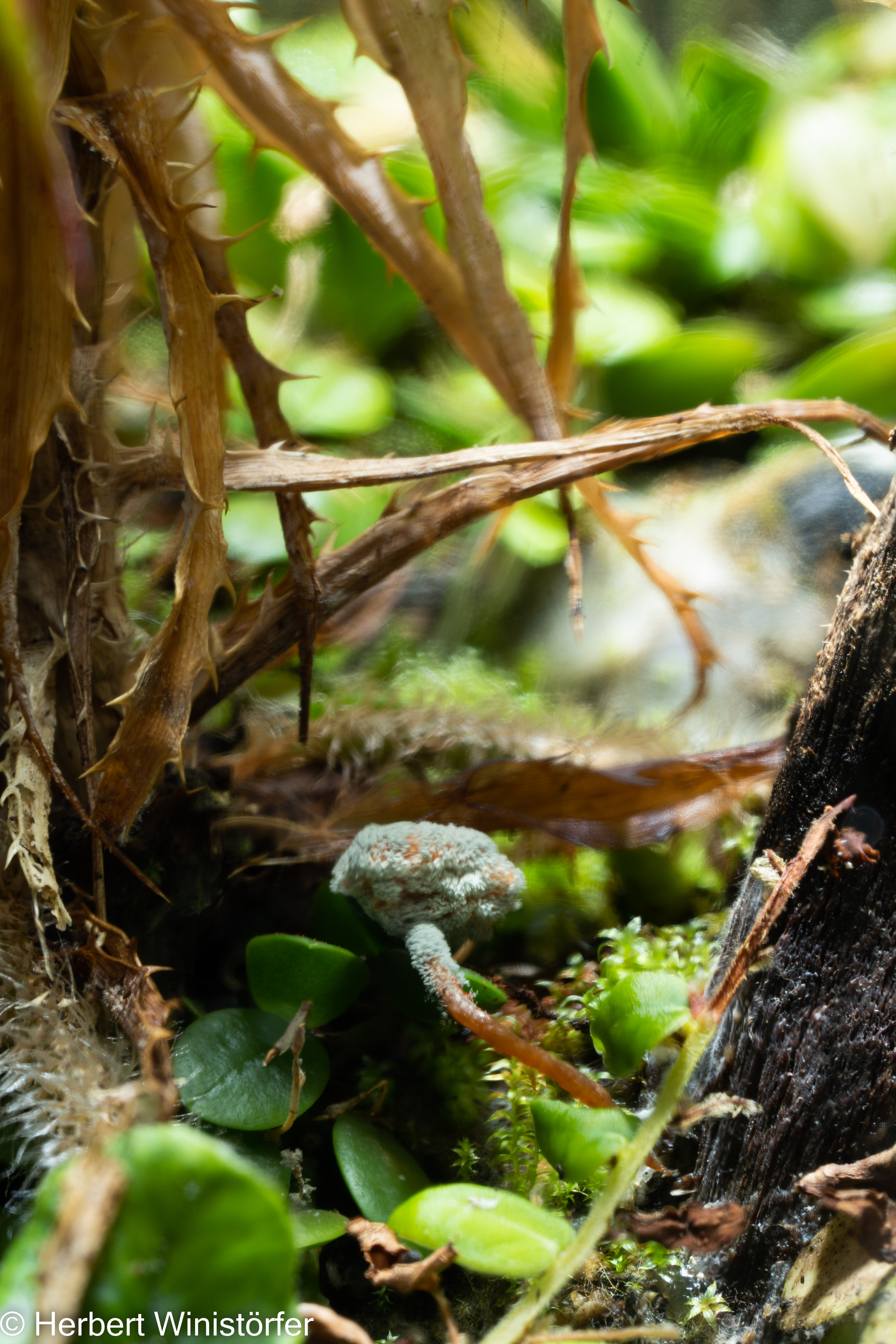
It began when I discovered a structure (image “after”; lower part, center), apparently growing from a piece of mangrove wood, in my Brazil Southeast jar. I was unable to link the new structure with either of the plants I had started the jar with:
- A bromeliad (Rokautskyia microglazioui), the dry leaves on the left side of the images
- A fern (Microgramma vaccinifolia), the hairy rhizome with oval fronds visible in the foreground of the images
- A miniature, creeping orchid (Barbosella cogniauxiana), visible in the background (image “before”)
- A small Margcravia, visible in the bottom right part of the images
- Two small bladderworts meanwhile extinct in the jar
The new structure had a stalk (15-20 mm long) and a head (7-8 mm in diameter) like a miniature mushroom, but no lamellae. The upper part of the stalk and the head were covered with a blueish-grey powder – spores? Confronted with the picture, two experts confirmed it was a fruiting body (sporangium) of a slime mould (Myxomycetes), colonized, in the upper part, by some kind of mould. When I dived into the virtual world of Myxomycetes, I discovered a new miniature world of breathtaking beauty. Following are two examples of slime moulds to show the analogy to the structure in my jar.
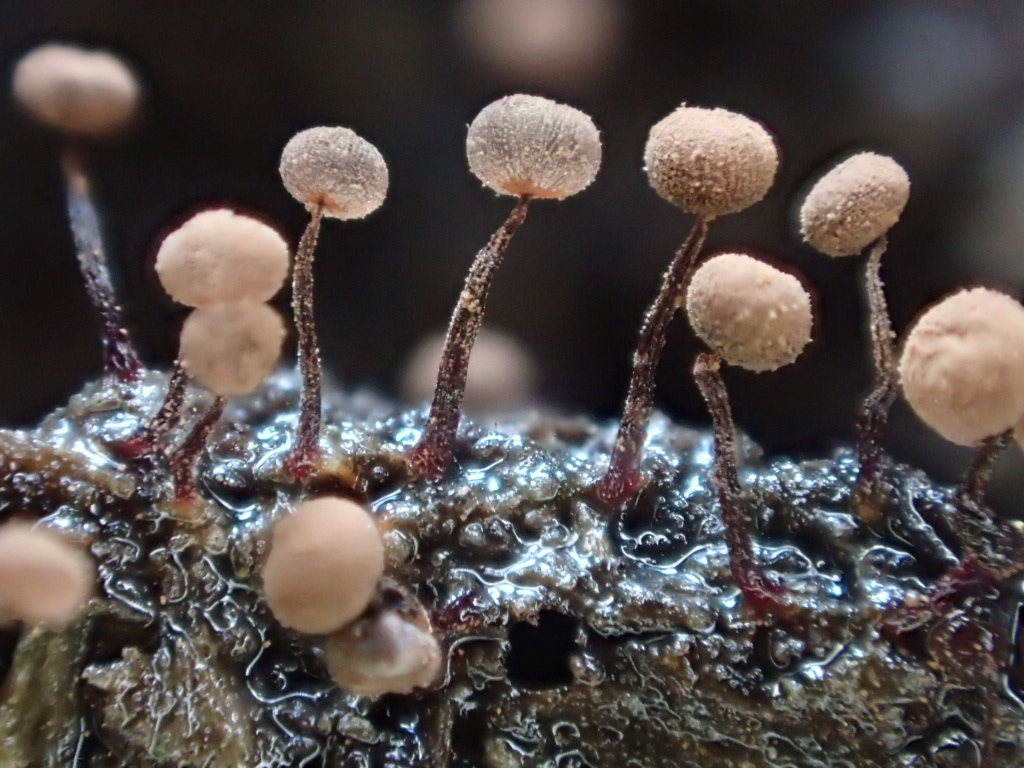
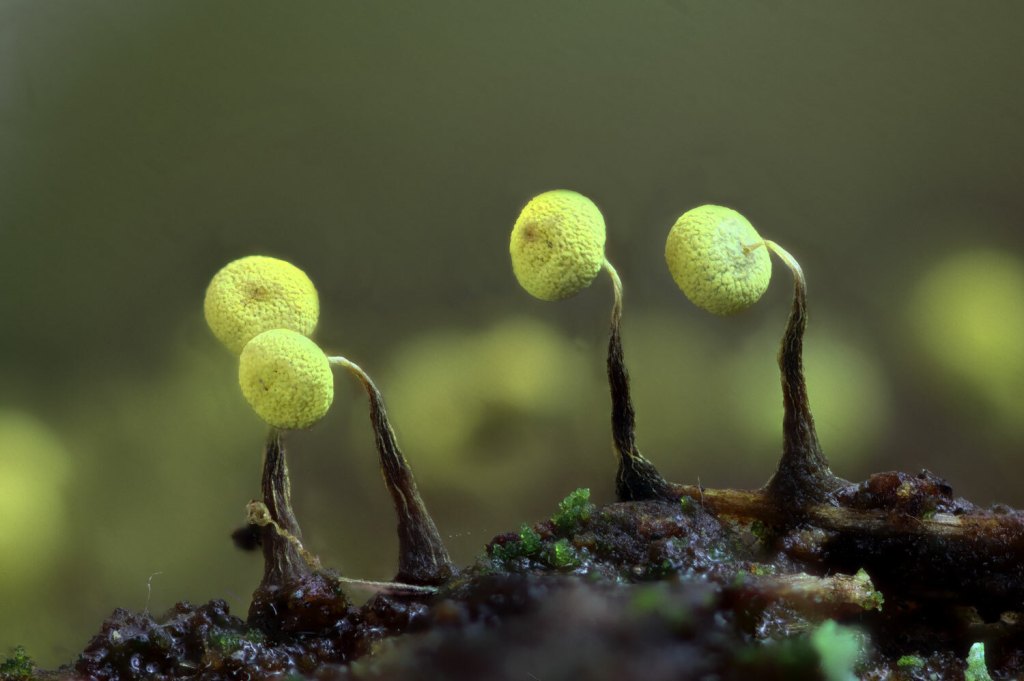
Because of their extraordinary biology, Myxomycetes have been classified with the animal kingdom as well as with fungi in the past (Lado and Eliasson 2022). Their unique life cycle has been nicely described by Marion Geib who has published an excellent identification guide for slime moulds of the eastern Saarland region, Germany (Geib 2021):
“They are born as small, almost invisible amoeba-like creatures, also move around like them and mate sexually. Subsequently, they develop as a single large plasma mass (plasmodium) with millions of cell nuclei that divide again and again synchronously and thus grow exponentially. Slime molds exist for life as the single-celled organisms they were born as.
As a slimy mass, they waft over moist substrate and have only one goal: to feed and grow. Everything organic is welcome here: Bacteria, protozoa, fungi – even dead insects are sometimes not spurned. Popular habitats are decaying tree stumps or compost heaps and rotting leaves. Some myxomycetes extend over a few square centimeters in the plasmodial phase, others over half a square meter or more. […].
At some point, this cell deforms, gradually dries up, and surrounds the maturing spores. In the process, depending on the size of the plasmodium, a few to several thousand so-called fructifications are formed, which adhere firmly to the substrate with the dried residue of the plasmodium, and are now quite stationary, like plants. […]
At this stage, the slime molds contribute to their reproduction with spores. These then give rise again to the unicellular amoebae – the next generation in slime mold life.”
 Hermetospheres
2 responses to “Unexpected guest”
Spannend!
LikeLike
Toll, was man entdeckt, wenn man den Pilz nicht nur als Störenfried abtut, sondern seine Besonderheiten zu studieren beginnt. Macht Spaß.
LikeLike