The “little tree plant” (Biophytum sensitivum) is very popular among terrarium hobbyists. Its natural habitat are wet lands of tropical India and South-East Asia, where it grows in the shades of trees and shrubs, in grass lands at low and medium altitudes (Sakthivel and Guruvayoorappan 2012). It looks like a miniature palm tree, is perennial, self-pollinating and only occasionally grows higher than 25cm. So it stands to reason to use it in hermetospheres. Indeed, it does very well in my Myanmar container. After a first blooming period, leaves turned yellow and I dreaded losing it. After a while, new leaves have grown at the vegetation point. But there is much more to this plant.
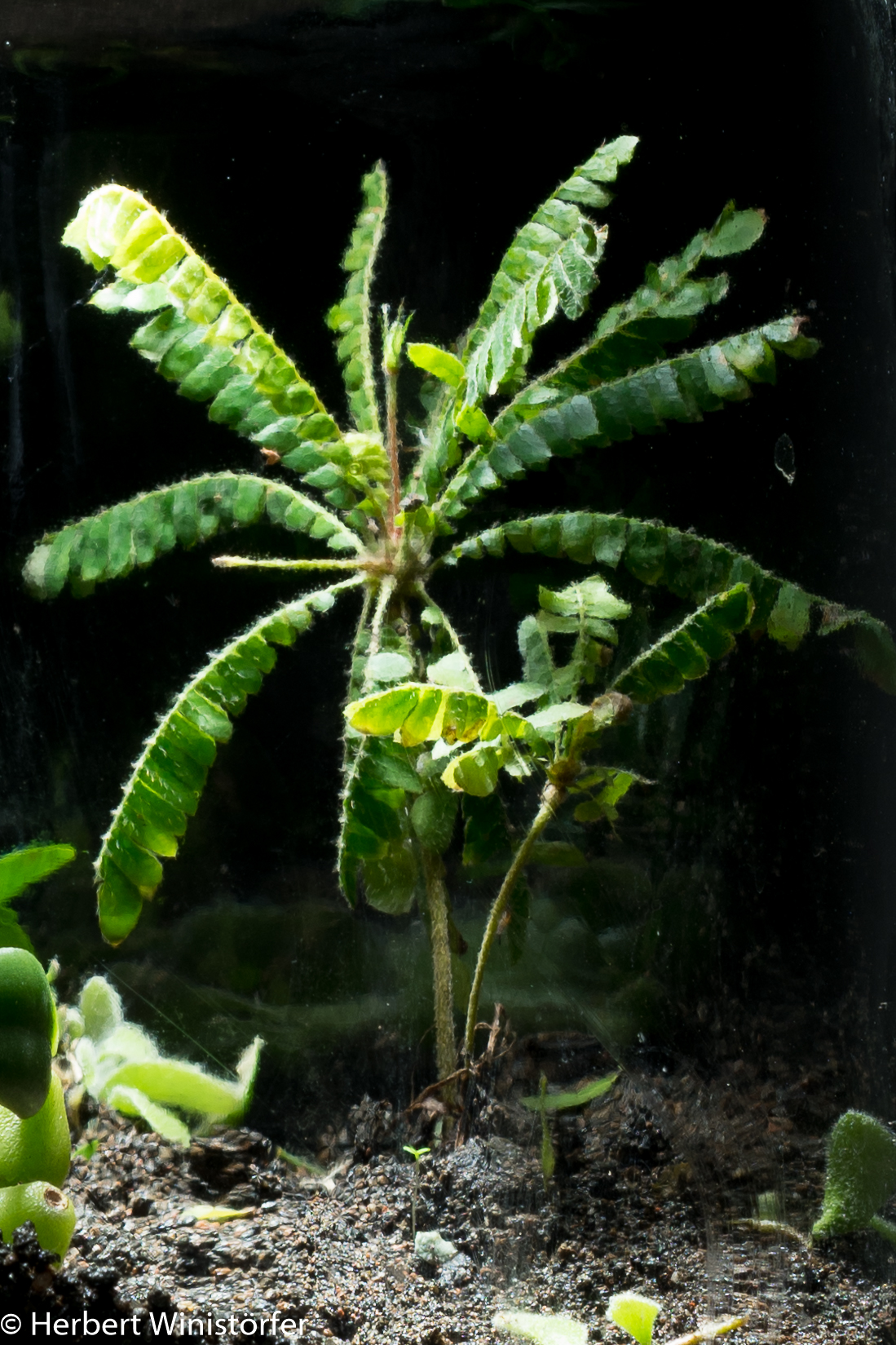
Plants usually do not show active movement, at least not independent from growth and reversible. However, some have developed stunning movement abilities. One of the rather well understood mechanisms is the leaflet movement of Mimosa pudica and Biophytum sensitivum. Although from different families and thus not closely related, the movement in both plants is based on the same structures and processes. Therefore, it is likely that we see an example of convergent evolution.
The movement is triggered by vibration or touch (seismonastic or thigmonastic). Sensors of mechanical perturbation are located in each individual leaflet. At the junction between leaf axis (rhachis) and leaflets (pinnules), specialized tissue contains cells that are able to change their internal pressure (turgor) by active transport of ions across membranes. The leaflets touched bend downward within 1 to 2 seconds. Excitation of the individual sensors appears contagious; it spreads to untouched leaflets close by and even at some distance. This means that signal transduction from leaflet to leaflet must happen. (Koller 2011)
This is the moment when Jagadish Chandra Bose (1858-1937) must be mentioned. He did exceptional work on signal transduction in plants, some of which with Biophytum sensitivum (Bose 1913). Bose was a world-renowned physicist and biologist and a pioneer in radio communication and plant biophysics. His findings on plant nervous system were so revolutionary at the time of their proclamation that these aroused disbelief and contradiction. More than a hundred years later, recent advances in molecular biology, genomics, ecology and neurophysiology have led to renewed interest resulting in a flurry of activity, confirming most of Bose’s observations. Born in British India, Bose was confronted with racial discrimination and fought it successfully. He was paid less than the British professors and was frequently denied funding and laboratory space. He was finally knighted in 1917 and elected to fellowship in the Royal Society in 1920. (American Institute of Physics 2017)
Although the basics of the leaflet movement described have been known for a long time, one key question still remains open: Knowing that the movement requires significant amounts of energy (Bao e.a. 2018), what is its evolutionary advantage for the plants? One of many explanations discussed is that the rapid closure of leaves might render the plant less obvious and, therefore, less appetizing to large herbivores (Minorsky 2019). However, no convincing evidence could be found for any of the hypotheses so far.
 Hermetospheres
2 responses to “Plant on the move”
Hi Herbie another facinating description of plant biology and bringing the scientist Bose made me remember my months of postdoc work in Calcuta at the Bose institute and yes I remember having visited the museum and seeing the instruments that Bose used for measuring movement in plants. Interesting at that time and even today reading again about his research. Not only plants react but he also did work with metals and showed that there are similar reactions as with biological organisms. Everything is somehow alife and reacts to external stimuli even when we think that it is innert and not alife. But when we walk outdoors we think that it is only the plants which are alife but stones are probably also charged with energy and in some form also alife. Thanks for sharing!
LikeLike
[…] 5l container representing Myanmar was started with two shoots of Biophytum sensitivum, one slightly smaller than the other. The other plants consisted of Bulbophyllum oblongum, Pyrrosia […]
LikeLike