Find out how the fern Selliguea metacoela is doing in the closed terrarium and how the fern genus got its name.
Selliguea is a fern genus with roughly 130 species, all native to the (sub)tropical zones of Southeast Asia (Kew 2026). The genus belongs to the Polypodiaceae, one of the most species-rich fern families worldwide.
Few Selliguea species are commonly traded, among them S. albidosquamata, S. feei, S. rhynchophylla and S. metacoela. The fern I purchased was labelled S. metacoela, and there is a good chance that this identification is correct. According to Hovenkamp (1998: 92), S. metacoela is “An easily recognised species, which can only be confused with Selliguea rigida. The latter is generally more stiff, with stiff, thick rhizome scales, an extremely thick, coriaceous lamina, and distinctly sunken coenosori.” To be fully confident of the identification, fertile fronds would have to be examined.
Some might find this fern unspectacular, but I like the clear shape of the fronds with their slightly thickened margins (see the picture below).
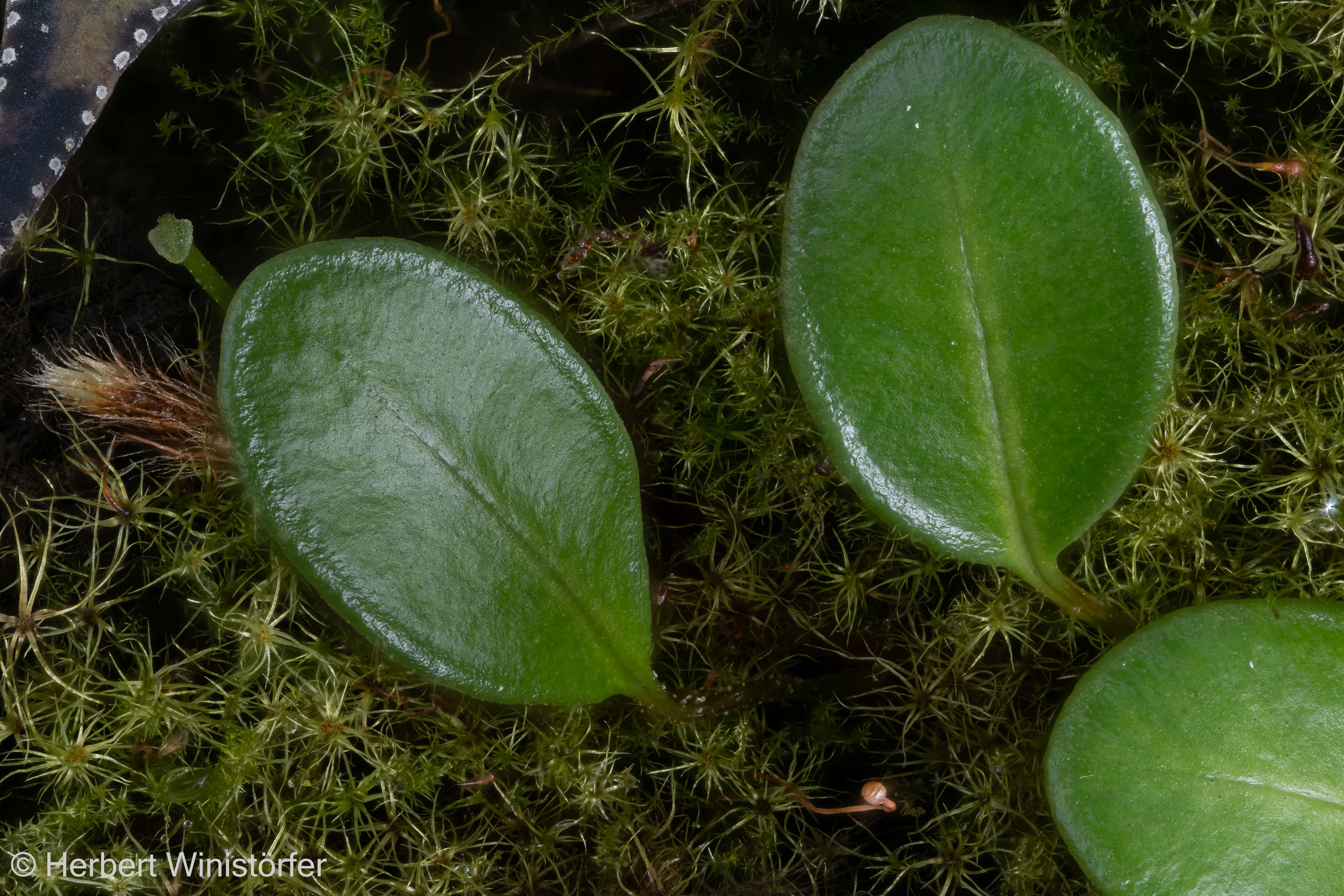
What I received was a piece of rhizome with 3-4 fronds. I placed it in a container of five litres together with Ludisia discolor and Selliguea albidosquamata. Over the course of 1.5 years the rhizome grew about 12 cm and produced 7 to 8 new fronds. This relatively slow growth and its low demands in terms of growing conditions makes this fern a perfect choice for hermetospheres.
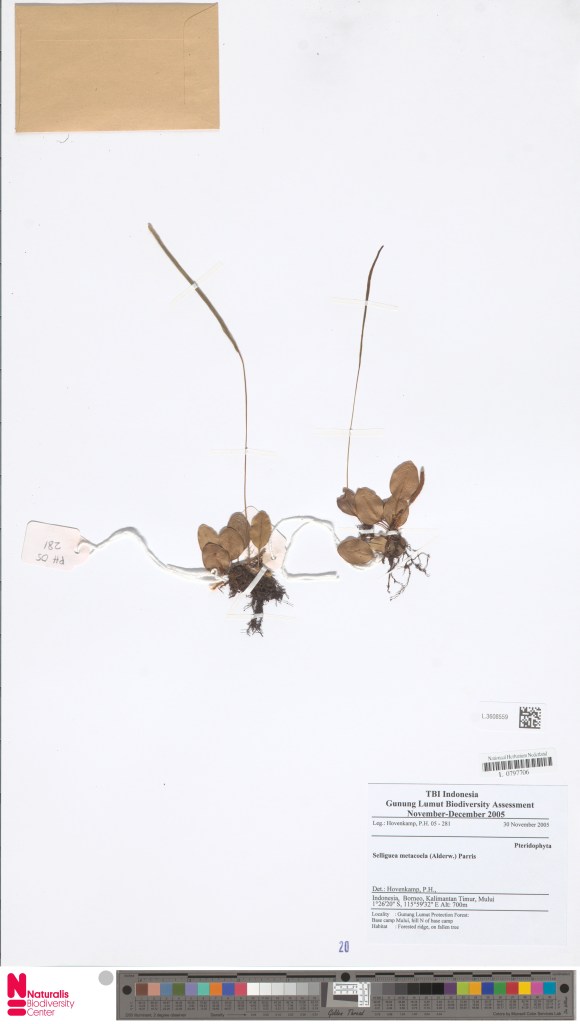
Unfortunately, the fern has not yet produced any fertile fronds, which are so clearly distinct from the sterile ones. Fertile fronds are up to 19 cm long (stipe & lamina; Hovenkamp 1998: 90ff.) and very narrow, with two rows of sori. See the picture below of a herbarium specimen with fertile fronds.
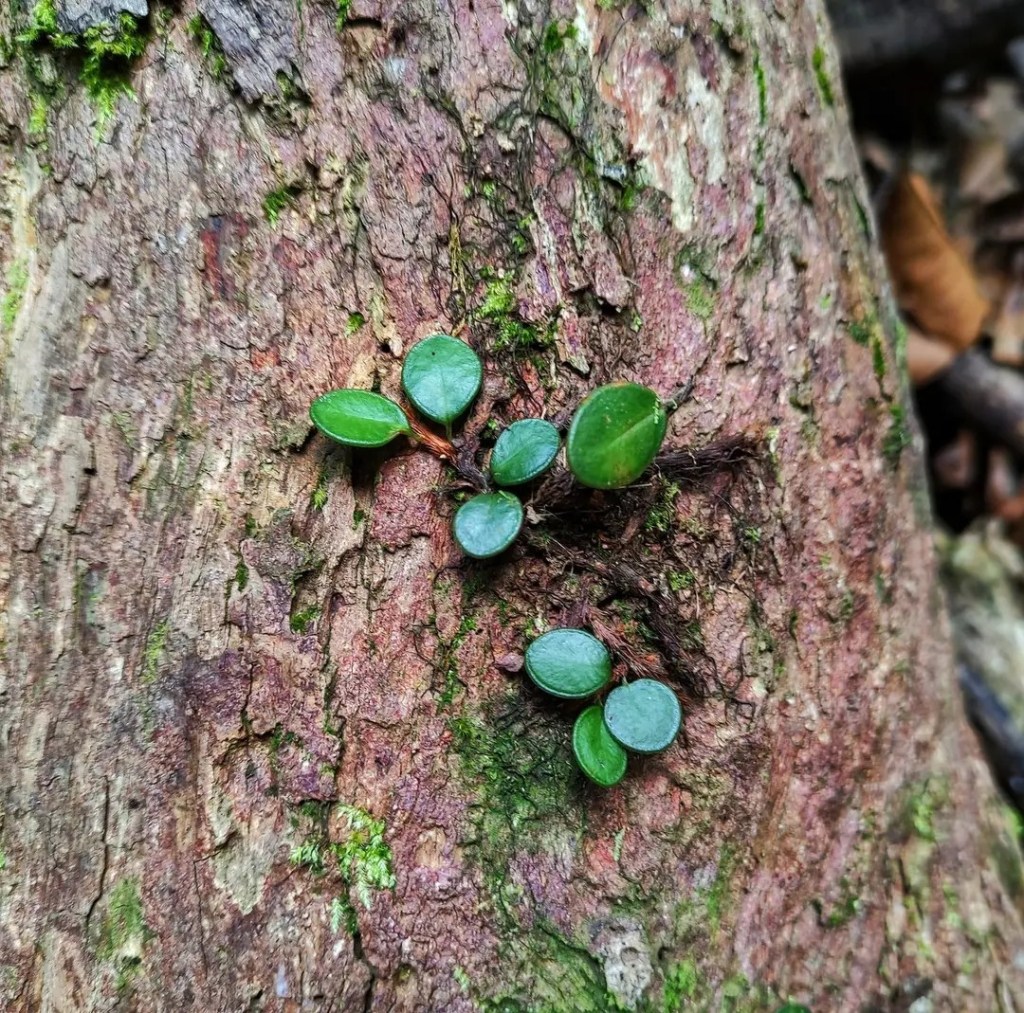
According to labels on herbarium species, the natural habitat of S. metacoela are wet tropical forests at altitudes of up to 500 m where it lives as an epiphyte on tree trunks and branches, on fallen wood or as epilithe on muddy rocks (see the picture below of a plant in-situ).
The genus Selliguea was introduced in 1824 by Jean-Baptiste Bory de Saint-Vincent (1778-1846) as the main editor of the Dictionnaire classique d’histoire naturelle as well as author of the chapter on ferns where he proposed the new genus. The origin of its name holds a remarkable story: “It is to the sagacious inventor of the finest microscopes that we dedicate this beautiful genre […]” (Bory 1824: 587). The engineer honoured in this way is Alexandre François Selligue (1784-1845). His name was in fact Alexandre François Gilles, but he used Selligue as an anagram of Gilles. Selligue’s key innovation lay in arranging a series of several achromatic lenses to achieve higher magnification without significant distortion. To put this innovation into practice, he needed the help of two opticians, Vincent and Charles Chevalier (father and son), but later ‘forgot’ to mention their contribution to the invention (Stevenson 2025).
 Hermetospheres