Usually, when I place a new plant in a new hermetosphere, I want to know its identification down to species level. I have several reasons for this. In most cases, identifying the species is a prerequisite for obtaining information about its natural habitat. This information is helpful to assess whether or not a plant is suitable for the closed container. In addition, reliable identification is often an indication that a plant is well established in cultivation. Conversely, poached tropical plants are often offered for sale without identification and under fantasy names.
When I acquired this plant, it was labelled Acanthaceae spec. ‚Kalimantan‘. The same plant was offered by traders under the names Argostemma spec. ‚Borneo‘ or Cosmianthemum spec. ‚Borneo‘. It is unusual among serious growers that not even the genus of a plant is identified with any degree of reliability. Here however, I disregarded my own principle because a) I trust my nursery to only offer plants propagated by itself, because b) reports on the obviously same plant showed that it should be easy to grow in a terrarium, and because c) I couldn’t resist the dark, reddish-brown leaves with their distinctive ribbed surface. It was only much later that I understood that the peculiar namelessness of the plant was no coincidence.
Planted in the hermetosphere, the new acquisition soon proved that it was ideally suited for the purpose. Within months it produced shoots with a dense cover of short, white hair, new pairs of leaves, and long, thin inflorescences with numerous tiny white flowers.
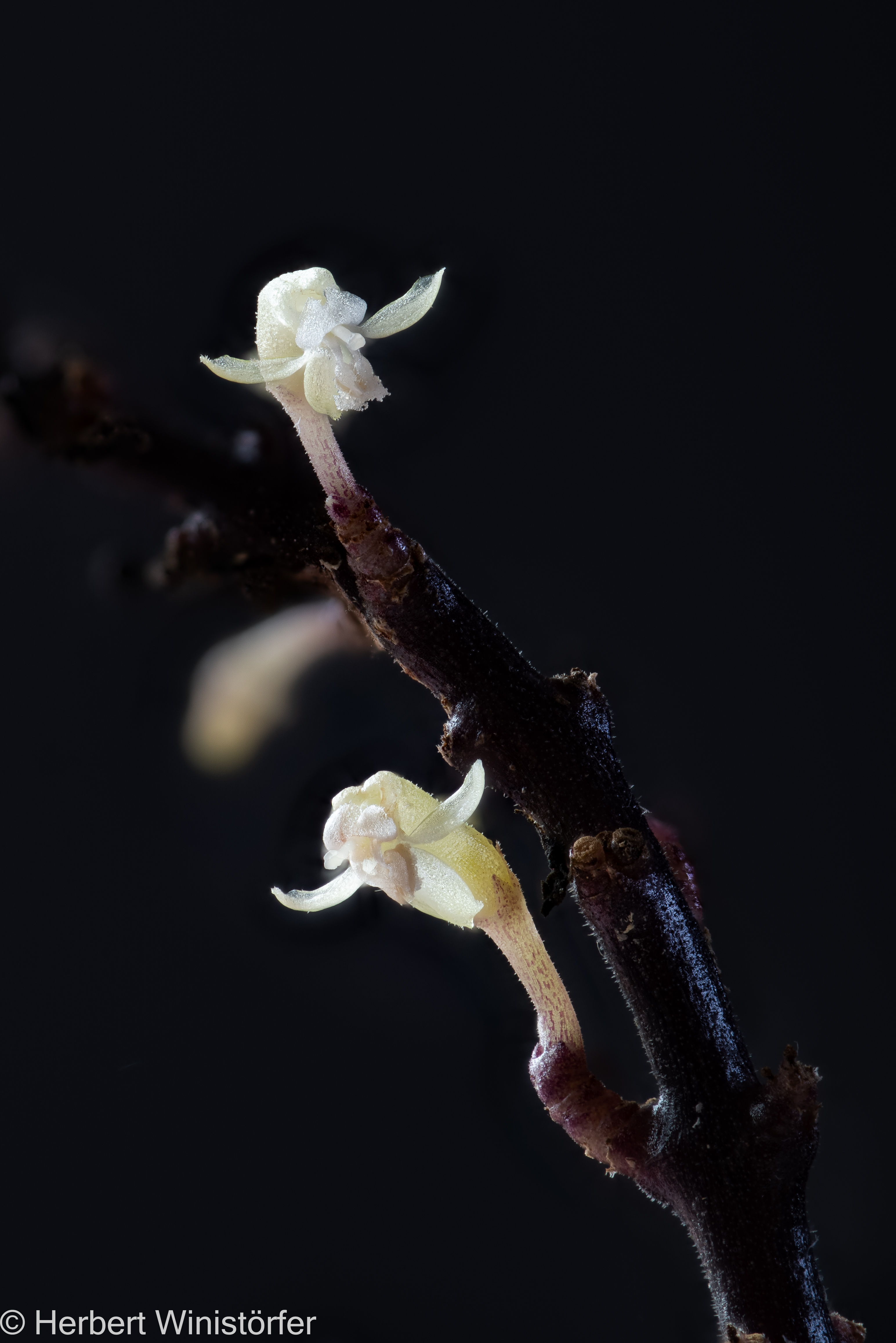
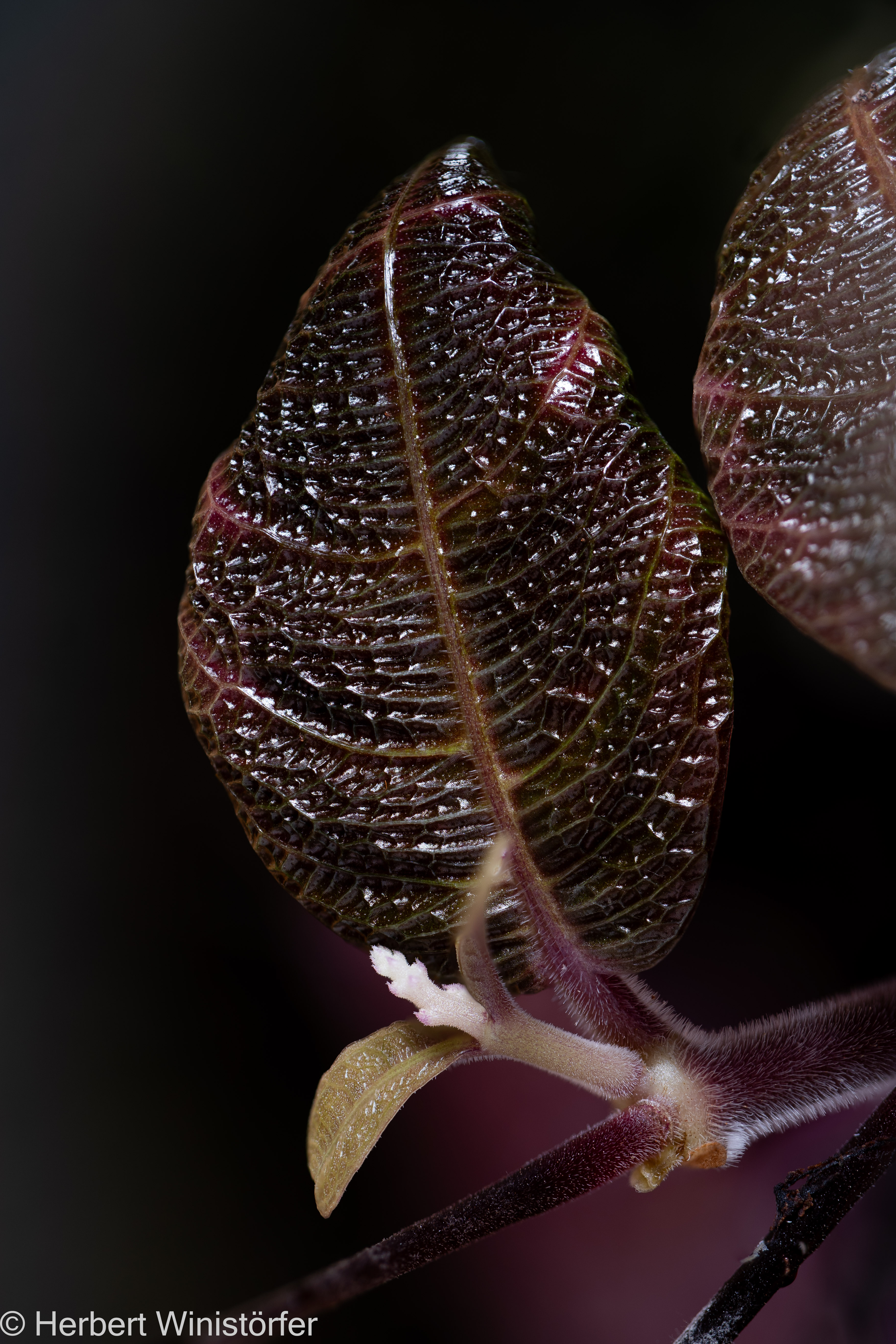
The picture below gives a good impression of the plant’s habit.

With 5.598 accepted species as per December 2023 (based on data published in Moonlight e.a. 2024), Acanthaceae are among the 14 most species-rich families of flowering plants worldwide. The majority of species are herbs native to the tropical and subtropical regions around the aequator. The extraordinary diversity of growth forms and flower shapes makes the family fascinating but also challenging for those who study it. This is because similar characteristics have often developed in only distantly related lineages (Manzitto-Tripp e.a. 2022: 107). These difficulties are likely to be among the reasons why, as the authors lament, only a few taxonomists are studying this plant family:
“Since the 19th century, there has been only one reclassification of the family. Scotland & Vollesen (2000) treated a total of 221 genera, […]. […]. Since this landmark recircumscription, extensive new knowledge, […], has accumulated […]. […]. Despite the high species richness and a nearly worldwide distribution, surprisingly few professional botanists are actively pursuing and publishing new phylogenetic and taxonomic knowledge in Acanthaceae. Tripp & Darbyshire (2017) lamented this low ‘scholars to species’ ratio and estimated fewer than 20 such individuals worldwide, of whom ~12 are providing regular contributions. This disparity contributed to the placement of Acanthaceae among the worst offenders in an angiosperm-wide synthesis of remaining knowledge gaps, thus challenging full achievement of ‘Targets’ put forward in the Global Strategy for Plant Conservation (Paton & al., 2008).” (Manzitto-Tripp e.a. 2022, p. 107)
Would it be possible for an amateur like me to identify at least the genus of my plant most probably native to Borneo? Manzitto-Tripp e.a. (2022, p. 120ff.) provide detailed dichotomous keys for this very purpose. The distinct form of leaves and flowers as can be seen in two of the pictures above chould be helpful, so I thought: On a close look at the flower, I can recognize a tubular calyx with short lobes, yellowish-white with red spots; a white, tubular corolla whose lobes form an upper and a lower lip and maybe what the key in Manzitto-Tripp e.a. (2022: 132) refers to as a pouch on the upside towards the end of the corolla tube (“a dorsal pouch distally”). However, I had to learn that without much more detail on ovary, pollen and seed morphology, the key can not provide a reliable result.
As far as the genus information provided by some retailers is concerned, Argostemma is definitely false, while Cosmianthemum could probably be correct. It seems we will have to wait until one of the few real experts on Acanthaceae takes a closer look at this plant and confirms an identification or, not unlikely, describes it as a species new to science.
 Hermetospheres