It is hard to imagine a plant more inconspicuous than Selaginella microphylla: tiny leaves on a uniform, branched shoot, monochromatic green, without flowers. Nevertheless, it was collected in 1801 or 1802 during an expedition through the rough wilderness of the northern Andes, carefully labelled, preserved, transported to the Pacific coast and shipped to Europe together with another estimated 70,000 plant specimens. This fact can be interpreted as an indication of how meticulously the two travelling naturalists Alexander von Humboldt (1769-1859) and Aimé Bonpland (1773-1858) proceeded on their expedition. Their collection was so vast that it was impossible for them to scientifically describe the objects themselves after their return. Instead, they commissioned Carl Sigismund Kunth (1788–1850) to process the plant specimens, who spent many years of his life on this task.

It was in 1816 when C.S. Kunth finally published his scientific description of the miniature spikemoss, based on the specimen below, under the name of Lycopodium microphyllum (Kunth 1816: 39), which was later changed to Selaginella microphylla. It is native to many countries of Central and South America and grows in the life zones of tropical dry forest to tropical moist forest and from lowlands up to altitudes of over 2,500 metres above sea level.

Like many other tropical spikemosses, S. microphylla thrives in the shady, humid and consistently warm conditions of hermetospheres. The shoots grow, branch out and readily form rhizophores, which they use to colonize new areas of substrate. Nevertheless, the plant is rarely traded; it seems that many plant lovers do not find it attractive enough. Rightly so? Make your own mind.

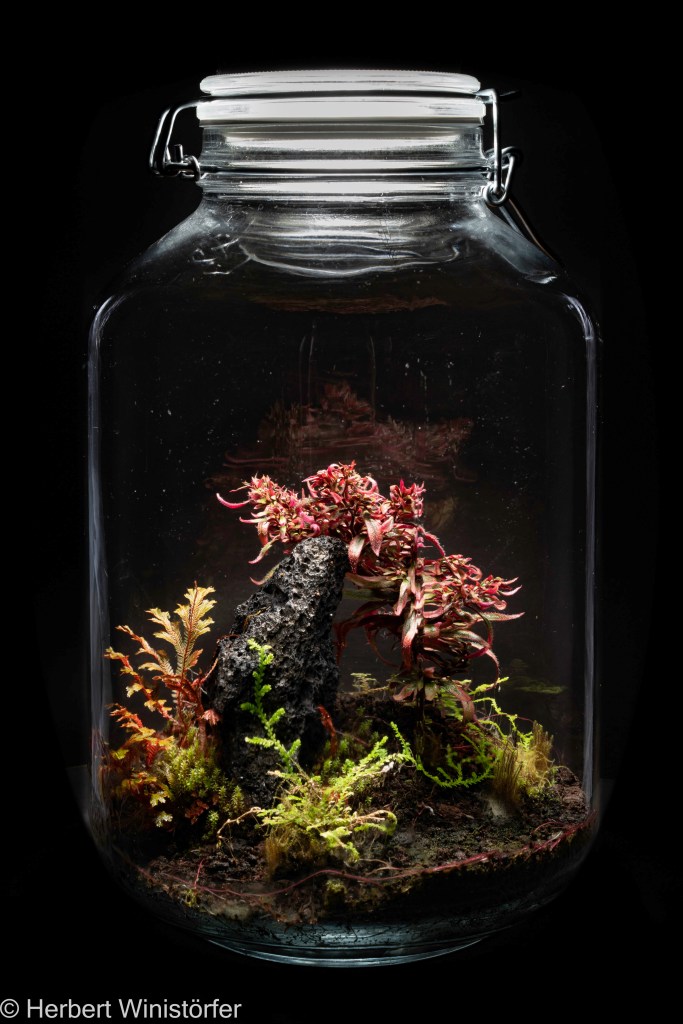
In hermetospheres with limited nutrient supply, S. microphylla is likely to gradually form a loose covering on the substrate without aggressively crowding out larger plants (see the example below).
If you like to learn more about the adventurous journey of the two famous naturalists Alexander von Humboldt & Aimé Bonpland and be thoroughly entertained, let me recommend the brilliant docufiction novel ‘Measuring the World’ by Daniel Kehlmann. You will enjoy it.
 Hermetospheres