In a previous post, I explained why I minimize the nutrient content in my hermetospheres and how I calculate how many nutrients I add to my substrate to start with. Even though nutrients are meant to be scarce, it can happen that a plant grows too tall or too wide for the container. The reasons may be that the plant naturally grows taller than I had assumed, that it grows taller under the conditions in the hermetosphere than in nature, or that despite everything there were more nutrients than necessary in the starting set-up. In this case, I intervene and cut the plant back to a size suitable for the container.
There are two options for the removed plant material: dispose of it or return it to the glass. If I want to further reduce the nutrient content of the glass, I dispose of the removed material. If, on the other hand, I want to retain the original nutrient content, for example because individual plants are showing signs of deficiency, I return the material to the jar. Let me show you an exemplary time line.
On 8 August 2023 a new container was planted with Strobilanthes sinuata, Anoectochilus setaceus, Bulbophyllum mutabile and Davallia parvula.
On 30 October 2023, 11 weeks after onset, a starter culture of tropical isopods and springtails was added as standard procedure.
On 6 December 2023, 16 weeks after onset, all plants appeared to have well established (see picture below).
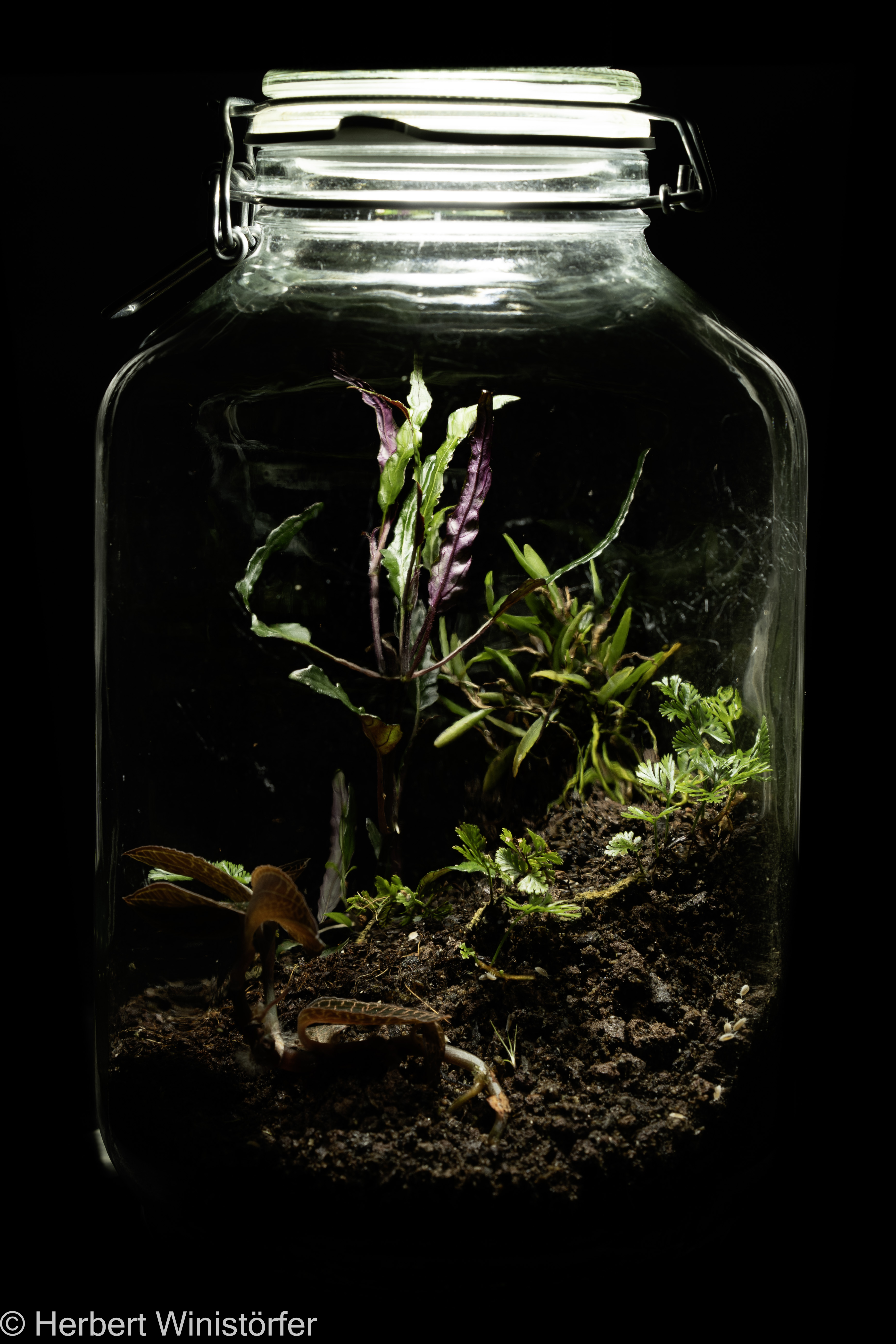
On 14 February 2024, six months after onset, the two tallest shoots of Strobilanthes sinuata had reached the lid of the container, were cut and removed.
On 25 May 2024 again, ten months after onset, the two tallest shoots of Strobilanthes sinuata had reached the lid of the container, were cut and removed (see picture below).
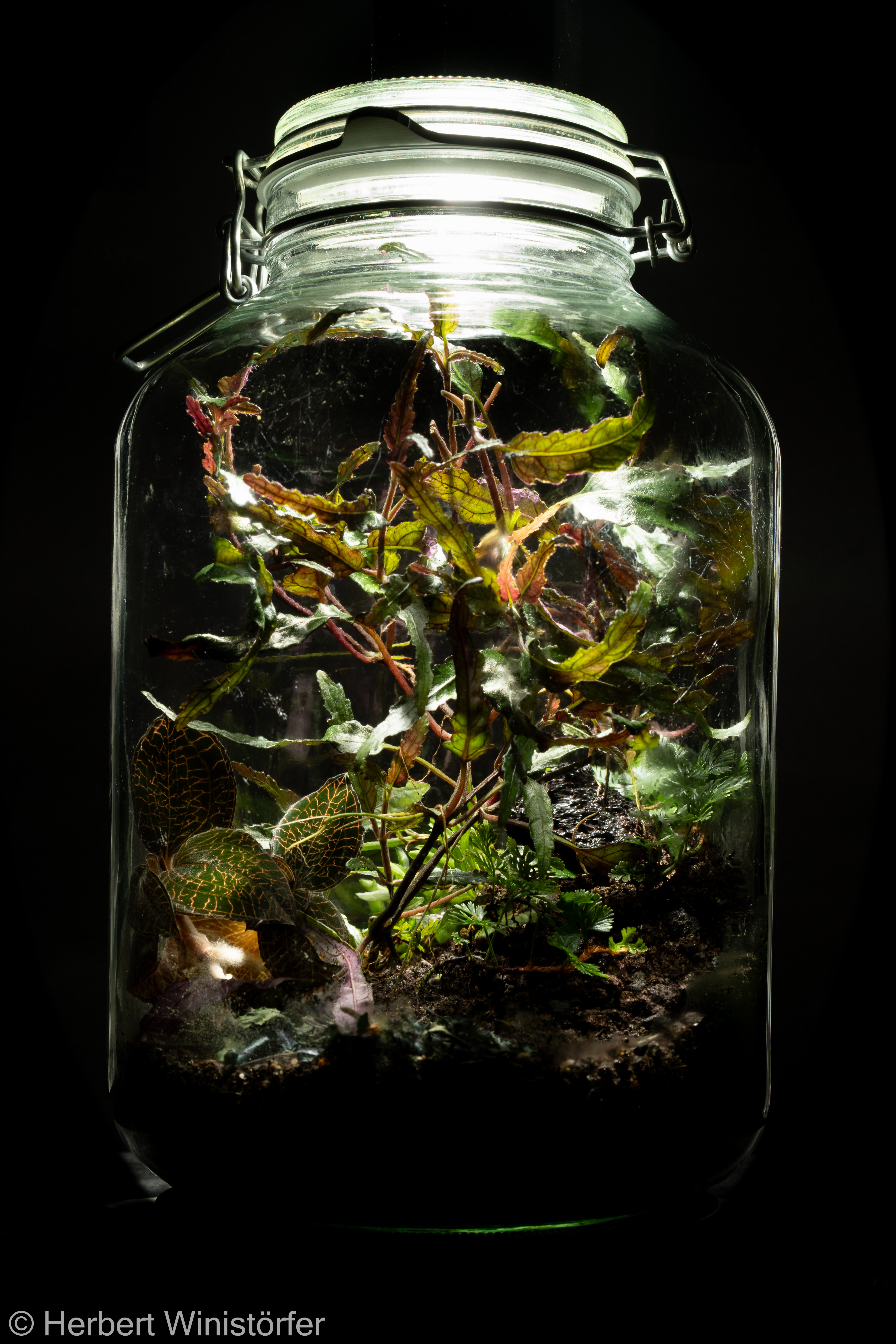
On 28 January 2025, 18 months after onset, Strobilanthes sinuata had grown massively and was cut back and dried.
On 30 January 2025, 1.7g of dried and ground plant material was given back onto the free surface of the substrate (see picture below).

On 20 February 2025, a massive workforce of isopods and springtails could be observed processing the dead plant material (see the video below, representing the area marked with a red frame in the picture above).
On 24 July 2025, the recycled plant material is no longer visible on the substrate surface. It has been completely decomposed and mineralized.
 Hermetospheres