When plants produce second and third generations is one of my best rewards from working with hermetospheres. Plants have several ways to do this, e.g. seeds or runners, and not always it is quite clear when a next generation actually begins. In the case of Begonia pteridoides shown here, the situation should be unambiguous.
Begonia pteridoides is closely related to Begonia bogneri, and both are native to the tropical part of Madagascar, on the Masoala Peninsula on the north-east coast of the island. Both have peculiar, long and very narrow leaves, and both can form underground tubers with which they survive unfavourable periods during which they lose their leaves and later sprout anew. Both have one characteristic in common with many begonias: they can be easily propagated with leaf cuttings. With these two species, it is usually sufficient to place a small piece of leaf on a moist surface for a new plant to emerge.

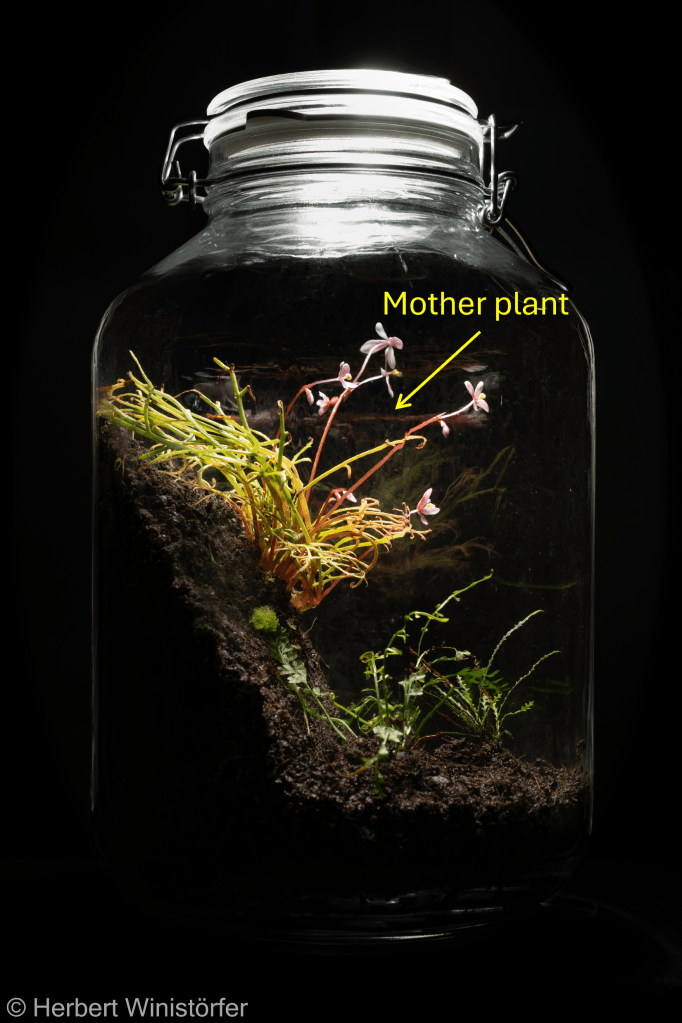
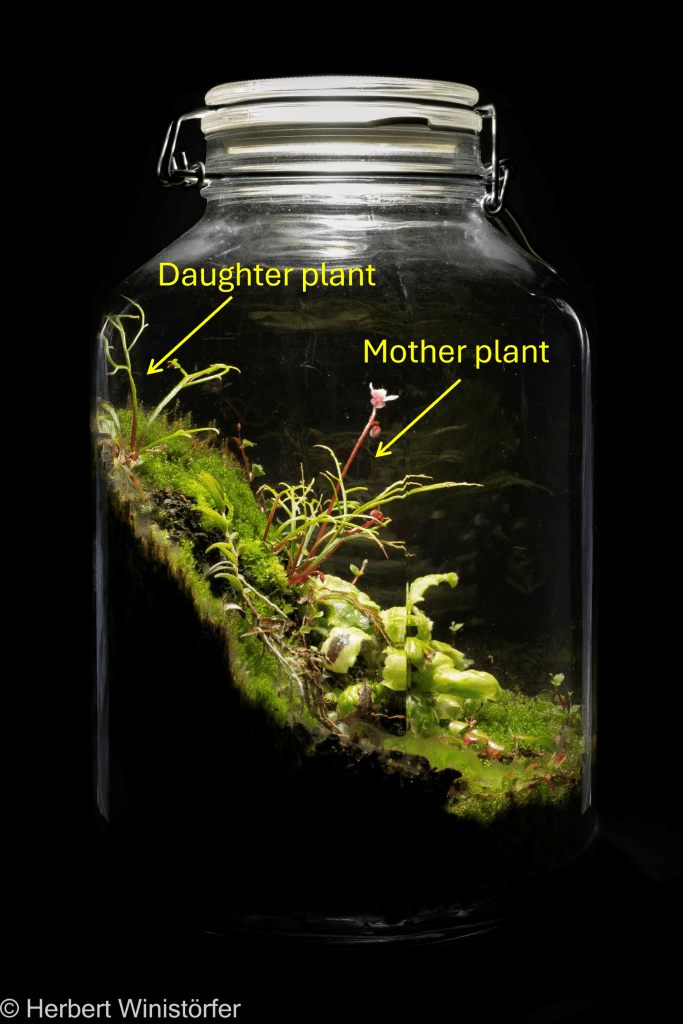
This is exactly what happened with the B. pteridoides I planted into a container of 5 litres inspired by the flora of Madagascar. After it had thrived and flowered, it lost its leaves. One of them remained lying on the substrate, and when I looked closely one day, a tiny plantlet had formed exactly where the substrate borders the inner glass wall and is presumably the wettest. I didn’t expect it to survive there, but it did. The picture below shows the container with mother and daughter plant.
And here is the 360° view of the container.
 Hermetospheres
One response to “Succeeding generations (2): Begonia pteridoides”
[…] generation plants: Production of seed through self-pollination and spontaneous formation of ‘leaf cuttings’. The terrestrial orchid Ludisia discolor has its own way of ensuring offspring in the absence of […]
LikeLike