The ‘jewel orchid’ Ludisia discolor is common in culture, and reports from fellow hermetosphere enthusiasts as well as the description of the orchid’s natural habitat made me confident that it would also thrive in the closed container: “Few lithophytic orchids are found in lowland evergreen forests. Normally the relatively rare orchids develop on acidic silicate rock outcrops that occur along canyons of montane streams and rivers. The following species often prefer these habitats within the lowland broad-leaved forests: […], Ludisia discolor, […].” (Averyanov 2003: 26)
My experience so far has proved me right; however, I can only report on a period of seven months, not enough for a reliable recommendation. During this period, the four original shoots of the Ludisia grew and developed new leaves and inflorescences (see the pair of pictures below). In the process, the shoots lost some of their stability and leaned towards the walls of the container. I have already observed this behaviour in other species of the sub-tribe Goodyerinae. The upper sides of the leaves have gradually changed colour from green to reddish brown. At the same time, small new shoots have emerged from the rhizomes. Eventually the inflorescences grew so high that I had to open the lid. This also allowed me to perceive the fine, fragrant scent of the flowers and take undistorted pictures of the flowers.


Jewel orchids are cultivateed mainly for their patterned leaves and less for their flowers. In the case of Ludisia, it is the flowers that provide an opportunity to tell a remarkable story about floral symmetry in angiosperms.
We are used to recognising symmetry in the flowers of angiosperms. In most cases this is true, but not with Ludisia. If you look closely at the pictures of the flower below, you will recognise two features that break the left-right symmetry of the flower: the column (the central portion of the orchid flower formed by the union of the male and female parts, i.e. stamens and style) bent to the left and the obliquely twisted lip. These characteristics have been observed and described 1858 by Carl Ludwig von Blume, whose scientific classification of the orchid is still valid today: “The column is twisted […], protruding like a beak, in which the lip and anther also participate in the torsion” (in my own translation from the Latin original). But how did this come about?

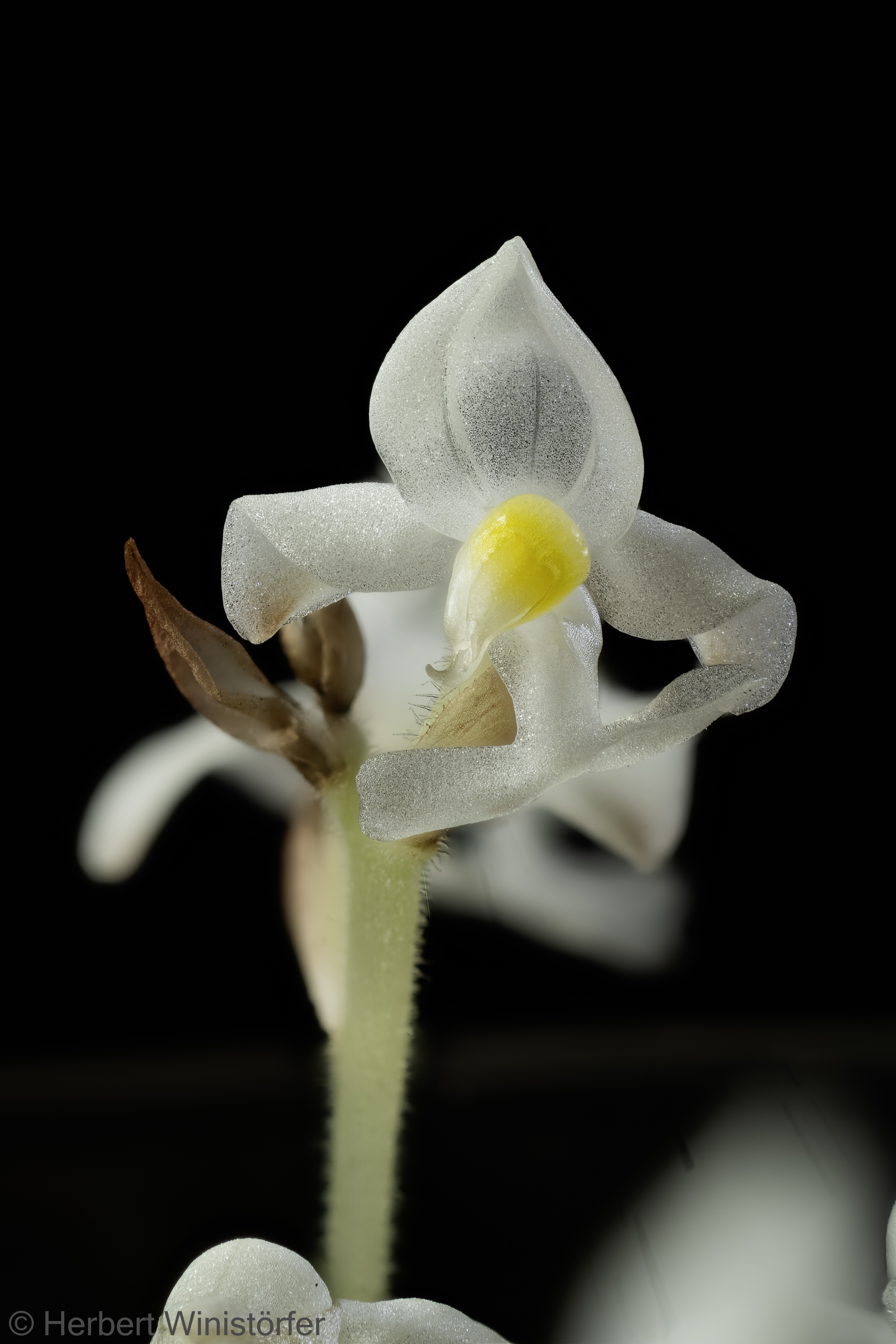
Based on the arrangement of flower organs, one usually distinguishes between three forms of floral symmetry (Endress 2001): radial symmetric flowers, where several planes of symmetry can be applied, bilateral symmetric flowers, where a single plane of symmetry can be applied and asymmetric flowers, where no plane of symmetry can be applied (see examples and an extended terminology in the document below).
At this point, it is worth taking a look back at the evolutionary origins of flowering plants following the informative review article by Citerne e.a. (2010): From angiosperm fossil history and phylogeny, we can assume that the first angiosperms had radial symmetric flowers. The first fossils of flowers with spirally inserted floral parts are dated to the early Cretaceous, ~ 125 Mya; bilateral symmetry is thought to have first evolved during a first angiosperm radiation in late Cretaceous, ~ 93 Mya, and thus about 30 million years later. Bilateral symmetry has since originated many times independently from radial symmetry and several large groups with predominantly or entirely bilateral symmetric flowers have evolved, such as orchids, legumes, Dipsacales, Lamiales, and Asteraceae. Bilateral symmetry is considered to be a successful system because of its potential for efficient precision mechanisms in pollination biology. Bilateral symmetry evolved in several plant lineages during the same period as the rise of some bee families, supporting the hypotheses of coevolution with these insects as the triggering mechanism for floral symmetry evolution. This idea has been discussed as early as 1877 in a correspondence between Gaston de Saporta and Charles Darwin (cf. Darwin Correspondence Project 2022).
Floral asymmetry is relatively rare, but occurs in many different taxa and can have many different causes. The focus here is on cases in which originally bilaterally symmetrical flowers have subsequently developed asymmetry. How can it happen that some taxa have left the seemingly successful path of bilateral symmetry in flower architecture towards asymmetry? Another review article (Jiang and Moubayidin 2022) gives useful insights: Asymmetry can be generated by a reduction in the number of specific flower organs compared with those in other whorls, or by a break in bilateral symmetry generated by a deflection of an organ either to the left or right side, e.g. the bending of the style to the side. However, it is important to note that asymmetry does not equal to disorder; in fact, asymmetric flowers can be seen as higher ordered complexity, in which breaking bilateral symmetry is often a strategy employed to co-ordinate pollen uptake and release by the pollinator visiting the flowers. This kind of one-sided flowers occurs in three variants (Endress 1999: 56): (a) both forms, left-bended and right-bended, occur on the same individual, (b) both forms occur on different individuals of a species, (c) only one form seems to occur in a species or larger group.
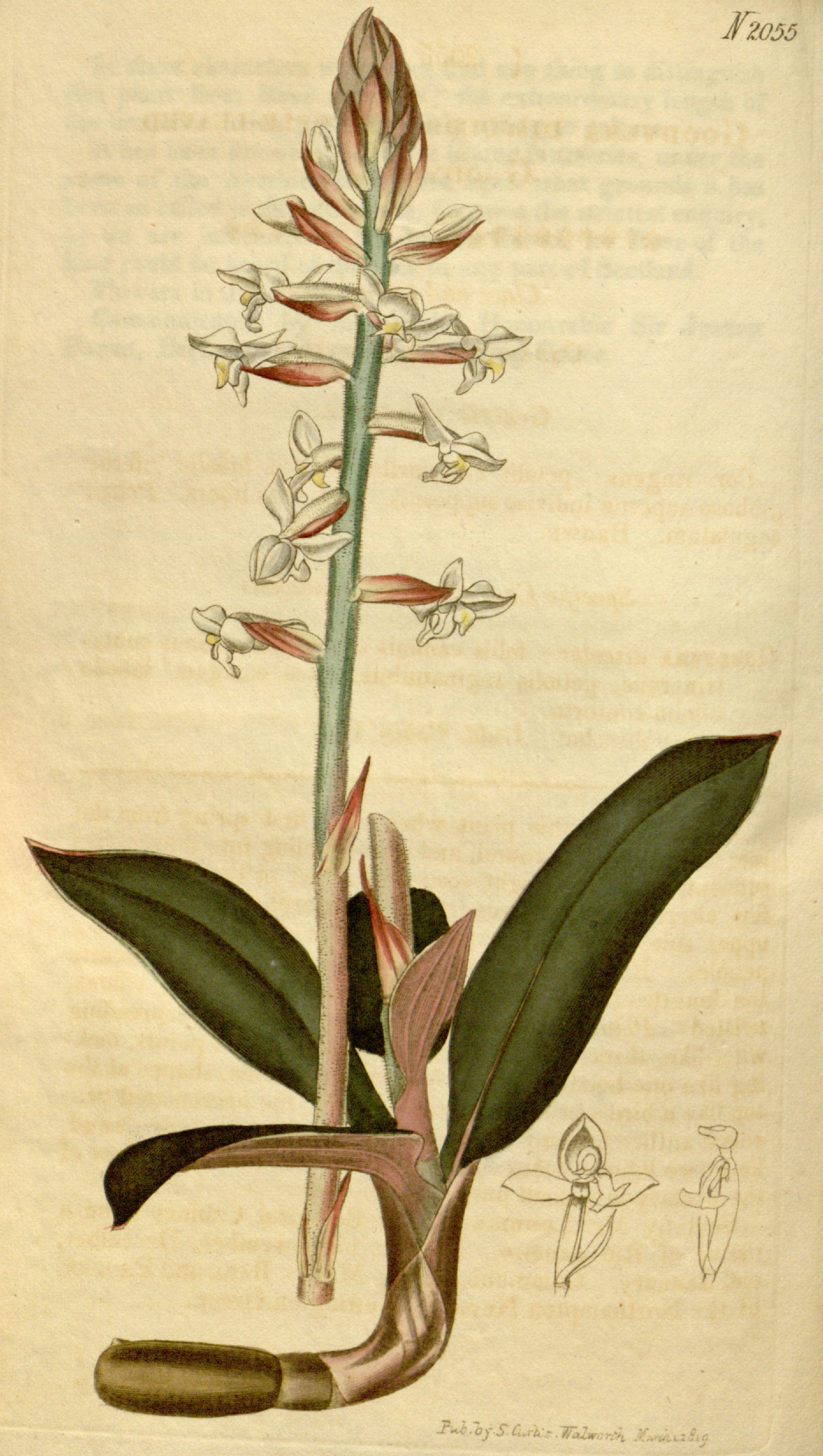
How does this apply to Ludisia discolor? In all the flowers of my L. discolor the column is bent to the left. All illustrations of flowers that I could find showed the same finding (cf. e.g. the drawing from Curtis 1819 at the bottom). Gao e.a. (2024) show how the (one-sided) orientation of the organs is established during flower development (see figure below). Thus it seems clear, that only one of the two forms that are mirror images of each other is present in L. discolor (variant c according to Endress 2001).

S3 (large-bud stage), and S4 (full-bloom stage)”; image source: Gao e.a. 2024, fig. 1, p. 3; distributed under the terms and
conditions of the Creative Commons Attribution (CC BY) license.
Can the one-sided floral asymmetry be directly linked tho the pollination of L. discolor, as is generally assumed for this kind of asymmetry? Zhang e.a. (2010: 14f.) describe in detail and with reference to the one-sided flower anatomy how the flowers of L. discolor are pollinated in the Botanical Garden of the National Orchid Conservation Center (NOCC), Shenzhen, southeastern China, by the butterfly species Pieris rapae (translated from Chinese with support from http://www.deepl.com and paraphrazed): The lip of L. discolor was not able to provide a landing platform for pollinators because of its downward-sloping extension and its mouth is far away from the sticky disc of pollen. When the butterfly inserts its proboscis into the spur to suck nectar, in order to stabilise its body, it usually grasps the lip with its right foot and the protruding column with its left foot, and at this time, the sticky disc of the pollen mass on the column will be stuck to the tarsal segment of the left leg of the butterfly (Fig. 1C). If the butterfly’s left leg failed to grasp the column the first time, the sticky disc on the tarsus would pull the pollen out of the cap, and then the pollen mass would quickly sag because of the weight of the pollen mass. When the butterfly grasps the column again with its left foot, the pollen mass will stick to the sticky stigma below the column, thus completing the intra-flower self-fertilisation. If the butterfly lands on the flower in a balanced position and leaves after sucking nectar, the pollen will be carried out by its left forefoot or midfoot. When it visits another flower, the pollen attached to the curved tarsus will be brushed onto the stigma of the other flower, thus completing inter-flower pollination. The butterflies usually visit several flowers on the same inflorescence in succession, and then fly to nearby plants, or visit other colonies of L. discolor or other plants that bloom at the same time. Therefore, the visit of the butterflies to L. discolor can result in intra-flower selfpollination (autogamy), inter-flower selfpollination (geitonogamy) or crosspollination (xenogamy).
!["Fig. 1 The floral morphology of Ludisia discolor [...], and their pollinators, Pieris rapae. (A) The inflorescence of L. discolor; (B) Front view of L. discolor flower: ac, Anther cap; l, Labellum; v, Viscidium; se, Spur entrance; (C) The pollinaria of L. discolor are carried by the legs of Pieris rapae; […]"; image source: Zhang e.a. 2010: 15, reproduced with kind permission from the Editorial office of Biodiversity Science; all rights protected.](https://hermetospheres.com/wp-content/uploads/2025/03/zhang_ea_2010_fig1_cropped.png)
The description of the pollination process demonstrates the link between floral asymmetry and successful pollination in L. discolor. However, I see no reason why the process could not be just as successful with a mirror-image asymmetrical flower (with the column bent to the right instead of the left). It therefore does not explain the occurrence of only one variant of the asymmetrical flower. If I have made a mistake in my thinking, please let me know.
 Hermetospheres
One response to “The orchid flower that lost its symmetry”
[…] self-pollination and spontaneous formation of ‘leaf cuttings’. The terrestrial orchid Ludisia discolor has its own way of ensuring offspring in the absence of pollinators. The key to this type of […]
LikeLike