The aim of hermetospheres, as I understand it, is to create plant communities that survive as long as possible without intervention. Now the lifespan of even perennial tropical plants is limited. It is therefore important to know whether plants are able to form subsequent generations in a closed container. In the simpler case, this is achieved with plants that form offshoots or runners, from which new plants of the next generation are formed. If they fail to do so, the only option is reproduction by seeds. The difficulty here is that pollination of the flowers in the glass is practically impossible. Sometimes there is no second plant of the same species flowering at the same time, and there are certainly no pollinating animals or wind to transfer the pollen.
A plant in the hermetosphere can be compared to a plant that is transported from the mainland to an island that has not yet been colonised by the species. It also lacks other individuals of the same species for sexual reproduction and usually lacks suitable pollinators. The only way to form a population with successive generations is for the flowers to self-pollinate. Plant scientists therefore surmised early on that the flora of islands must contain a disproportionately high number of plants that are capable of self-pollination. This was formulated most clearly by the British-American botanist and evolutionary biologist Herbert George Baker (1955). His hypothesis was that any colonization scenario involving ‘long-distance dispersal’ ensures a relative advantage for individuals capable of self-fertilization. This connection was later referred to as ‘Baker’s Law’.
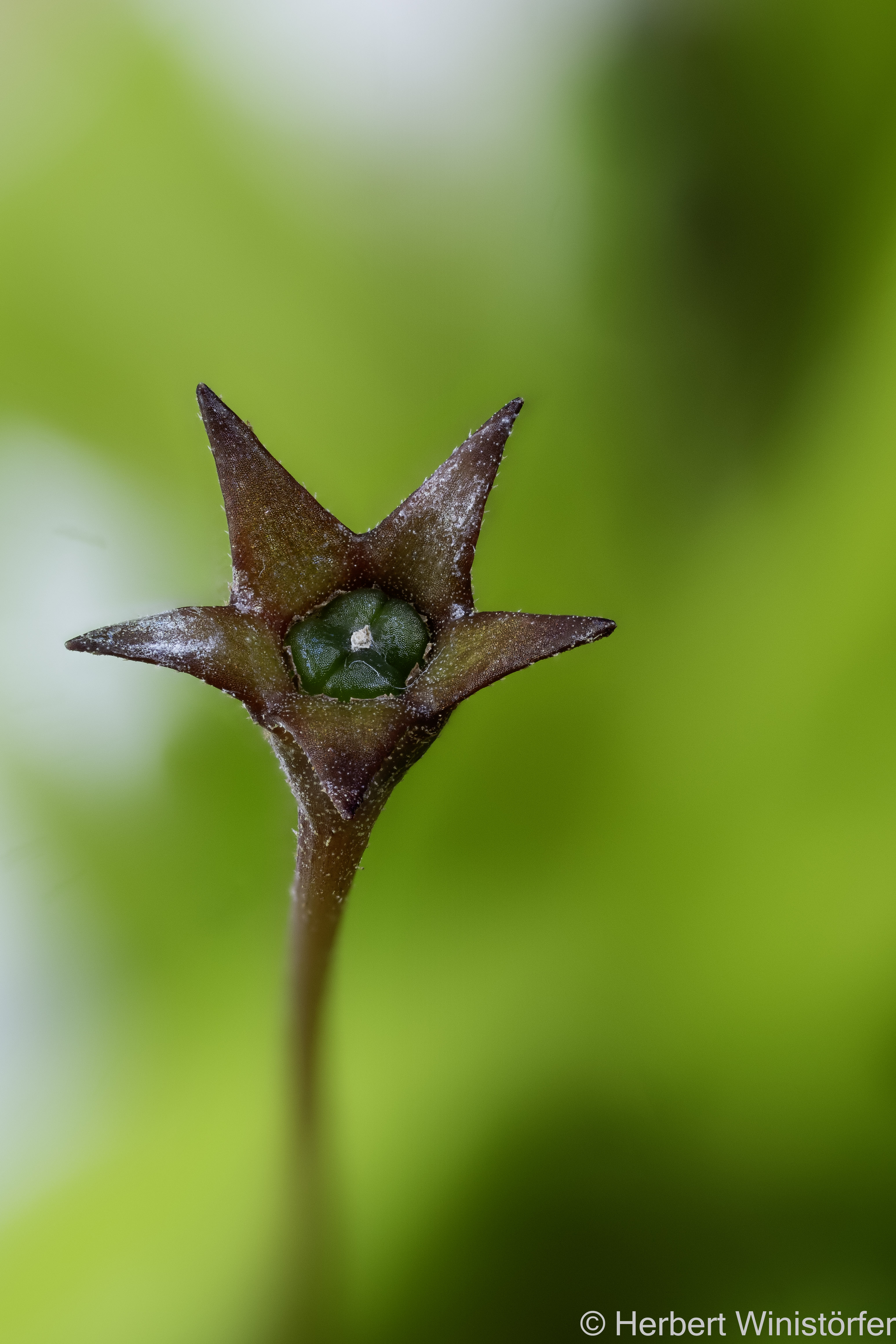
Gesneria cuneifolia is endemic to the island of Puerto Rico and it is able to thrive and flower in hermetospheres. It has long been known that the plant is capable of autonomous self-pollination. Martén-Rodríguez e.a. (2015) report a probability of 61% for bagged flowers (i.e. flowers without pollinator contact) of G. cuneifolia to set fruit. The two flowers in my containers both did so (see one of them on the pictures below). Can we assume therefore, that without the ability of G. cuneifolia (or its ancesors) to self-pollinate, the species would not be present in Puerto Rico? Not exactly, the truth is – as often – more complex.

Understanding which factors govern the composition of insular floras and faunas, why species vary in their ability to colonise, and how particular traits or ecological agents of selection impact species distributions are each among the fundamental and long-standing questions in evolution and ecology (e.g. Darwin 1859; Wallace 1880).
Recently, several studies (e.g. Zell e.a. 2025, Razanajatovo e.a. 2019) have attempted to establish correlations between certain traits of plant species and their distribution on mainland and on islands by statistically analyzing big data sets covering a large number of plant species from different families. They found that the following traits of angiosperm species are overrepresentated in insular ecosystems compared to mainland ecosystems and therefore are likely to favor successful island colonization:
- a self-compatible breeding system (compared to self-incompatibility), thus confirming the hypothesis formulated in Baker’s law;
- radial symmetryc flowers (compared to bilateral symmetric flowers), based on the assumption that radial symmetric flowers are generally associated with a greater diversity of floral visitors and therefore more likely to get cross-pollinated;
- a perennial life span (compared to an annual or biannual life span), based on the assumption that many reproductive attempts can increase the probability of successful pollination over the course of a lifetime.
However, in the models tested by the scientists, these three traits can only explain a relatively small proportion of the variance. This means that the colonisation of islands may be influenced by previously unmeasured or inaccurately measured traits, and that further research is needed to determine these and their significance.
In a study on Gesneriaceae, 47 species from Costa Rica, Mexico and the Caribbean islands were studied in 2006–2013 to identify differences between insular (n=28) and mainland (n=26) species that can possibly be explained by the colonization of the island ecosystem. It was found that “autofertility rates vary greatly among species in both island and mainland regions, possibly reflecting intricate interactions between pollinator visitation, plant breeding systems and the environment. The widespread occurrence of autonomous self-pollination in insular and mainland environments suggests the advantages of this breeding system are context dependent and should be evaluated across different plant lineages and environments.” (Martén-Rodrıguez e.a. 2015: 1202)
On the other hand, it was found that those species are more common on islands that are less specialised in terms of potential pollinators, i.e. where more different pollinators were observed. It could therefore be that, in addition to self-pollination, increasing the probability of cross-pollination through a broader range of pollinators is a successful strategy for colonising island ecosystems.
It remains to be observed whether mature seeds develop from the seed capsules of my Gesneria cuneifolia in the hermetosphere, whether they reach the substrate and whether they can germinate.
 Hermetospheres