Gesneriads (Gesneriaceae), a family of plants named in honour of the Zurich Renaissance naturalist Conrad Gessner (1516-1565), have been very popular as ornamental plants for a long time. Main aspects of the cultivation are covered by The Gesneriad Society. Although most gesneriads are perennial herbs or shrubs native to topical or subtropical regions, some species have tubers or rhizomes as storage bodies which help them through periods of dormancy.
Gesneria is a genus of approximately 50 species most of which are native to islands of the Caribbean. Gesneria cuneifolia is a perennial that is largely herbaceous but slightly woody at the base (a ‘subshrub’) and “grows in the central and western part of Puerto Rico […] on shaded, damp limestone banks and cliffs at elevations of ca 250-400 m.” (Skog 1976, p. 110) It does not develop any kind of storage organ and is therefore not subject to dormancy phases. The blades of the alternate leafs are 2-14 cm long, and the internodes are very short. This gives the plant the appearance of a basal rosette. The two pictures below give an impression of the plant’s habit.
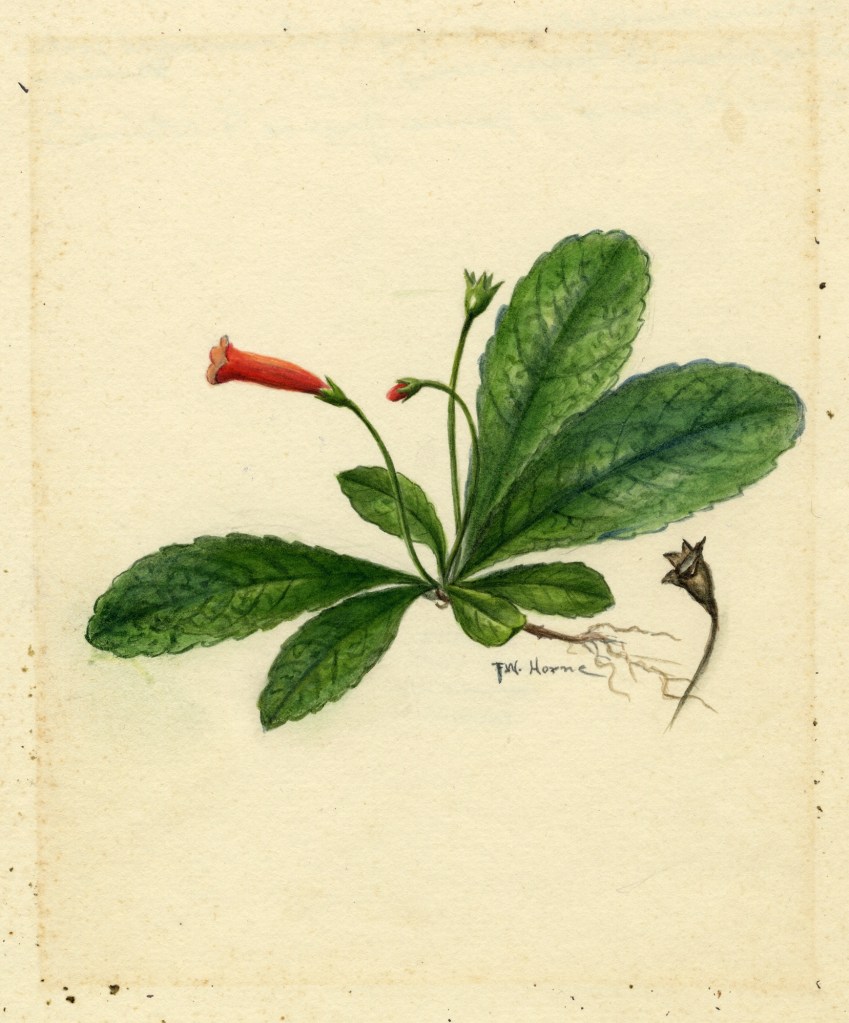

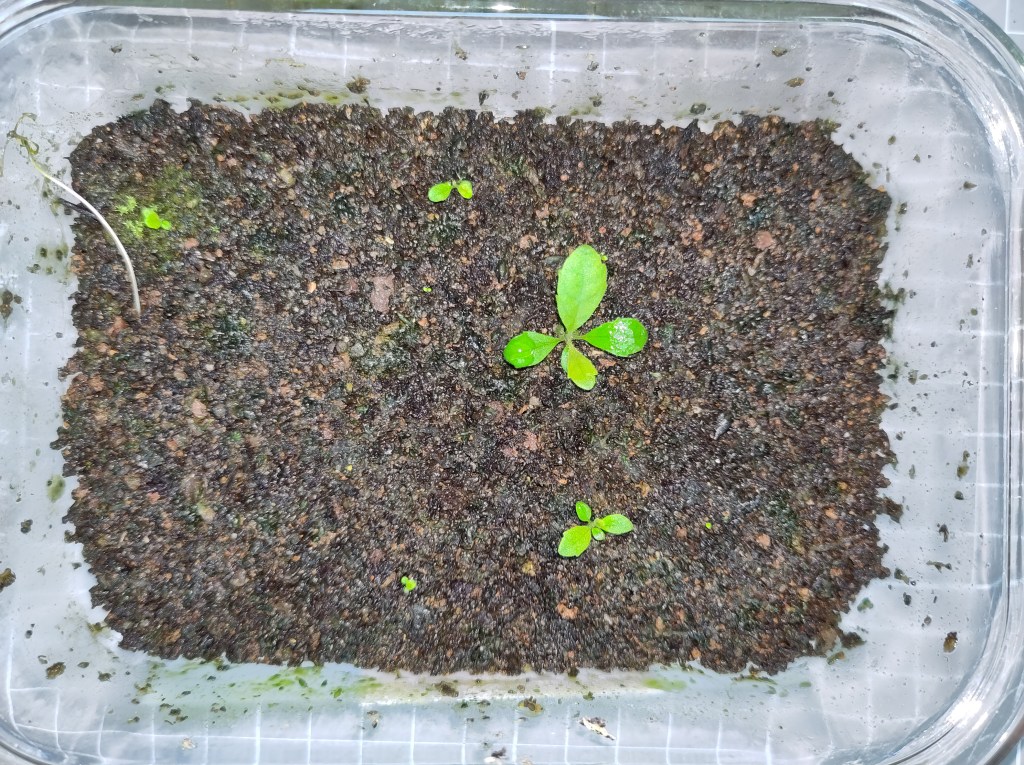
When I had the chance to obtain seed of G. cuneifolia, I decided to try the plant as candidate for closed terrraria. The information available to me about the natural habitat (see above) seemed promising, except for the fact that the plant is observed on limestone. With my standard lava-based mixture, I would not be able to provide the limestone and thus the increased pH value of the substrate. Seed germination took a while. The picture below shows the tray with the seedlings, 9 weeks after sowing. From the very beginning, the different speed at which the seedlings developed was striking. 13 weeks after sowing, I took the two fastest developing plants out of the tray and planted them in a 5-litre container together with other plants native to the island of Puerto Rico.
The pair of pictures below show the development within the container over eight months. The habit of the G. cuneifolia plants in the container is distinctly different from the habit in nature (see above). Unlike previously observed on plants acclimatised in closed containers, the size of the leaves is within the range described. The striking difference lies in the length of the internodes (the interval between two successive points of attachment of a leaf). While the internodes are still very short in the one-month container, as is the natural growth habit of the plant, further growth takes place with increasingly longer internodes (up to 2 cm for the youngest leaves). How can this be?


The first guess would always be that the plant has grown under insufficient light. However, I do not think this applies here. First, the plant is a shade adapted plant and these usually do not show etiolation. Second, the light intensity for my containers varies between 10 and 100 µmol m-2 s-1 depending on the time of day, which should be sufficient for shade plants.
A hint for an explanation can be found in the morphological description of the plant in Skog (1976, p. 109). He states, that the distance between the point of attachment of a branch on the stem was “usually very short, but up to 1 cm long in rapidly elongating individuals”. Does the same apply to leaf internodes? And if so, can the growth of my plants in the container be considered rapid? And if so, what makes the plants in my container grow particularly rapidly?
So far, I have not found any satisfactory answers to these questions. But I have indeed noticed that those plantlets that have grown much more slowly from germination have a habit that is much closer to the plant’s natural appearance. Those have only recently been planted in a separate container and I am excited to see whether they will maintain their natural habit and perhaps flower one day.
 Hermetospheres
One response to “Acclimation (5): Gesneria cuneifolia”
[…] six months ago, I reported first experiences with seed-grown Gesneria cuneifolia. Now it is time for a […]
LikeLike