Previous entries in this blog (#1, #2, #3) have already discussed the observation that some plants change their habitus after being planted in a closed container, presumably from “ordinary” greenhouse conditions. This is another example. The plant is marketed under the name Labisia sp. ‘Boyan’, and its natural habitat is stated as Borneo. However, in this group of the Primulaceae family, the taxonomy and identification even on genus level is more than tricky, not to mention the species level. If you are interested in the circumstances, continue reading to the bottom.

Members of the two closely related genera Labisia and Ardisia have become popular in the hobby in recent years mostly for the texture and coloration of their foliage. Although most of the traded plants labelled with either of these names grow too large for my standard container of 5 litres, I was tempted to give it a try when I came across Labisia sp. ‘Boyan’. As with other groups of tropical plants that are of interest to the trade (e.g. Bucephalandra), the diversity of traded varieties and cultivars exceeds the range of scientifically described species. This is why the plants are often offered under fantasy names. In this case, ‘Boyan’ most likely refers to the plant’s natural range in Insular southeast-Asia. The Bawean or Boyanese people come from Bawean Island, off the north coast of Java from where some have been migrating to Malaya. The word Boyan actually means driver or gardener, because at the beginning of the migration, many Baweans in Malaysia worked as drivers or gardeners (Sarifin and Sukimi 2017).
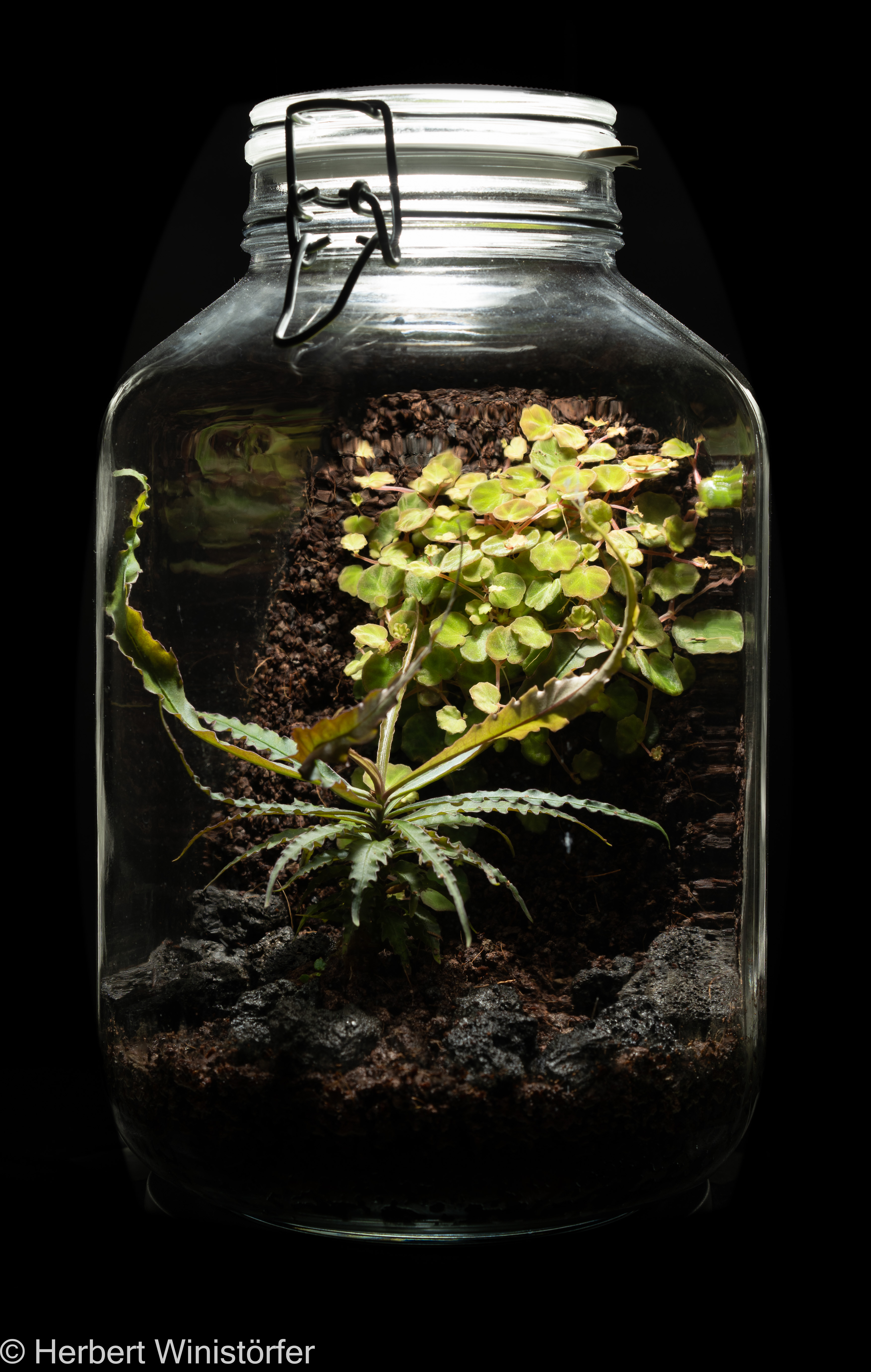
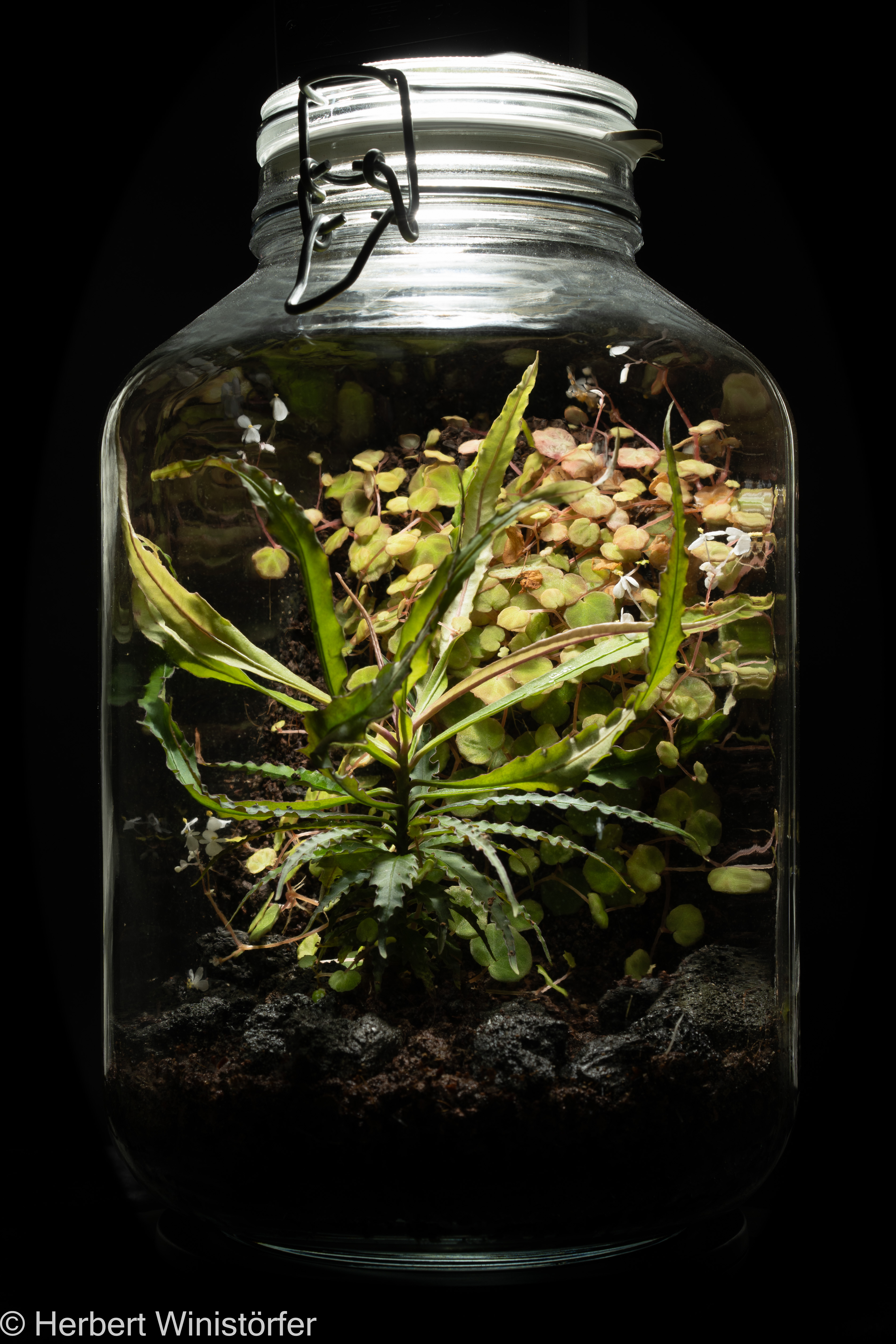
When I acquired the plant, it was a rosette, approx. 12 cm in diameter, of narrow, elongated leaves in a deep green colour with toothed leaf margins. As soon as the plant was placed in the closed container, newly emerging leaves were longer and of brighter green to yellowish colour. The reaction is similar to an observation on Strobilanthes reptans, and the speculation made there about the physiological reasons may also apply here. In short: High relative humidity makes some plants increase the size of their leaf blades. The picture above gives an impression of the difference in length and colour between the approx. 10 leaves newly developed in the hermetosphere and the older ones. The two pictures below show the development of the plant between day 42 and day 117 in the hermetosphere.
Ardisia and Labisia, among other genera, belonged to the Myrsinaceae family before the taxon was integrated into the Primulaceae family as subfamily Myrsinoideae (APG III 2009). The most recent comprehensive, species-level systematic treatment of the taxon was written by Carl Mez (1866-1944) in 1902. At the time, the classification into genera and subgenera was based on characters of habit, leaf morphology, inflorescence position, and floral morphology (Mez 1902). Myrsinoideae in the current classification system includes both herbaceous species and woody species. Within the woody Myrsinoideae, Ardisia is the most diverse genus, with over 700 accepted names distributed throughout the tropical regions (Yang and Hu 2022). Labisia, on the other hand, currently contains only 9 accepted species and its natural range is limited to Indo-China to W. Malesia (Kew). Its best-known and best-studied species is Labisia pumila, employed in traditional Malaysian medicine for the maintenance of female reproductive health and postpartum care and more recently identified as a promising anti-cancer candidate (Lee e.a. 2024).
However, molecular phylogenetic studies have recently shown that the current taxonomy does not adequately reflect the evolutionary relationships within the Myrsinoideae. According to these, the known species of Ardisia share their most recent common ancestor with at least 19 other genera, including Labisia, provisionally summarised under the term “Ardisioids“. As soon as studies with similar methods and more extensive sampling will be available, an extensive taxonomic revision of genera within the Ardisioids can be expected (Larson e.a. 2023). It is therefore likely that the plant discussed here will appear under a different name sooner rather than later.
 Hermetospheres