My standard method to take pictures is, both for containers as a whole and for details within: Place the light source, a camera flash light with remote control, directly on the lid of the container. This prevents the light source from being reflected on the surface of the glass and thus affecting the image. Today, the goal was to capture a detail from Begonia lichenora, its first flower (see picture below).
Container dedicated to Borneo with Labisia sp.“Boyan” (foreground) and Begonia lichenora (background), 28.02.2024, 74 days after onset; Begonia flower marked with yellow arrow.
The first attempt with the light source on top of the lid failed: the Begonia flower as main motive was shadowed by leaves of the Labisia, whereas neighbouring Begonia leaves reflected heavily and got too bright (see the two pictures below with two different depths of field).
Inflorescence of B. lichenora; illuminated by a flash light on the glass lid of the jar; stacked from 14 images.
Inflorescence of B. lichenora; illuminated by a flash light on the glass lid of the jar; stacked from 58 images.
For the next attempt, I used indirect flash light from the right hand side, provided by a reflector made of white cardboard. This attempt failed again as it produced reflections on the glass (see the two pictures below with two different depths of field).
Inflorescence of B. lichenora; illuminated by a reflector on the right hand side of the jar; stacked from 15 images.
Inflorescence of B. lichenora; illuminated by a reflector on the right hand side of the jar; stacked from 59 images.
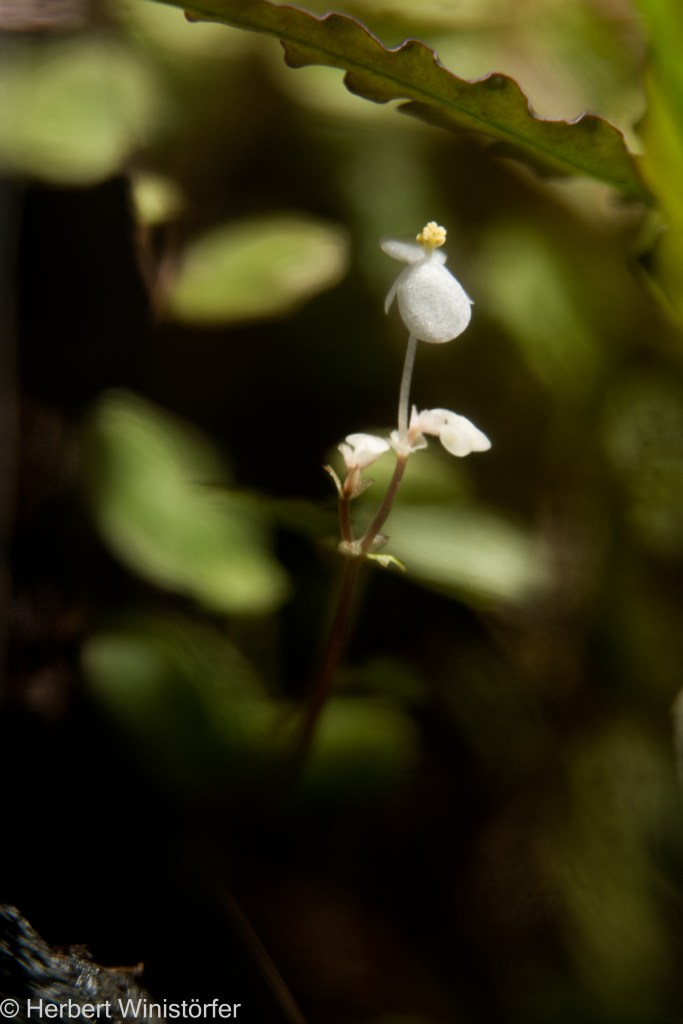
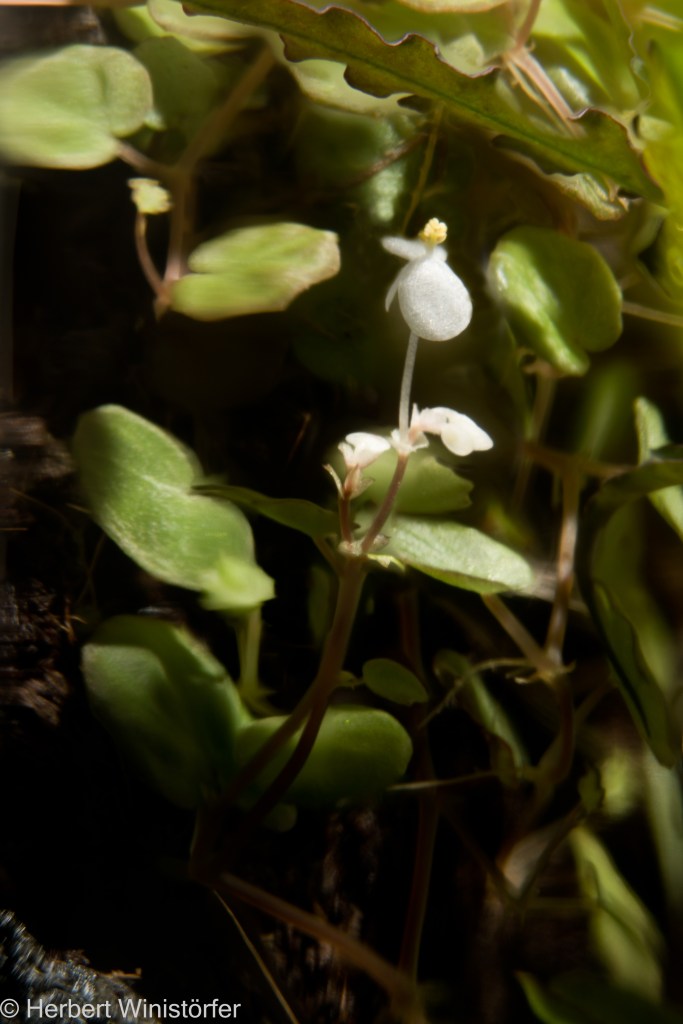
The solution was finally to place the flash in the plane of the object (the flower) so that it shines into the container from the top right (see the two pictures below with two different depths of field and a picture of the arrangement at the bottom of the post).
Inflorescence of B. lichenora; illuminated by a flash in the plane of the object so that it shines into the container from the top right; stacked from 16 images.
Inflorescence of B. lichenora; illuminated by a flash in the plane of the object so that it shines into the container from the top right; stacked from 101 images.
The image below shows the arrangement for the two final images above.
Arrangement for the final pair of pictures: a camera flash, remote controlled and mounted on a seperate tripod was the only light source for the two picutrues; Placed close enough to the object plane, the flash does not cause any reflections on the glass and still illuminates the flower optimally; the white reflectors on both sides help to brighten the shadows of the flash light. Because of the alighment of the reflectors in an angle open towards the camera, they don’t cause reflections at the frontside of the jar, either.



 Hermetospheres