Two previous posts on water and light conditions in my hermetospheres contain some speculations about the conditions inside the glasses, as I did not have the respective measurements at that time. However, sensor technology has advanced to such an extent that small, easy-to-use and sufficiently reliable sensors are now available and affordable. Inspired by PumpkinBeth, I have made it my goal to collect data from the inside to refine my understanding of the processes involved. Using the same equipment, I recorded ambient light, temperature and relative humidity in a 5-litre container during nine days for an initial series of measurements.


How the sensot tag is placed in the lid of the jar.
A narrow strip of adhesive-free tape was all I needed to fix the small 41.0 x 41.0 x 8.5 mm wireless sensor tag to the lid of one of my standard jars, and data logging could start. Here are the insights I was able to gain from it.
Insights into light conditions
- The light sensor is placed on the front side of the sensor tag. This is why the illuminance value measured in lux changes depending on the position in relation to the light sources. The maximum value is measured when the sensor is facing the strongest light source. A series of measurements in which the glass with the sensor tag is rotated once around its own axis in steps of 5-6° between the individual measurements gives the minimum and maximum values (see figure below). When illuminated by two LED spotlights only (without ambient light), the measured values range between 650 and 2700 Lux i.e. between 12 and 50 µmol m-2 s-1. These values match well with values previously determined under similar conditions with other devices, which strengthens confidence in the measurement.

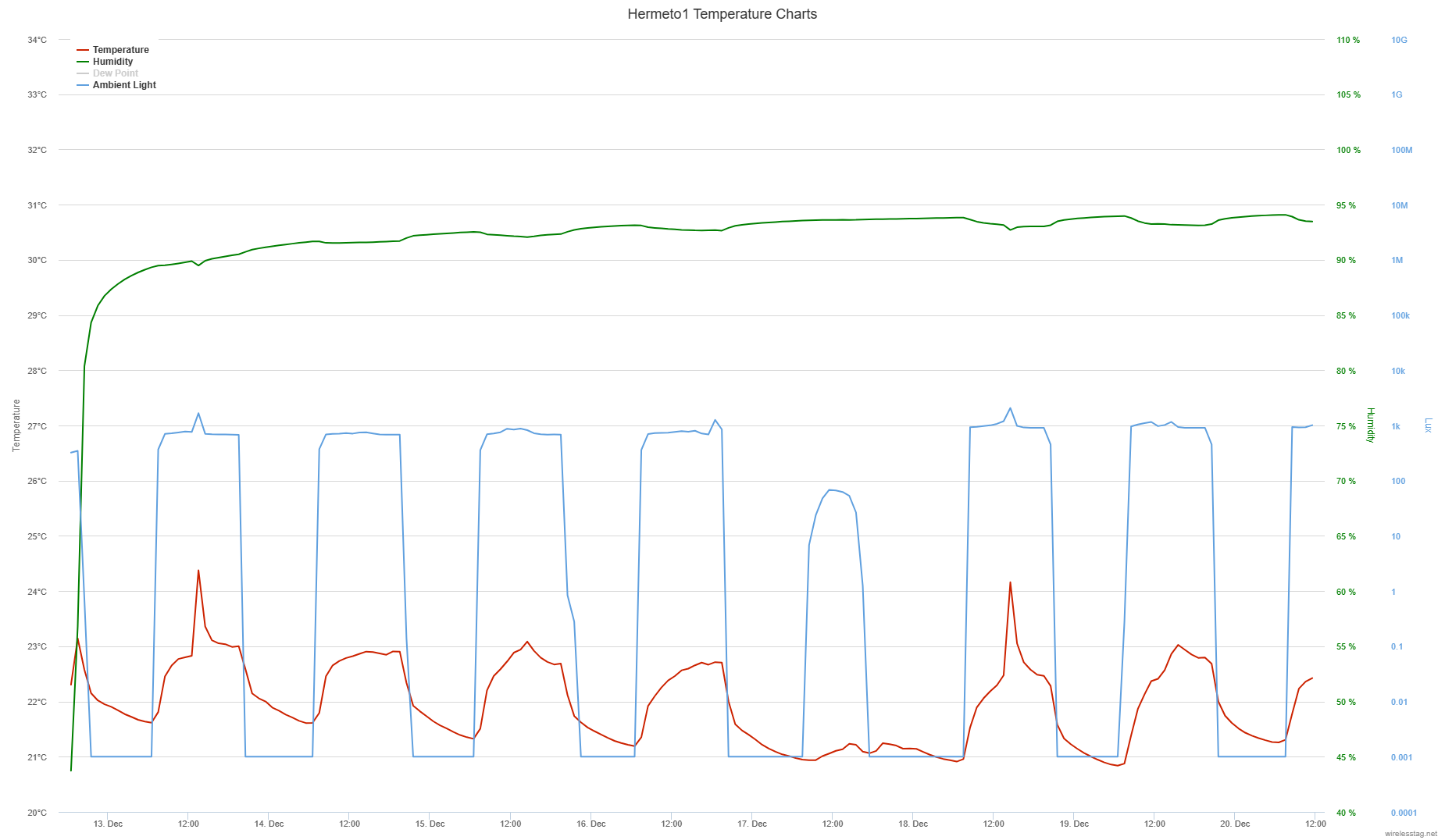
- The highest light intensities (6500 lux and 5000 lux) were measured when the jar was exposed to direct sunlight in addition to the LED spots (13 December, 13h20 and 18 December, 15h00 respectively, see top chart).
Insights into temperature conditions
- The room temperature in the winter season is determined by the room heating and ranges between 21 and 22°C depending on the outside temperature. From 13 December to 17 December, daily lows in the outside temperature (early in the morning) fell from 7.5 to -1.5°C. This effect could also be observed in the temperatures in the jar, where the lowest morning temperatures fell by approx. 0.7°C in the same period.
- Over the course of a day, the temperature inside the vessel rises by approx. 1.5 °C. This rise in temperature is largely caused by the lighting from the LED spotlights. This can be seen from the fact that the temperature rose only minimally on 17 December (see chart above), as the LED spotlights were switched off on this day and only the natural light remained.
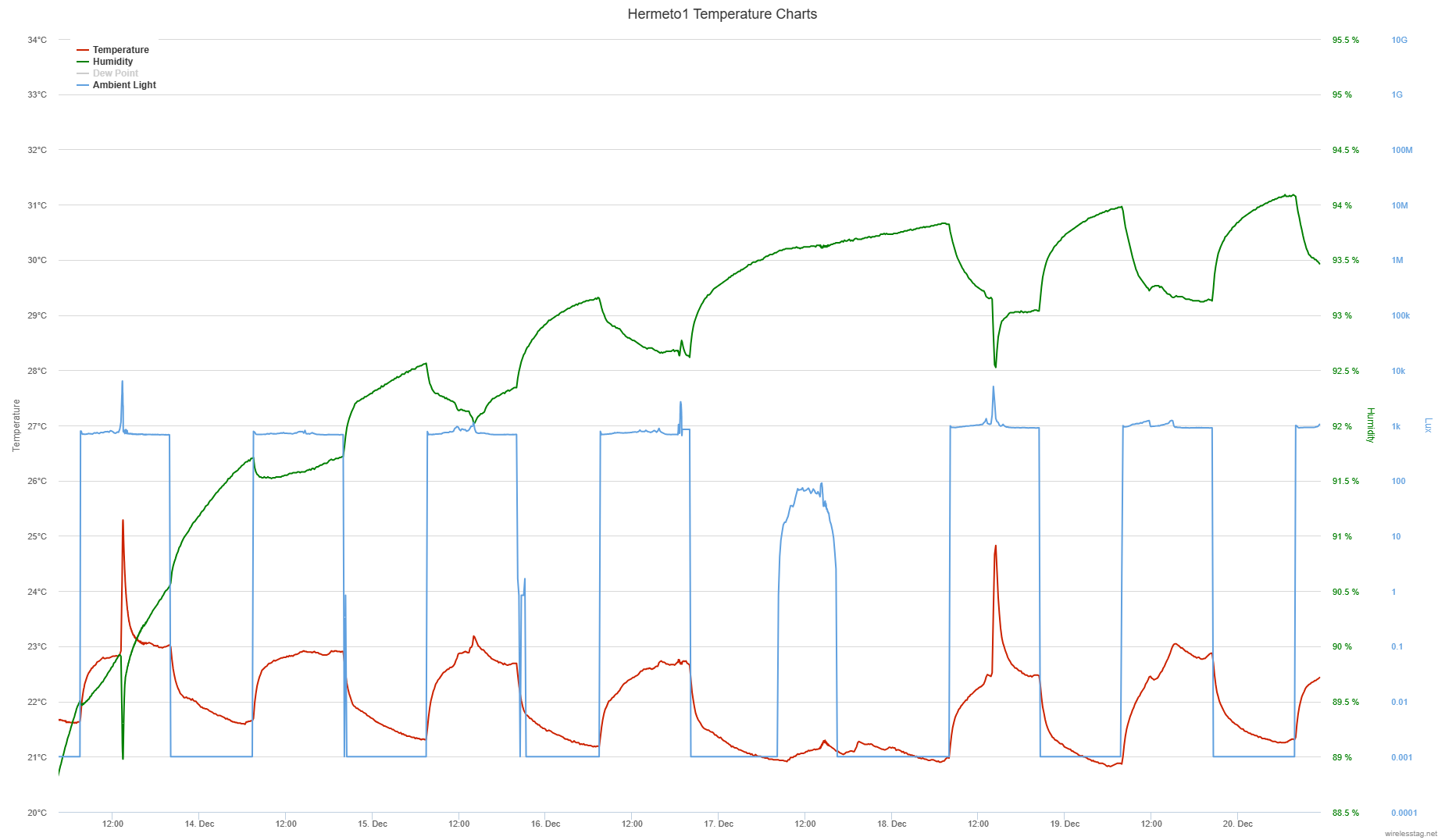
- Direct sunlight leads to a very rapid rise in temperature. On 13 December from 13h, direct sunlight was permitted for about 15 minutes before the blinds were closed. During this short time, the temperature in the glass rose by more than two degrees. At the same time, the relative humidity dropped (see chart below), as warm air can hold more humidity.

Insights into water conditions
- From the moment, the jar is closed (see top chart, start of the time line, 12.12.2023 at 19h), the relative humidity increases from room level (approximately 44%) to 85% in less than three hours. By 15h next day, further 17 hours later, it had raised to 90%. However, relative humidity did not stop increasing until the end of the mesurement at day 9 when it reached 94.1%. This can best be seen in the chart below, covering day 2 to day 9. The fluctuations in relative humidity over the course of a day are due to temperature fluctuations.
The next step will be to measure the carbon dioxide content of the air inside the jars. This should make it possible to observe how the CO2 content decreases with increasing biomass over a longer period of time with the lid closed. Unfortunately, I have not yet found a CO2 sensor that is small enough, practical and provides reliable data. If you tested a sensor like this, let me know.
 Hermetospheres