Aerangis hyaloides is popular with orchid collectors for its lush, brilliant white flowers. For me, this was also one of the reasons to choose it for my Madagascar container. Other reasons were its small size, its supposedly undemanding cultivation and its suitable temperature, humidity and light preferences as an understory species of lowland forests.
My plant had three leaves when I bought it and soon began to develop a fourth in the hermetosphere. I had placed it on (and with some roots in) lava gravel, not too far away from the water providing inner wall. This winter, at the expected time of the year, two inflorescences began to form. One of them has died, the other has produced buds. Three of them have developed into full flowers.
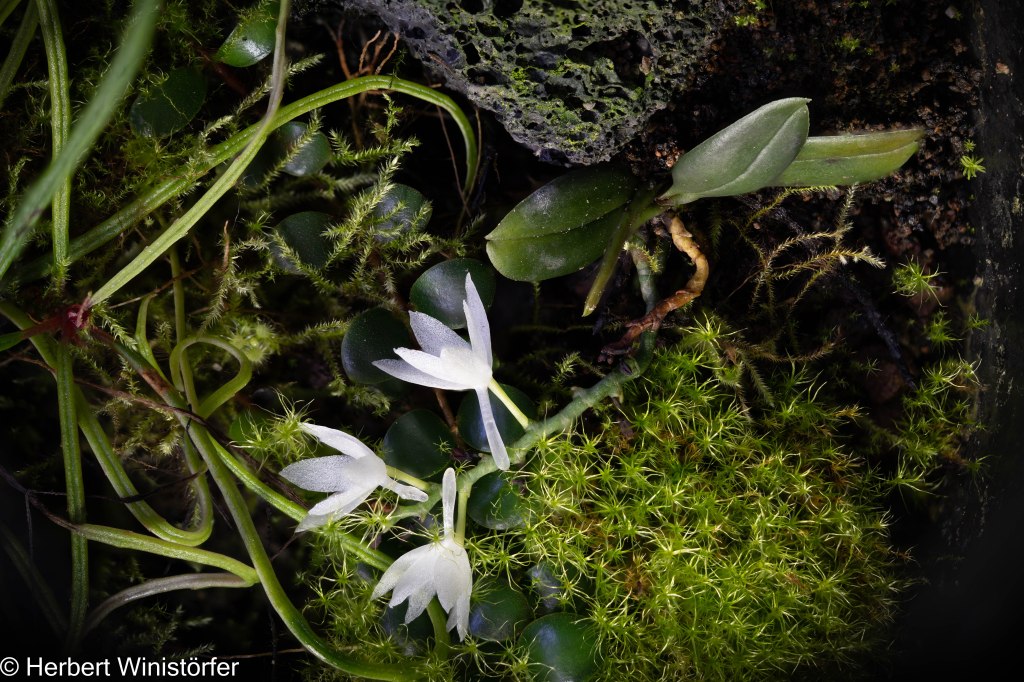
A. hyaloides is endemic to Madagascar and was first collected and imported to Europe in 1879 by Charles Curtis (1852-1928), an orchid collector for James Veitch & Co. nurseries in Exeter and Chelsea (Reichenbach 1880, p. 264; Veitch 1906, p. 85). According to the IUCN Red List of Threatened Species, A. hyaloides is now, nearly 150 years later, considered as “vulnerable” and therefore “facing a high risk of extinction in the wild” (Verlynde e.a. 2019). Confronted with this finding, three major questions arise: (1) How exactly does this assessment come about, (2) to what extent do private “plant collectors” like me promote the extinction of endangered species, and (3) what can I do to prevent harmful wild collection of tropical plants?
IUCN is the most important international institution governing (guidelines for establishing) red lists of species threatened by extinction. Governmental bodies of currently 85 states are considered state members. Red list assessments are established on three levels (global, regional, national) for four kingdoms of life: Fungi (625), Plantae (62’666), animalia (87’082) and Chromista (15) (IUCN 2023). In place in its current form since 1994, assessments are made based on categories and criteria providing a system for classifying species at high risk of extinction. The red list categories are: Extinct (EX), Extinct in the Wild (EW), Critically Endangered (CR), Endangered (EN), Vulnerable (VU), Near Threatened (NT), Least Concern (LC) as well as Data Deficient (DD) and Not Evaluated (NE). The categories are assigned based on quantified criteria covering: population (current size, reduction observed in the past or projected for the future or fluctuating); geographic extent of occurrence and area of occupancy (current size, decline observed in the past or projected for the future, fragmented or fluctuating); probability of extinction in the wild based on quantitative analysis. (IUCN 2012a, IUCN 2012b)
For currently 1’970 (IUCN 2023) of 33’334 accepted (GBIF 2023) orchid species, a global scale red list assessment based on the IUCN categories and criteria is available. For A. hyaloides, the specific reason given by the assessors for assigning the category Vulnerable is: “We suspect a population reduction (number of subpopulation) of 45% […] based on a decline in AOO, EOO and habitat quality where the causes of reduction, forest clearing, is understood, will not cease and may not be reversible.” (Verlynde e.a. 2019). So for this particular orchid, the international plant trade does not seem to pose a critical threat. Is this also true for other orchids and for tropical terrarium plants in general?
According to Hinsley e.a. (2018, p. 437f.), “Ornamental horticultural trade also includes wild, often illegally harvested plants. This […] is […] frequently conducted on a commercial scale. Historically, tropical orchids were collected in the hundreds of thousands for international export to Europe, dating back to the Victorian orchid fever. […]. International trade of wild horticultural orchids to Europe, the USA and Japan was widespread up to the establishment of CITES in the 1970s. However, commercial trade in wild plants continues, in response to both domestic and regional horticultural demand from hobbyist growers and specialist international demand from enthusiasts who target rare species for their collections. Contemporary, commercial horticultural trade in wild plants has been formally documented from Cambodia, China, Indonesia, Thailand, Myanmar and Lao PDR, Vietnam, Nepal, Mexico and Peru. Formal research is limited, but collection of wild orchids for the horticultural trade is also known to be occurring in many more countries, including Costa Rica, Madagascar, Malaysia, the Philippines and Venezuela.”
Beyond national legislations, one of the most important regulations on international level to protect wild species from extinction is the Convention on International Trade in Endangered Species of Wild Fauna and Flora (CITES). Appendix I lists taxa whose international trade of plants collected from the wild is prohibited and contains nine distinct orchid species. Appendix II lists taxa where trade of wild collected specimens is allowed, but requires import and export permits, and a demonstration that any export will not be detrimental to the survival of the species); it contains all Orchidaceae. However, among the five main conservation challenges associated with global orchid trade, #1 is that “trade is often associated with unsustainable, sometimes illegal, forms of harvest and trade. [..].” (Hinsley e.a. 2018, p. 440ff.) Especially trading online allows traders and buyers of illegal products to evade detection (Hinsley e.a. 2016).
“Unsustainable harvest pressure on wild orchid populations can be the result of illegal collection that violates domestic and international legislation. Notably, much of the unsustainable harvest and international trade […] is not reflected in official CITES trade statistics […] even in cases of CITES Appendix II listed species, for which international trade might be legal, trade is frequently occurring without the requisite permits and CITES Non-Detriment Findings. In many cases, this appears to be an issue of non-enforcement of environmental and CITES legislation, [..] In other cases, illegal trade involves the laundering of wild specimens as artificially propagated species to circumvent protections on wild plants.” (Hinsley e.a. 2018, p. 443)
“Preference for wild plants has been shown in ornamental markets due to perceived differences in attributes such as robustness, fragrance and ‘authenticity’. Similar preferences and price premiums have been found for rare species […]. This can be linked to the desire to collect and be the first to own new or unusual species and varieties and to produce new hybrids from these species that can be named and publically shown for horticultural awards. This is probably the driver for a phenomenon by which orchid species enter commercial trade even prior to scientific description.” (Hinsley e.a. 2018, p. 444)
“We therefore suggest that communities of horticultural orchid hobbyists represent a large, influential community with clear potential to help raise the profile of orchid conservation.” (Hinsley e.a. 2018, p. 449f.)
An additional aspect is hardly ever considered: According to the Convention on Biological Diversity (CBD) and its Nagoya Protocol on Access and Benefit-sharing (ABS), countries have a right to benefit when genetic resources are used by others (United Nations 2011). This involves collection of wild material to supply companies directly, or to enable artificial propagation or captive breeding ex situ (Hinsley and Roberts 2018). “However, shifts in trade networks, product types and methods of trade have taken place since the CBD came into force over two decades ago, some of which are likely to add further complexity to ABS implementation. A good example is the rapid increase in online wildlife trade, a development that has provided opportunities for small businesses to access international markets, but that has proved difficult to monitor and regulate. […]. One […] market is the the international horticultural trade, which has a relatively limited awareness of ABS.” (Hinsley and Roberts 2018, p. 261)
What does all this mean for me, my Aerangis hyaloides and my hobby in general?
- Buying tropical live plants online (as I often do) has a potential to be both illegal and threatening to wild populations.
- From now on, before buying, I will ask sellers: “How exactly do you make sure the plants you trade comply with the CITES regulations (and additional national regulations if applicable)?”
- When in doubt, I will refrain from purchasing plants that are offered as particularly rare and instead go for plants that are most likely to come from greenhouse propagation.
- My A. hyaloides, endemic to Madagascar, was most likely not collected in the wild. However, since the population of Madagascar of about 28 million (2020) has one of the world’s highest poverty rates, and since these people have a right to benefit from what I spend on “their” plants, and as long as there is no system in place that guarantees a fair compensation for the commercial use of the island’s genetic resources, I am going to donate to a project in favor of the poorest.
 Hermetospheres
One response to “A vulnerable orchid”
Always a pleasure to 1) see a beautiful flower, 2) read something interesting and new, 3) (this time) be confronted with what is right and what might be wrong to do. I just wander if the community of horticultural hobbyist can also be part of ensuring that some species are kept (not lost) and when needed could potentially be re-introduced to areas wher society has realized that they play a small but important role for our own survival.
What is facinating about these organisms is the fact that they are torn away from their original habitat and somehow make it, they must be able to learn a lot in a short time to adapt. I wander what it would feel like to be returned to its original place of birth? Would they survive and thrive or no longer be able to adapt?
LikeLiked by 1 person