So far, this jar represents little more than a series of failures. Originally, it was supposed to represent the Mexican Gulf province of Veracruz. There, in the cloud forest of the Sierra Madre Oriental, at an altitude of around 1500m, are the only known locations of Pinguicula emarginata. The species had been recommended to me when I had asked Pinguicula enthusiats about the best choice of a Mexican butterwort to grow in a hermetosphere. Other than most, P. emarginata does not necessarily go through a winter dormancy period. To imitate the plant’s natural habitat on the edge of streams, I made an effort to create a steep slope of lava rock and a wet zone in the foreground. However, not only did the six young Pinguicula plantlets grown from leaf pullings die, but so did Elocharis acicularis and Anathallis lewisiae that were supposed to complete the initial setup. So, frustrated, I was left with a container that had sophisticated topography but no plant growth except for a few patches of the moss Kindbergia praelonga, which slowly began to colonize the lava slope.
What next? Having a wet foreground habitat available, I decided to try another carnivorous plant of the same family (Lentibulariaceae) and chose Utricularia juncea, a bladderwort common in wetlands of (sub)tropical North and Central America. Recent research has confirmed that the plant has one closely related taxon, U. cornuta, and together they form the section Stomoisia within the subgenus Bivalvaria (Silva e.a. 2018).
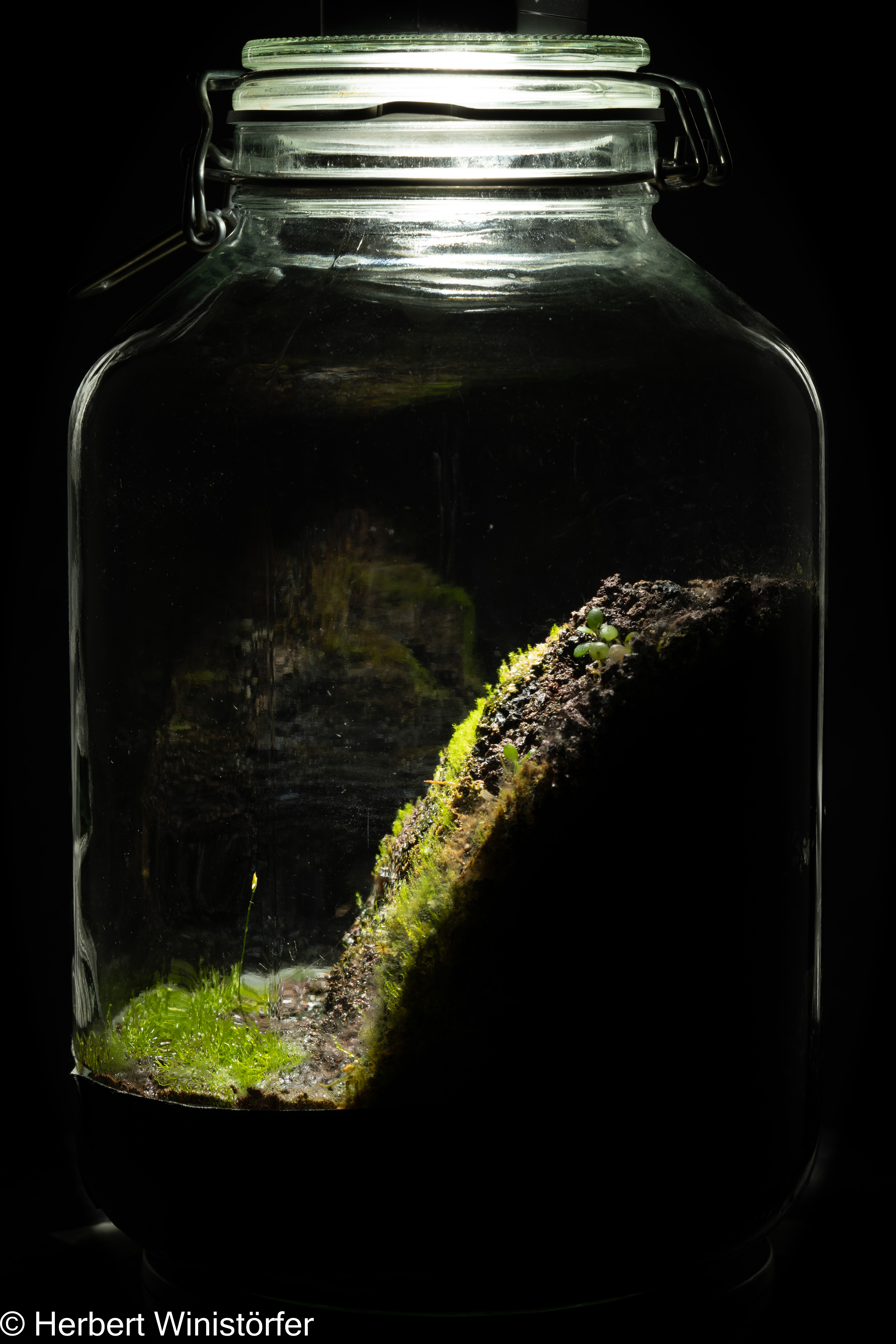
One month after I had planted three plugs of 33x33mm each, a single inflorescence began to grow. But it never looked like a true flower of U. juncea as I had seen in many pictures, not least those of the seller of my plants. It took an article in the The Carnivorous Plant FAQ (Rice 2018) to give me the answer: This was a cleistogamous flower. I may have heard the term before but what exactly is it and what role does it play in the reproduction of my bladderwort?
The vast majority of knowlege on the biology of U. juncea can be traced back to a single publication (Kondo 1972) cited by most later authors. How little this was until recently is evident from a statement by Brewer (1999): “The details of the life history and demography of this species are poorly understood, but most species of Utricularia are widely assumed to be annuals”. If the herb is really “annual” and I cannot offer pollinators, should I be concerned that the plant in my container will be extinct the next year? There are three reasons why not:
- Vegetative reproduction: My bladderwort has the ability to reproduce without flowers: “In some species, the vegetative reproductive structure is the leaf, e.g. U. cornuta and U. juncea. Leaves separate, float away after rain, and develop into new individuals (Kondo 1972)” (Guisande e.a. 2007).
- Chasmogamous (CH) flowers: Fully developed flowers made for cross-pollination; however, these flowers are also capable of self-pollination; flower morphology indicates that the species are entomophilous but the insect pollinators of U. juncea have not yet been identified (Kondo 1972).
- Cleistogamous (CL) flowers: Reduced/closed flowers that allow only self-pollination. At least two categories of cleistogamy are distinguished (Culley and Klooster 2007): In dimorphic (“true”) cleistogamy, CL flowers are morphologically distinct from CH flowers and are the result from divergent developmental pathways; this category is exemplified by many Impatiens and Viola species; on a given plant, both flower types can appear at the same time but in different positions (spatially separated), or they may be produced sequentially during the season (temporally separated). In induced (“ecological”) cleistogamy, unfavorable conditions such as drought and low temperatures cause CH flower development to stop before anthesis and the flower fails to open; unlike dimorphic cleistogamy, there are no morphological differences between CL and CH flowers other than tha absence of floral expansion and anthesis in CL flowers; the two types of flowers do not follow fixed developmental courses. Four cases of dimorphic cleistogamy are recorded for the genus Utricularia, one of which being U. juncea (Lord 1981). Since cleistogamy is thought to have evolved independently approximately 34 to 41 times among angiosperms (Cullen and Klooster 2007), it must be associated with a distinct evolutionary advantage for the respective plants. Several theories are discussed, and it is likely that different explanations apply for different taxa. Since CH flowers are also often self-pollinated in U. juncea, CL flowers can simply help to save energy. They also allow colonization of habitats where pollinators are not (yet) abundant.

Will I see future generations of the bladderwort in my jar? I will keep you informed.
 Hermetospheres