Begonia is not only among the most diverse genera in nature (about 1’550 described species), but also among the most intensively cultivated ornamental plants in the world (over 10’000 cultivars). Begonias are known from Africa (160 species), the Americas and Asia (more than 600 species each), but not from Australia. Attempts have been made to establish an evolutionary history of the spread across the continents by comparison of corresponding DNA sequences (molecular divergence analysis, Dewitte e.a. 2012). Given certain time necessary for small changes in the DNA, the time required to develop two species (of which specific DNA sequences are known) from a common ancestor is calculated. A timeline created using this method is usually calibrated with fossil records whose age is determined with physical methods (e.g. radiometric dating). However, fossil records of begonias are extremely rare, the first ever record of a begonia fossil being described only quite recently (Stults and Axsmith 2011). This makes the time dimension of the current assumptions speculative to some degree: that the first begonia developed in Africa around 45 million years ago (in Eocene) and the colonization of the Americas occurred 10-15 million years ago (in mid-Miocene). According to Moonlight e.a. (2015), two successful long-distance dispersal colonizations of South America from Africa happened. At the time, no overland dispersal routes existed between the two continents, leaving long-distance dispersal the only feasible explanation. Transatlantic, westerly dispersal of entire plants by oceanic currents is considered plausible.
Of the c. 56 Madagascan (incl. Comores and Mascarenes) begonia species, B. oxyloba is also widespread on the African continent. The other Madagascan species seem to be the result of a single dispersal event from continental Africa and a subsequent radiation (Dewitte e.a. 2012), to be dated between 36.5 and 13.5 million years before now (Plana e.a. 2003). Nine new species from Madagascar have been discovered since 2010 (Scherberich & Bardot-Vaucculon 2022), which makes it likely that more will follow soon.
One Madagascan species, B. bogneri, is exceptional for several reasons: It was discovered at a single site and collected more than fifty years ago, but has never been found in the wild since; it is widely cultivated, and all plants are descended from the specimens initially collected, which survived transport back to Europe and were first cultivated in botanical gardens; there is as yet no picture of the plant in its natural habitat, and all drawings are based on dried or cultivated specimens; from a distance the plant does not look like a begonia at all, as the typical asymmetry of the leaves is hardly recognizable.
!["Pl. 12. - […] Bégonia bogneri Ziesenh. : 4, ensemble de la plante fleurie x 2/3; 5, détail d'un fragment de feuille x 2; 6, Fleur ♂ x l,5; 7, androcée x 4; 8, fleur ♀ x 1,5; 9, styles et stigmates x 4 (Bogner 262 et photographie)." (Keraudren-Aymonin 1983)](https://hermetospheres.com/wp-content/uploads/2022/10/keraudren_aymonin_1983_pl_12_s_43_begonia_bogneri-1.jpg)
“Josef Bogner discovered this extraordinary species in Madagascar while he was exploring the remote and botanically little-known Masoala peninsula. He has described how he [travelled] to the rugged and precipitous western side of the peninsula called Hiaraka. Here the moutains rise steeply from the coast to over 1000 m. After landing on 23rd January 1969, he set out with two Madagascans to climb the mountains in search of Aroids and before long, at an altitude of only 50 m., they came upon large, moist granite rocks in the deep shade of tall trees. Here, amongst mosses and ferns, mostly on vertical faces, he found the small linear-leaved plants of the new species which, despite diligent searching to the highest altitude, apparently occurred only in a limited zone at the foot of the mountain.” (Sands 1986)
That the plant is quite widespread now among growers and hobbyists may be due to the fact that it is relatively easy to cultivate in terrariums and, in my own experience, in hermetospheres.

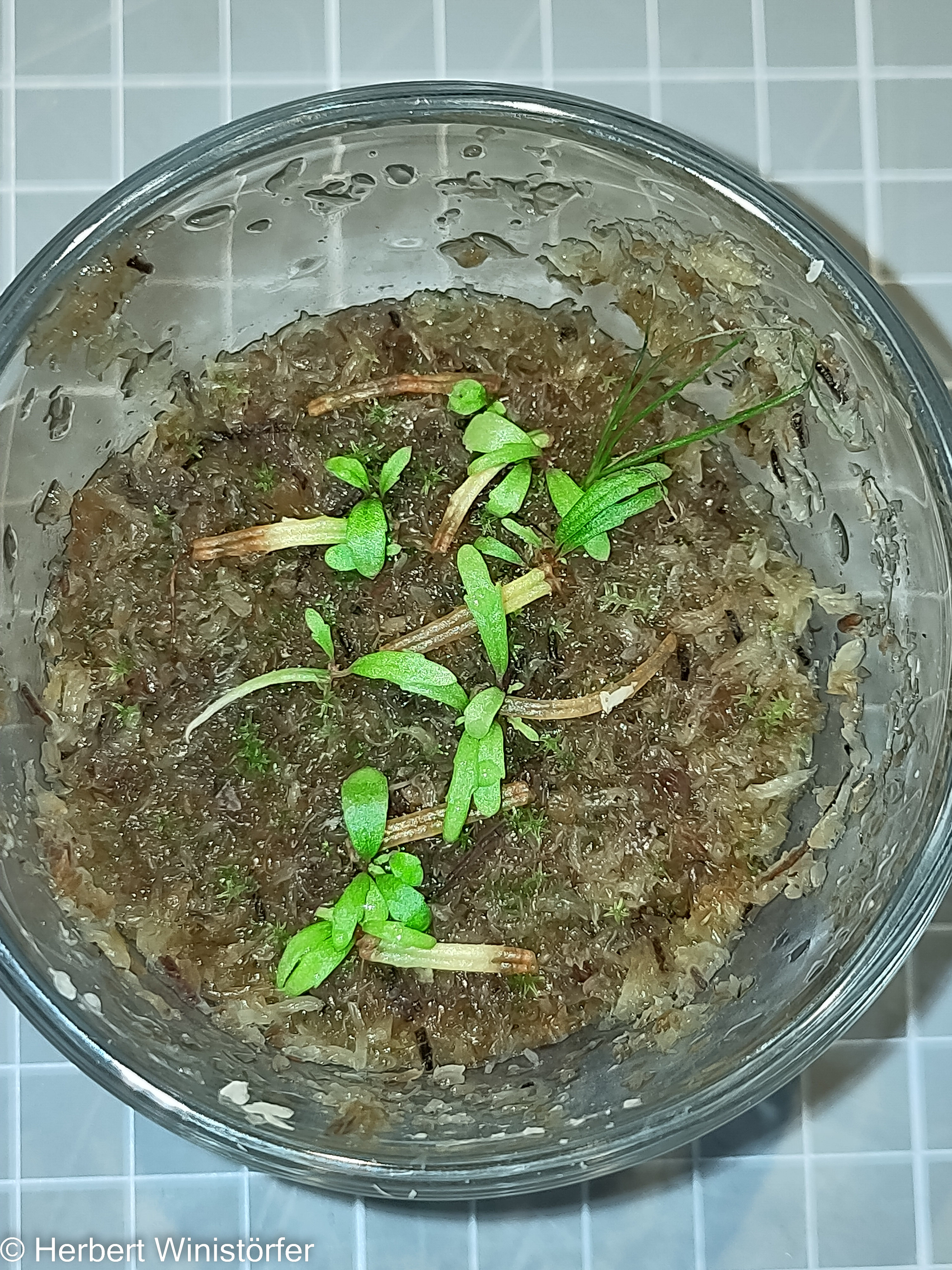
Encouraged by experiences of a begonia enthusiast (https://collectiondebegonias.wordpress.com), I am currently trying to propagate my plant. Eight leaf cuttings about one centimeter long were placed on milled and moistened Sphagnum moss and covered with cling film. Two months later, all cuttings have produced small leaf rosettes at one end. Once grown out of the initial container, I will repot them into a mix of lava sand and milled Sphagnum moss, where they are expected to go through a dormant period before forming tubers and growing into mature plants.
 Hermetospheres