On 7 August 1803 the sailing ship Nadeshda under captain Adam Johann von Krusenstern left St. Petersburg for the first Russia-led circumnavigation of the globe on behalf of Tsar Alexander I. During a first stop in Copenhagen, German naturalist Georg Heinrich von Langsdorff (1774-1852), later diplomat in the service of the tsar, came aboard. After crossing the Atlantic Ocean Langsdorff began collecting plants and insects on Santa Catarina Island off the east coast of Brazil. When he later reported the results of his work during the expedition, addressed to the tsar himself, he wrote about the stay in Santa Catarina (Langsdorff and Fischer 1810):
“Le Brésil est un de ces points de notre globe, qui sera pour longtems une source féconde de découvertes; la variété des animaux et des végétaux est si immense que les plus riches tableaux d’une imagination brillante ne peuvent atteindre à la beauté inexprimable de la nature. — Pendant notre séjour à l’île de St. Catherine, dans le Brésil méridional, au mois de Décembre et de Janvier 1804 la température moyenne d’après le thermomètre de Réaumur étoit à l’ombre de 21° au
dessus de zéro . L’humidité y est extrême.”
Among the 32 new plant species described and illustrated in this report was Polypodium vacciniifolium from Santa Catarina.
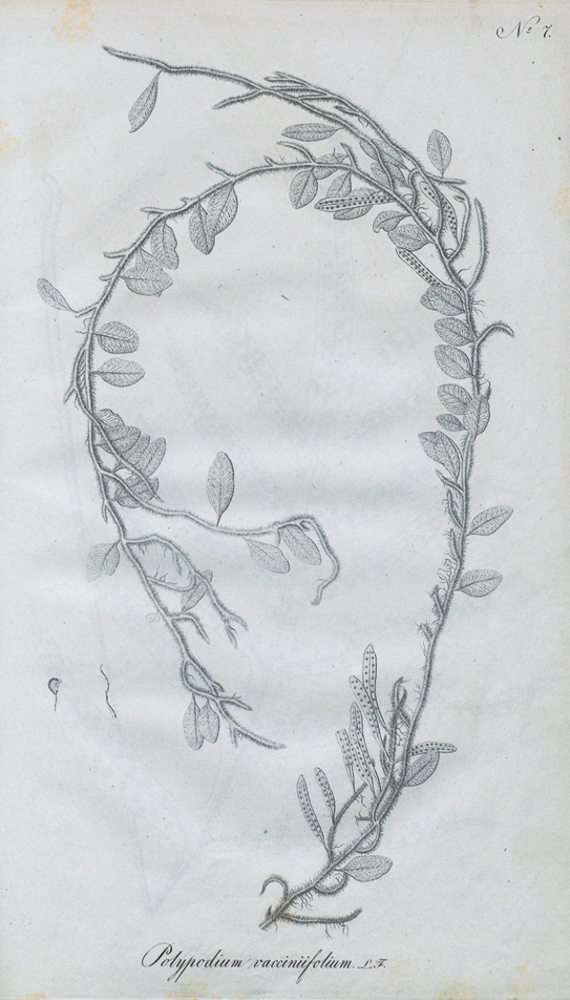
In his comprehensive monograph on fern genera, Edwin Bingham Copeland renamed the epiphytic species, common throughout much of South America, Microgramma vacciniifolia (Copeland 1947), a name that has prevailed to this day.
Being known for medicinal use by the native population for long (e.g. Keller e.a. 2011), the fern has recently been rediscovered as potential drug. Lectins (carbohydrate-binding proteins) have been isolated from both rhizome and fronds and positively tested in vitro and in vivo for anti-inflammatory, antitumor and immunomodulary properties (e.g. de Siqueira Patriota e.a. 2021).
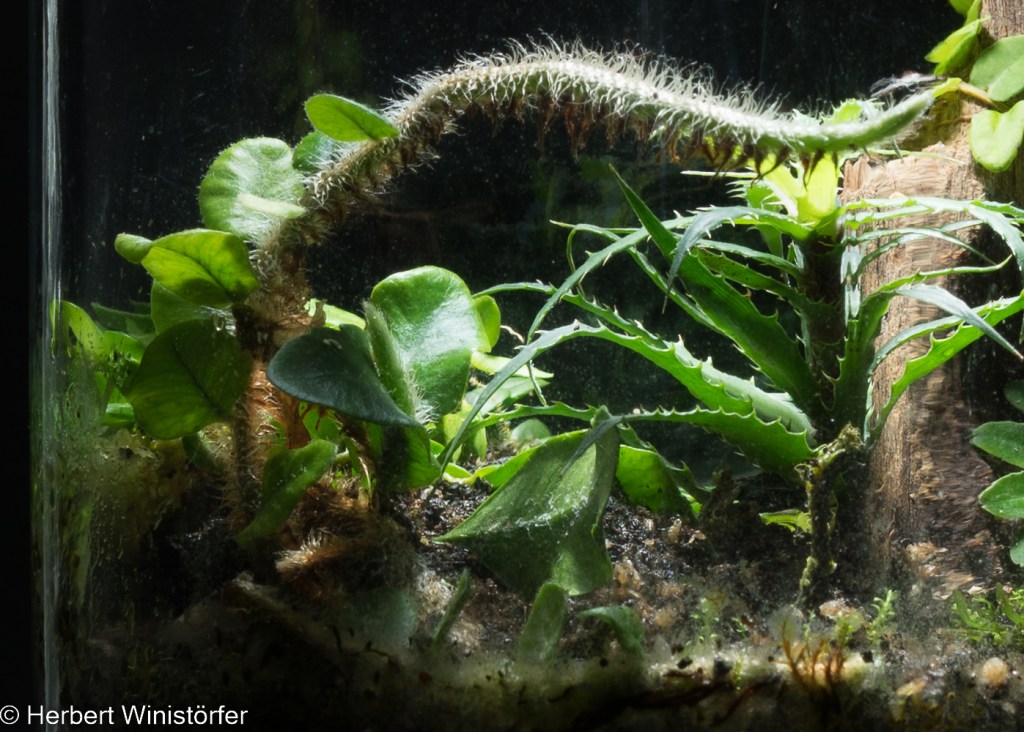
In the hermetosphere, the fern does quite well. Steadily, but not threatening to crowd out the other plants, it produces long, hairy rhizomes sending strong roots far down into the substrate. Of two distinctly different kinds of leaves visible in the drawing above, it has only developed the oval-shaped sterile one so far, but not the long, narrow, fertile one. All in all, the fern seems to be a good choice for the conditions a hermetosphere of this kind can offer.
 Hermetospheres
One response to “Around the world on behalf of the tsar”
Es sieht aus wie ein Mini Urwald!!!!
LikeLike