When I acquired this plant as one of my first purchases to grow in a hermetosphere, it was labelled Marcgravia umbellata, but it might as well be Macgravia oligandra. Both plants originate from the caribbean islands and belong to the shingle-leaf climbers – root-climbing plants whose leaves are adpressed and often overlap (Zona 2020). As can be seen from herbarium specimens, M. umbellata develops two distinctly different types of leaves. This stunning difference was already registered by Charles Darwin and published in his monograph on climbing plants (Darwin 1865):
“Root-climbers.—A good many plants come under this class, and are excellent climbers. One of the most remarkable is the Marcgravia umbellata, which in the tropical forests of South America, as I hear from Mr. Spruce, grows in a curiously flattened manner against the trunks of trees, here and there putting forth claspers (roots), which adhere to the trunk, and, if the latter be slender, completely embrace it. When this plant has climbed to the light, it sends out free and rounded branches, clad with sharp-pointed leaves, wonderfully different in appearance from those borne by the stem, as long as it is adherent. This surprising difference in the leaves I have observed in a plant of M. dubia in my hothouse.”
Flowers only appear from shoots with the large, pointed type of leaves not attached to the underground. When I added M. umbellata to my Brazil SE container (by mistake, as the plant is not native to the area) in July 2021, I offered a piece of mangrove wood to the two shoots with small leaves to let them climb. One shoot grew constantly along the wood in a clockwise (right-handed) coil. In August 2022, one 360 degree round was completed. The second shoot grew far more slowly in the same time (see below).
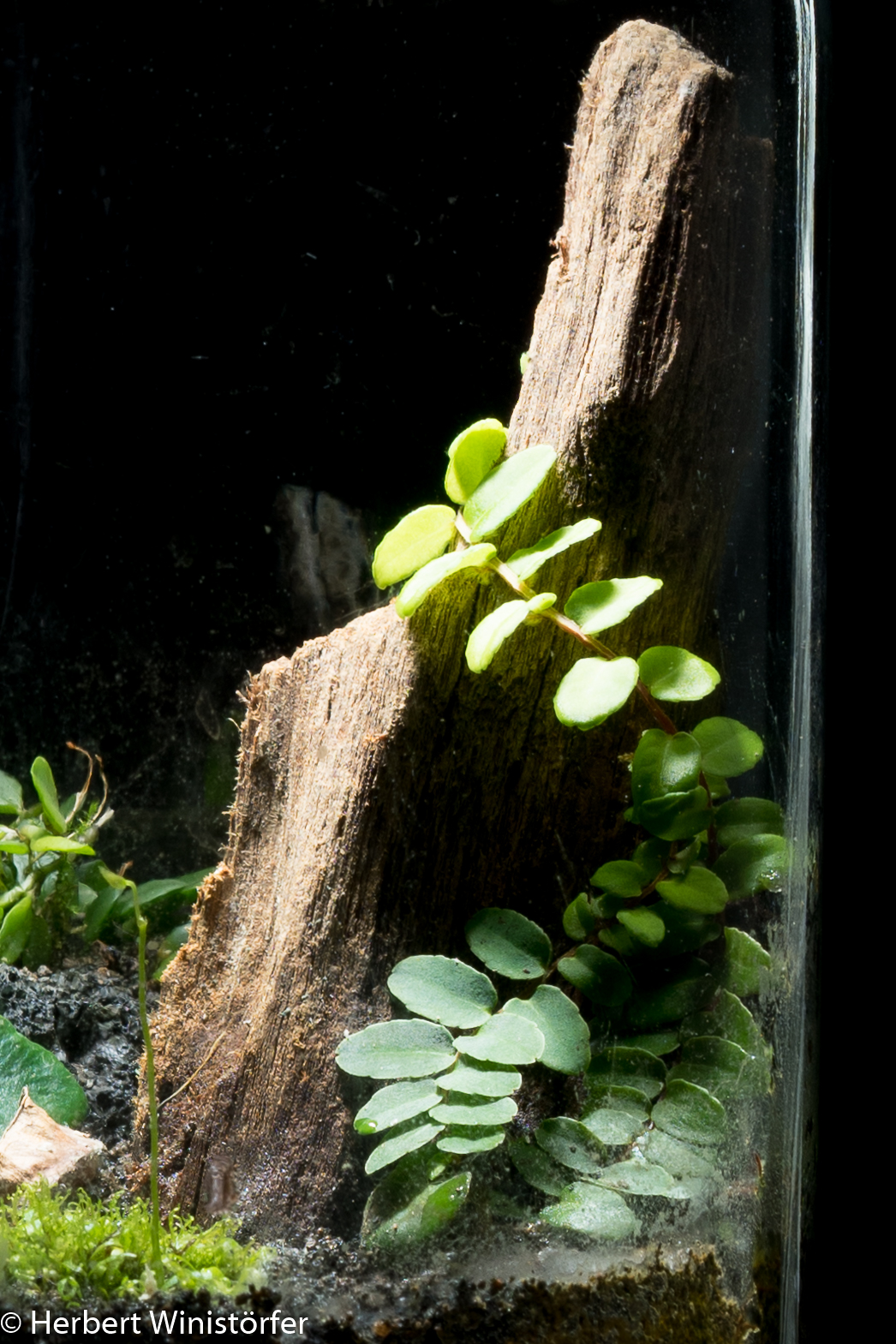
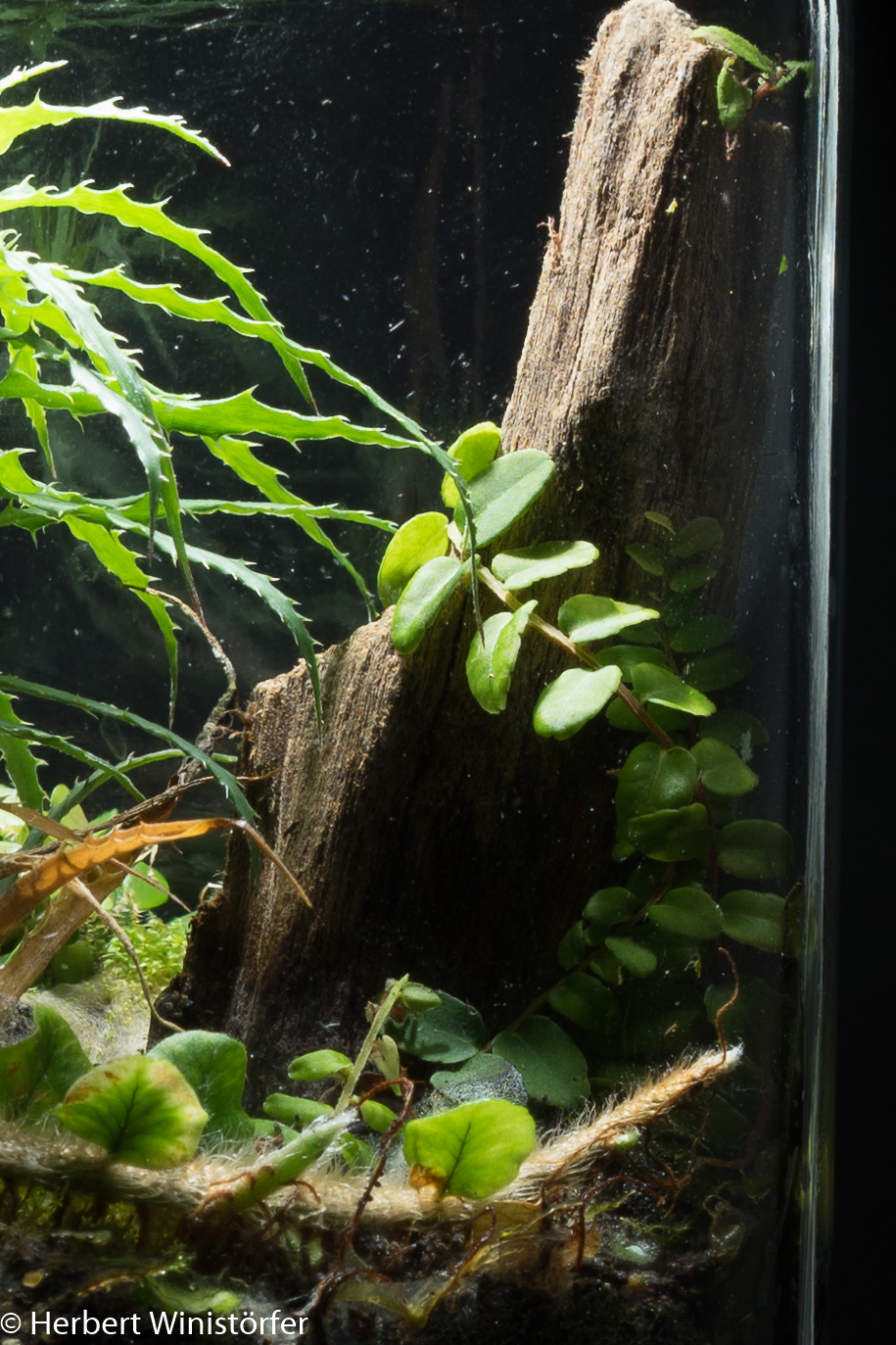
Does the right-handed coiling direction occur by incident? Charles Darwin was among the first to ask why some vines veer right and others left, in the publication cited above. The mystery has not been solved until 20 years ago:
“It has been known for more than 100 years that twisting direction is an inherited trait that cannot be influenced by light, heat or humidity. To track down the genes and proteins involved, a Japanese team studied a twisty mutant of a normally straight plant, the cress weed. They reported in the journal Nature this week that the culprit protein is one that forms tiny hollow tubes within the cells of plants. These microtubules help guide the construction of the walls of new cells. In a plant that grows straight the microtubules are arranged at right angles to the central axis of their cells, and the rows of new cells form straight lines. In the left-veering mutant weed, the researchers found that the protein forms tubules that are skewed at a different angle to the axis, forcing the rows of new cells to be twisted in an anti-clockwise helix. Presumably, in a right-veering plant, the tubules would be skewed in the opposite direction. Most twining plants coil clockwise, according to the Japanese researchers. A few species were ambidextrous, with left- and right-handed varieties.” (The Sydney Morning Herald, May 11, 2002 about findings published by Thitamadee e.a. 2002)
 Hermetospheres
One response to “Darwin and the mystery of the coiling direction”
I always thought that in the Northen hemisphere coiling would go in one direction and in the Southern Hemisphere the other direction? What about roots they also have an interesting movement as they grow. And the coiling od DNA is it clock or anti-clock?
LikeLike