One of my two jars dedictated to plants native to Myanmar is currently able to tell more than one story.
The fern called Peacock’s tail, A. radiata, was meant to be the main protagonist when I started the jar in mid August 2021. Initially, the plant seemed to be comfortable and produced new fronds. After a certain time, older fronds began to develop geyish-white spots. They became yellow, brown and dried out. Today, almost a year after onset, the plant seeme to be dead. However, experience told me not to give up too soon. So I will just leave the jar untouched for now and see what is going to happen next.
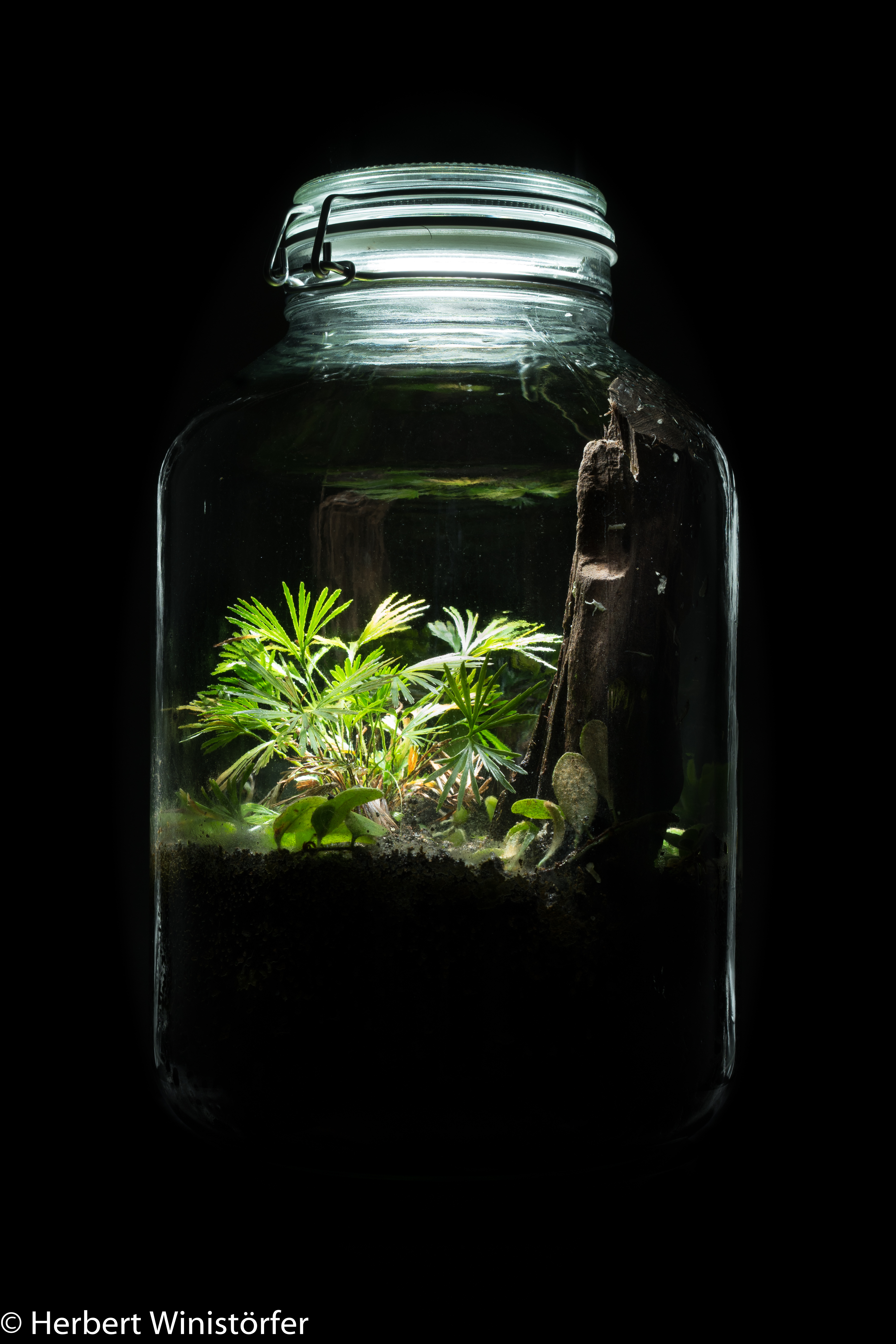

According to my initial research, my standard conditions seemed not to fit too badly to the natural habitats of the plant:
“It is a tiny terrestrial fern, found throughout India, Burma, Sri Lanka, Afghanistan, Persia, Arabia, Yemen, South Eastern Egypt, Tropical Africa, Australia and Madagascar. […]. Black or reddish gravelly soil is best suited for its growth. It is of limited distribution, and in areas where it occurs, is restricted to depleted walls and rocky crevices of steep slopes of exposed hilly areas, up to the altitude of 1200 m.” [Naik e.a. 2015]
“Sodium and potassium contents of the soil were low in the Commiphora cyclophylla-Actiniopteris radiata-Sansevieria ehrenbergii community type. This plant community was found on rocky terrain with relatively steep slope and poor nutrient content, and showed the highest percentages of sand as well as low percentages of clay and silt.” [Soromessa e.a. 2004}
“Epilithic or epiphytic, in rock crevices, at boulder bases, in shallow soil pockets overlaying sheet rock, and among low scrub in seasonally moist conditions. Exposed or in light shade. Seasonal pattern pronounced, fertile fronds are produced during the rainy season (December to April), usually dormant during the dry winter months. Single plants without any biotic association sometimes grasses were associated. Found on the way of cows in the Pahad Rampura.” [Singh e.a. 2013]
However, other hermetosphere experimenters reported experiences with A. radiata similar to mine. If there is more experience with the fern out there, please leave a comment.
 Hermetospheres