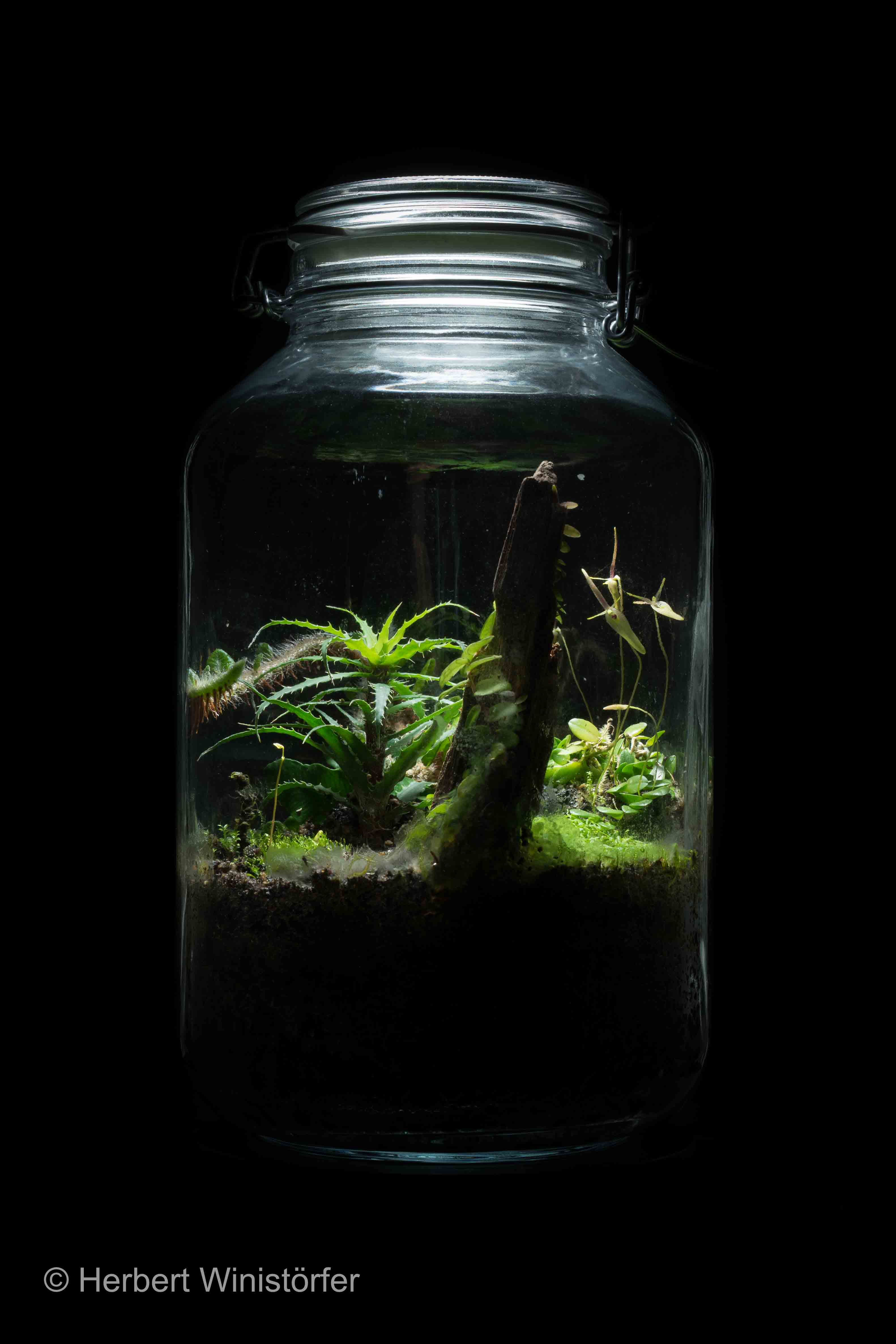
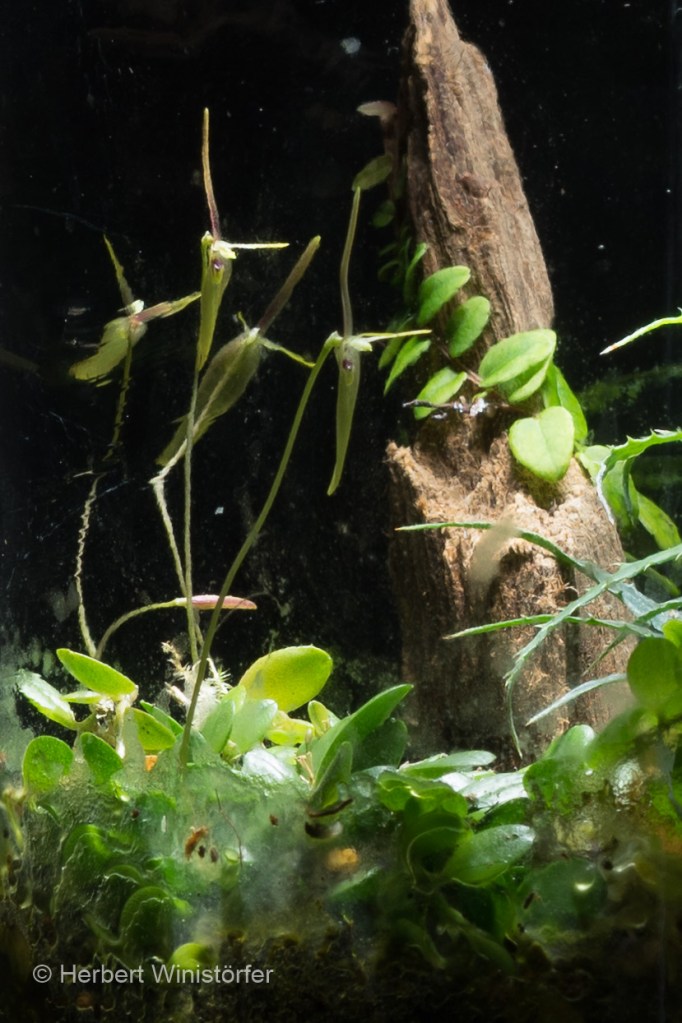
I currently run two jars representing Brazil Southeast, both etablished in May 2021. They both contain Barbosella cogniauxiana in different combinations. Under my standard conditions, the plant does very well so far. At the end of March 2022 it showed its extraordinary blooms for the first time.
The specimen that served for the first scientific description of the sepcies was probably collected during an expedition in 1906 or 1907 by Carlos Luis Spegazzini in Argentinia, Province Misiones, near the village San Pedro. Spegazzini (1858-1926) was a leading figure in Argentinian natural history, mainly recognized for his mycological and vascular plant studies. He published ca. 100 papers on vascular plants, mostly in Argentinian journals, describing ca. 1000 new taxa. He was professor at the University of La Plata and Buenos Aires in Argentina and curator of the herbarium of the National Department of Agriculture [Katinas e.a. 2000]. However, Spegazzini seems not have been very consequent in labelling his collections.
The new orchid was described as Restrepia cogniauxiana by Friedrich (“Fritz”) Wilhelm Ludwig Kraenzlin [1908]. Kränzlin (1847–1934) was one of the most important German orchidologists in the first quarter of the twentieth century. His magnum opus, Orchidacearum Genera et Species, remained unfinished. The extensive notes for this have recently been made publicly available by the Chicago Botanic Garden’s Lenhardt Library. Kraenzlin was an enthusiastic taxonomist, but unfortunately did not carefully follow taxonomic rules in designating type specimens (holotypes) or depositing these types in publicly accessible collections [CBHL 2022]. The holotype of B. cogniauxiana he used for his description was placed in Kraenzlin’s own Berlin herbarium, a portion of which was destroyed in an Allied bombing raid in March 1943. Some portions of his herbarium were saved in the Hamburg Herbarium Hamburgense. Thanks to that collection’s relocation during World War II to a site near Leipzig, the material remained undestroyed. After the war it was deposited in East Berlin (HBU), where the specimens were not available for consultation. In 1990, the they were returned to Herbarium Hamburgense (HBG). [CBHL 2022, Christenson 1994].
Alfred Célestin Cogniaux (1841–1916), after whom Kraenzlin named the new sepecies, was a Belgian botanist, University teacher, co-founder of the Belgian Botanical Society in 1862 and vice-consul for Brazil from 1887 till 1902. In 1872 he was asked by August Wilhelm Eichler from Botanical Garden Berlin Dahlem to contribute to the “Flora Brasiliensis”, a monumental and standard setting monography of fifteen volumes. Cogniaux provided, among others, the part on Orchidaceae. The project took 66 years to realize and was finally brought to a successful ending in 1906 by Ignatius Urban. [Walter Lack 2010, Renner 1990]
 Hermetospheres